Last updated: March 16, 2026
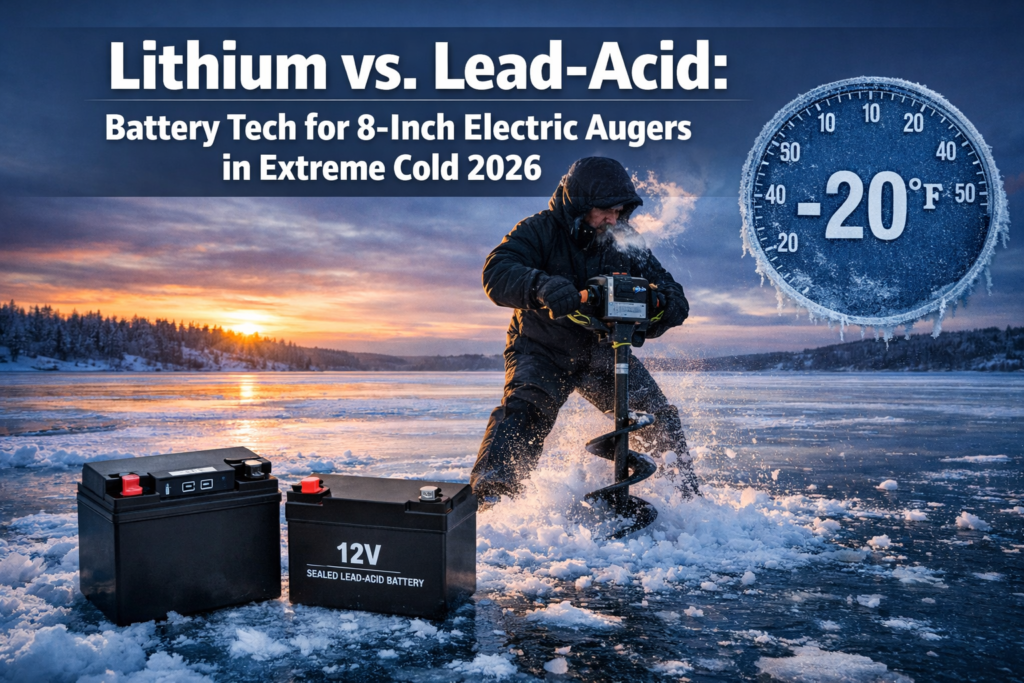
Quick Answer: Choosing the right Battery Technology for 8-Inch Electric Augers is the difference between fishing and fighting your gear. Here is how the two main technologies compare in the field:
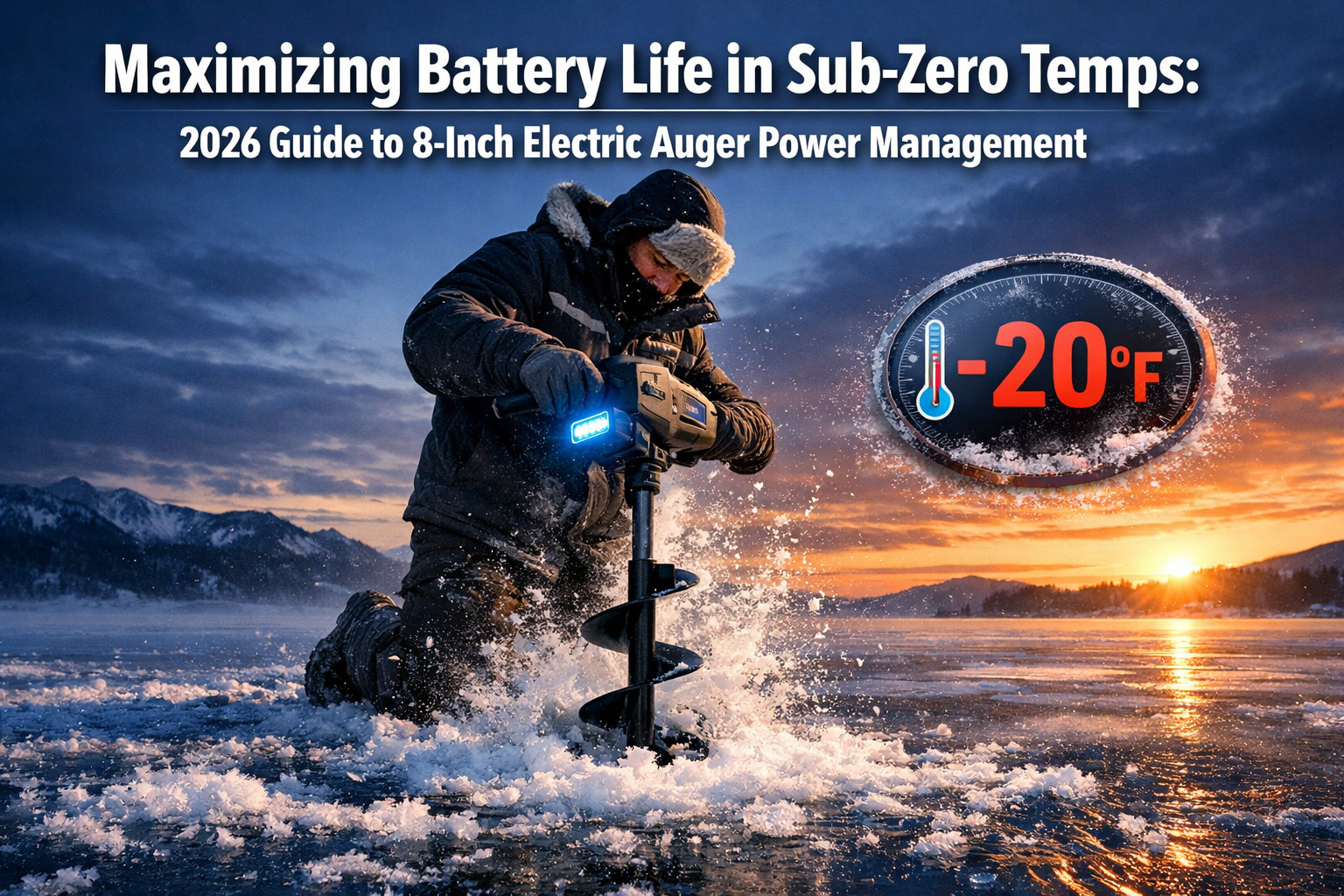
The Bottom Line: For temperatures below -20°F, lithium is the only reliable option for high-volume drilling.
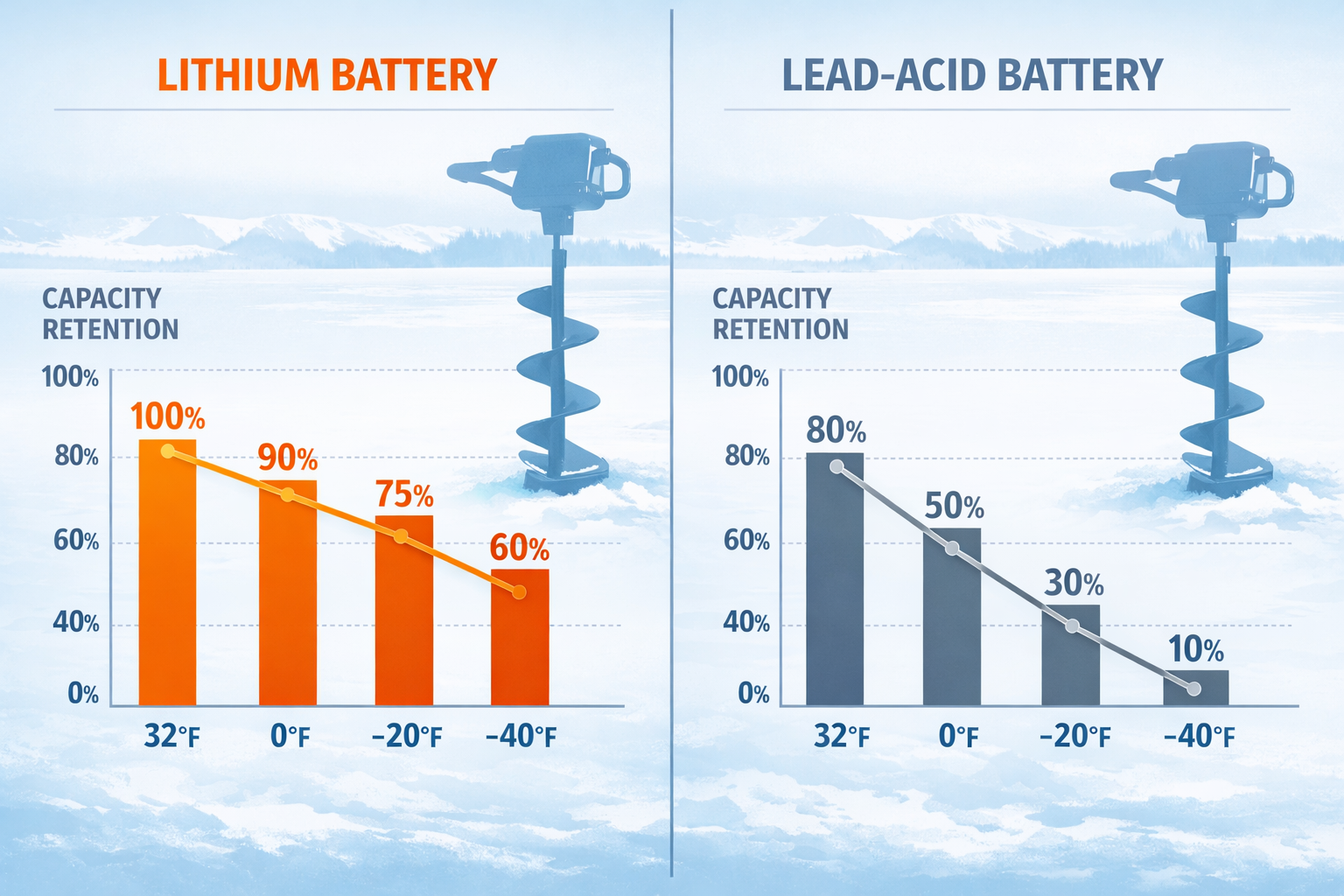
Lithium-Ion (The Pro Choice): Retains ~70% capacity at 0°F. It provides consistent, high-torque power, making it the proven choice for drilling through 24+ inches of ice.
Lead-Acid (The Budget Choice): Capacity drops to ~45% at 0°F. These are heavier and lose voltage quickly as the temperature falls below zero.
Key Takeaways
- Lithium batteries retain approximately 70% capacity at 0°F versus 45% for lead-acid
- Lead-acid batteries lose runtime fast in cold because their internal chemical reaction slows dramatically below freezing
- Keeping your lithium battery warm inside your jacket between uses is the single most effective cold-weather strategy
- Modern 40V lithium systems on 8-inch augers drill 300 to 500+ holes per charge in moderate cold
- Below -20°F, active battery insulation is required for both chemistry types, but lithium recovers better when warmed
- Lead-acid batteries resist freezing when fully charged, but that advantage disappears once you start drawing current in the cold
- Brushless motor augers squeeze more runtime from every battery charge compared to brushed designs
- Sodium-ion and polymer battery platforms are emerging alternatives, but lithium remains the proven field choice in 2026
- Never charge a lithium battery below 32°F without a battery management system (BMS) designed for cold-weather charging
- Store both battery types fully charged in a warm location between ice sessions to preserve cycle life
How Does Extreme Cold Actually Affect Battery Chemistry?
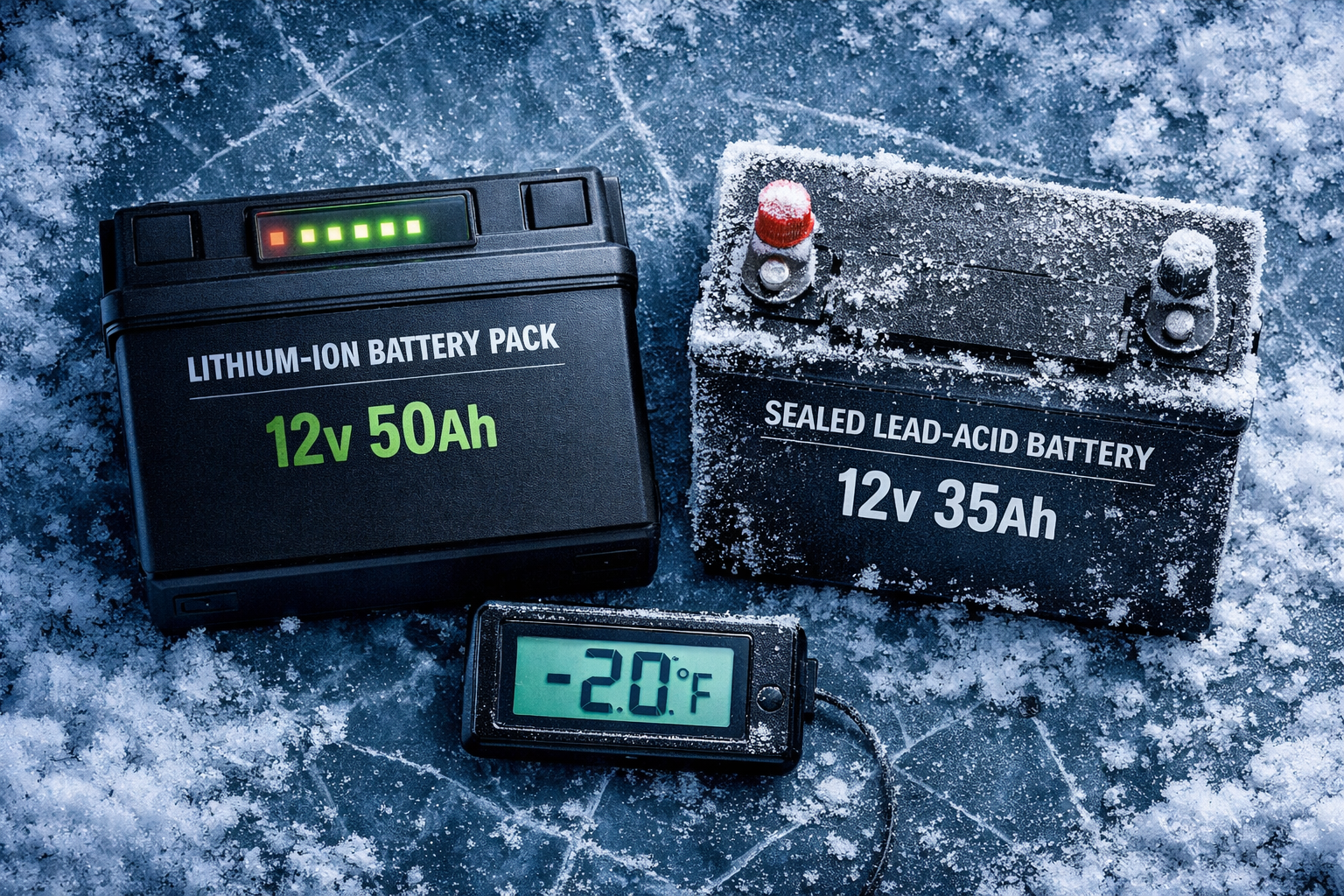
Cold temperatures slow the electrochemical reactions inside every battery. The colder it gets, the harder ions move through the electrolyte, and the less usable energy you get from the pack.
Lead-acid batteries use a sulfuric acid electrolyte. That electrolyte thickens in cold, which slows ion transfer and drops available current fast. At 32°F, a lead-acid battery delivers noticeably less power than at room temperature. At 0°F, you are working with roughly 45% of rated capacity. The plates also sulfate faster under cold-weather discharge stress, which shortens the battery's overall lifespan.
Lithium-ion batteries use a liquid organic electrolyte. That electrolyte also thickens in cold, but lithium ions are lighter and move more efficiently than the heavy lead-acid reaction. At 0°F, lithium holds around 70% of rated capacity. At -20°F and below, conventional lithium-ion packs lose 50 to 80% of capacity, but they recover quickly once warmed.
Key chemistry differences at a glance:
- Lead-acid: Sulfuric acid electrolyte, heavy, slow ion transfer in cold, high self-discharge in cold storage
- Lithium-ion: Organic electrolyte, lightweight, faster ion transfer, lower self-discharge, better cold recovery
- Both chemistries lose capacity in cold. Lithium loses less and recovers faster.
Edge case: A fully charged lead-acid battery resists freezing down to approximately -55°C. That sounds impressive, but a discharged lead-acid battery freezes near 0°C. On the ice, you discharge your battery constantly. Freezing risk is real if you leave a partially discharged lead-acid pack in your sled overnight.
What Runtime Should You Expect From Battery Technology for 8-Inch Electric Augers in Extreme Cold 2026?
Runtime depends on ice thickness, battery capacity, motor efficiency, and temperature. Here is a practical breakdown based on field data and manufacturer specs.
Lithium Runtime Estimates for 8-Inch Augers
The ION Alpha Plus 8-inch auger with a 40V lithium pack drills approximately 300 to 500 holes through 8 to 12 inches of ice under normal conditions. In extreme cold below -20°F, expect that number to drop by 30 to 40% without active battery management.
The StrikeMaster 40V Maven and similar 40V brushless platforms perform comparably. One verified field report documented successful operation at -40°F simply by keeping the battery inside the angler's jacket between holes [5]. That single habit preserved enough battery warmth to maintain consistent drilling performance throughout the session.
Lead-Acid Runtime Estimates for 8-Inch Augers
Older SLA-powered augers and some budget electric models use 12V or 24V sealed lead-acid packs. At 32°F, you might get 60 to 70% of the rated hole count. At 0°F, that drops to 40 to 50%. Below -20°F, runtime becomes unpredictable and often insufficient for a full day session without a spare battery.
Side-by-Side Runtime Comparison
| Temperature | Lithium Capacity Retained | Lead-Acid Capacity Retained | Practical Impact |
|---|---|---|---|
| 50°F (10°C) | ~95% | ~85% | Minimal difference |
| 32°F (0°C) | ~85% | ~65% | Lithium drills ~30% more holes |
| 0°F (-18°C) | ~70% | ~45% | Lithium drills ~55% more holes [3] |
| -20°F (-29°C) | ~50-60%* | ~25-35% | Lithium essential with insulation |
| -40°F (-40°C) | ~30-40%* | Unreliable | Active warming required for lithium [5] |
*Estimates assuming no active battery warming. With jacket storage between holes, lithium performance improves significantly.
For a full breakdown of how these auger systems compare head-to-head, read our Eskimo Outbreak 450XD vs StrikeMaster 40V Maven Auger comparison.
What Are the Best Cold-Weather Strategies for Battery Technology for 8-Inch Electric Augers in Extreme Cold 2026?
The biggest gains in cold-weather battery performance come from simple field habits, not expensive upgrades.
Lithium Battery Cold-Weather Protocol
Follow this sequence on every sub-zero session:
- Store your battery indoors the night before. Never leave it in your vehicle overnight in extreme cold.
- Start your session with a fully charged, room-temperature battery.
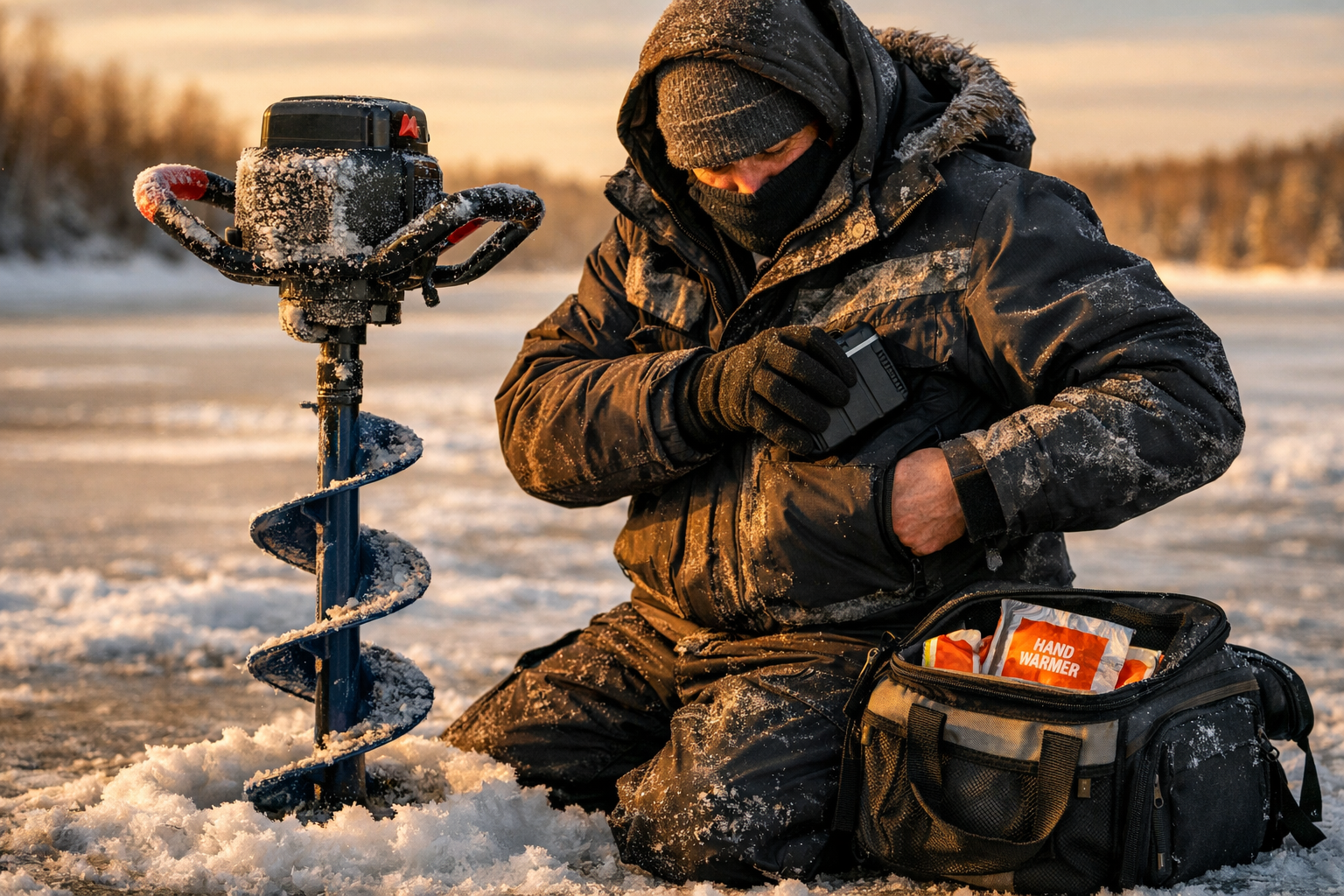
- After each drilling sequence, remove the battery from the auger and place it inside your jacket against your body.
- Use an insulated battery bag with hand warmers as a backup when you need both hands free.
- Drill your holes in batches. Concentrated use generates heat in the motor and battery, which helps maintain performance.
- Monitor the battery's LED fuel gauge. When it drops to one bar, stop drilling and warm the pack before the next set of holes.
An ION engineer confirmed that the auger powerhead tolerates sitting outside in extreme cold for extended periods, but the battery itself needs active warmth below 20°F. The motor is rugged. The battery is the variable you manage.
Lead-Acid Battery Cold-Weather Protocol
- Keep the battery fully charged at all times. A discharged lead-acid battery freezes near 0°C.
- Wrap the battery in a neoprene sleeve or insulated case before heading out.
- Plan for shorter sessions or carry a second battery.
- Recharge immediately after each session. Cold discharge accelerates sulfation.
Choose lithium if: You drill more than 50 holes per session, fish below 20°F regularly, or need to move between multiple spots quickly.
Choose lead-acid if: You fish occasionally in mild cold (above 25°F), already own SLA equipment, and budget is the primary concern.
For anglers who need shelter warmth to extend their sessions in brutal cold, pair your battery strategy with a quality heating setup. The Heat Hog and Clam Heater comparison covers portable heater options that keep both you and your gear functional in sub-zero conditions.
Staying warm yourself matters as much as keeping your battery warm. Check out our guide on ice fishing hoodies and base layers for extreme cold to build a complete cold-weather system.
What Charging Protocols Protect Lithium Batteries in Cold Conditions?
Charging a lithium battery in cold temperatures damages it. Cold charging forces lithium ions to plate onto the anode as metallic lithium instead of intercalating properly. That causes permanent capacity loss and, in severe cases, creates internal short circuits.
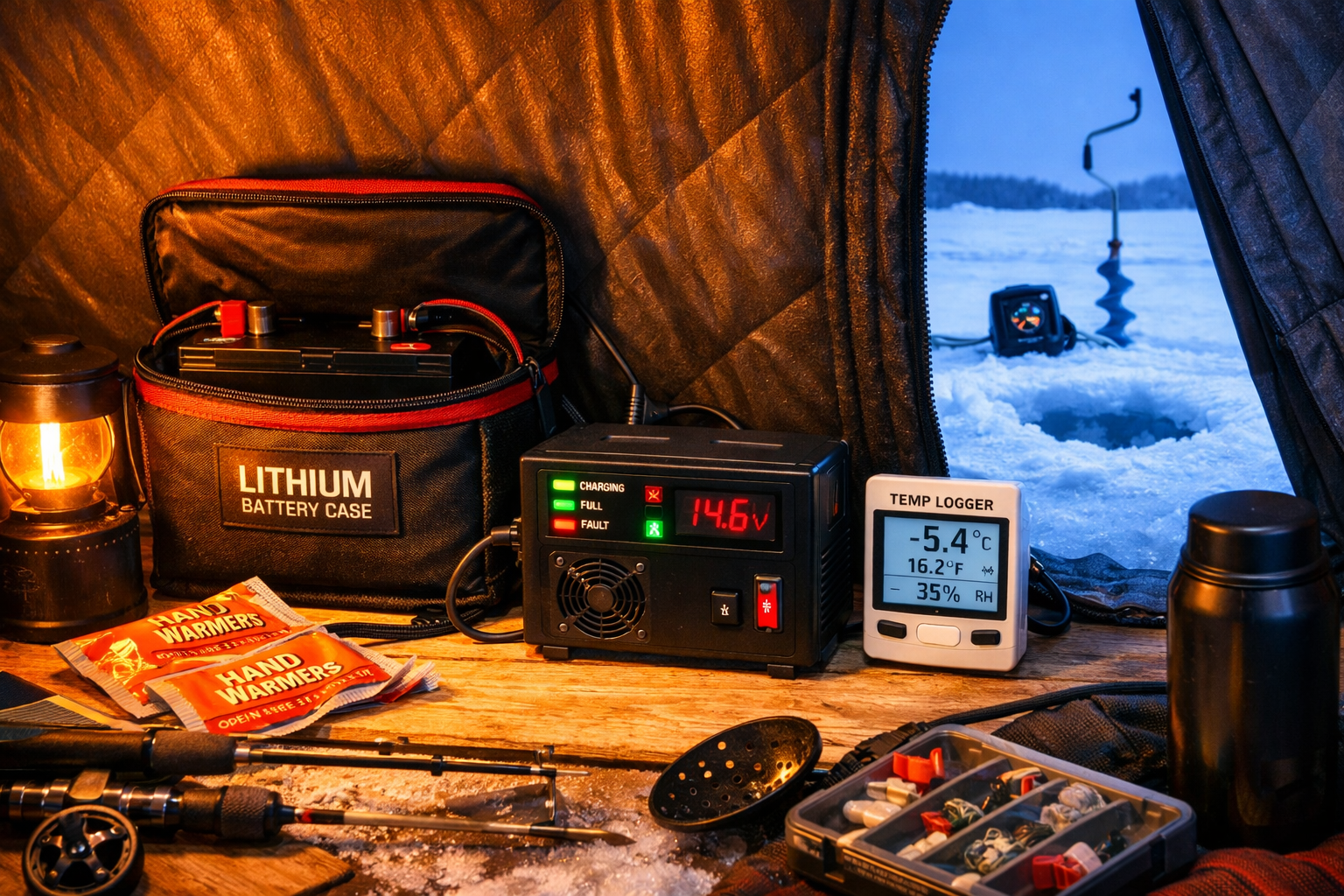
Cold Charging Rules for Lithium Auger Batteries
- Never charge a lithium battery below 32°F (0°C) unless the battery has a built-in low-temperature charging BMS
- Warm the battery to at least 40°F before connecting it to a charger
- Use the manufacturer's charger. Third-party chargers often skip the low-temperature cutoff protection
- Charge at a lower rate in cold conditions if your charger has adjustable output. Slow charging generates less heat stress on cold cells.
Modern 40V auger batteries from ION, StrikeMaster, and EGO include BMS circuits that prevent charging below safe temperatures [8]. That protection is one reason these systems cost more than budget alternatives. It is also one reason they last longer.
For a broader look at how cold affects electronics in your ice fishing kit, our article on cold weather performance for wireless underwater cameras covers similar thermal management principles that apply across your entire gear setup.
How Do Brushless Motors Change the Battery Equation for 8-Inch Electric Augers?
Brushless motors draw current more efficiently than brushed motors. That efficiency directly extends battery runtime in cold conditions.
A brushed motor wastes energy through friction and heat at the brush contact points. In cold weather, that wasted energy is energy your battery cannot afford to lose. A brushless motor eliminates that friction loss entirely, converting more of the battery's stored energy into actual cutting torque.
The EGO IG0800 8-inch auger uses a brushless motor and a 56V arc lithium battery. StrikeMaster's 40V Maven platform also runs brushless. Both systems drill more holes per charge than equivalent brushed designs, and that advantage grows in cold conditions where every percentage point of efficiency matters.
Practical result: A brushless 40V lithium auger in -10°F conditions often outperforms a brushed auger in 20°F conditions, simply because the motor wastes less energy.
If you are evaluating your first electric auger or upgrading from gas, our electric vs gas ice auger pros and cons guide breaks down the full decision.
What Emerging Battery Technologies Will Affect Electric Auger Performance?
The battery industry is moving fast in 2026, and some of that research directly applies to ice fishing applications.
Researchers at the Dalian Institute of Chemical Physics developed a liquid-solid-state lithium battery that retains over 85% capacity at -34°C after eight hours of use. That represents a significant step beyond conventional lithium-ion packs that lose 50 to 80% capacity below -20°C. This technology has been validated in industrial drone and robotics applications, and commercial versions are in development.
Texas A&M researchers published findings on an organic dual-ion battery using redox-active polymers that maintains 85% capacity at 0°C and 55% at -40°C. The polymer electrolyte approach avoids the ion-plating problems that make cold charging dangerous in conventional lithium cells.
University of Michigan engineers developed a lithium-ion battery capable of charging 500% faster at temperatures as low as 14°F (-10°C) using a 20-nanometer glassy lithium borate-carbonate coating. That coating maintains 97% capacity after 100 fast-charge cycles in cold conditions. For ice anglers, that translates to faster turnaround between sessions without capacity degradation.
Sodium-ion platforms are also advancing as an alternative chemistry. Sodium-ion batteries tolerate cold better than lithium in some configurations and use more abundant raw materials. For stationary ice shelter power applications, sodium-ion packs are worth watching as prices fall.
Timeline for auger applications: Liquid-solid-state and polymer battery systems are 2 to 4 years from consumer ice fishing products based on current development trajectories. For the 2026 season, lithium-ion with active thermal management remains the proven choice.
For a detailed look at how the StrikeMaster 40V Maven and ION Alpha stack up in real-world use, see our StrikeMaster 40V Maven vs ION Alpha review.
FAQ: Battery Technology for 8-Inch Electric Augers in Extreme Cold
Q: How many holes does a 40V lithium auger battery drill in extreme cold? A: At -20°F with no active warming, expect 150 to 250 holes through 8 to 12 inches of ice. Keep the battery inside your jacket between uses and that number climbs to 250 to 350 holes.
Q: Will a lead-acid battery freeze on the ice? A: A fully charged lead-acid battery resists freezing to approximately -55°C. A discharged or partially discharged lead-acid battery freezes near 0°C. Discharge it during a cold session and leave it in your sled overnight, and you risk a frozen, cracked battery case.
Q: Can I charge my lithium auger battery in my ice shelter? A: Yes, if the shelter interior is above 40°F. Never charge a lithium battery in ambient temperatures below 32°F without a BMS-equipped charger that includes low-temperature cutoff protection.
Q: How do I know if my battery is too cold to use? A: Most modern 40V lithium auger batteries include LED fuel gauges. If the indicator drops rapidly after just a few holes, the battery is too cold. Warm it inside your jacket for 10 to 15 minutes before continuing.
Q: Is a 4Ah or 6Ah battery better for cold-weather ice fishing? A: Higher capacity (6Ah or more) gives you more buffer against cold-related capacity loss. A 4Ah pack at 0°F delivers the equivalent of roughly 2.8Ah of usable energy. A 6Ah pack delivers roughly 4.2Ah under the same conditions.
Q: Does running the auger in cold weather damage the motor? A: No. Modern brushless motors in electric augers tolerate extreme cold without damage. The motor housing and powerhead can sit outside in -40°F conditions without issue. The battery is the component that requires protection.
Q: What is the best way to store lithium auger batteries between ice sessions? A: Store them at room temperature, charged to 50 to 80% of capacity for long-term storage. For storage between weekly sessions, a full charge stored indoors works fine.
Q: Are lithium batteries worth the price premium over lead-acid for ice fishing? A: For anglers fishing below 20°F or drilling more than 50 holes per session, yes. The runtime advantage, weight reduction, and longer cycle life justify the cost difference within two to three seasons of regular use.
Q: Can I use hand warmers to keep my battery warm on the ice? A: Yes. Place chemical hand warmers inside an insulated battery bag alongside the battery. This approach adds 10 to 20°F of effective temperature to the battery environment and meaningfully extends runtime in extreme cold.
Q: Will sodium-ion batteries replace lithium in ice fishing augers? A: Not in the near term. Sodium-ion batteries show promise for cold-climate performance and lower material costs, but energy density remains lower than lithium-ion. Expect lithium to dominate auger applications through at least 2028.
Conclusion
Lithium wins the cold-weather battery battle for 8-inch electric augers. The chemistry is more efficient in the cold, the weight advantage makes marathon sessions easier, and the runtime gap versus lead-acid widens the colder it gets [3]. The most important thing you do on the ice is keep that lithium pack warm between holes. Remove it from the auger, put it inside your jacket, and you preserve the performance gap that justifies the investment.
Lead-acid still works for anglers fishing in mild cold or running occasional short sessions. But for anyone drilling hard in sub-zero temperatures, lithium is the only choice that holds up.
Your action steps for the 2026 season:
- Upgrade to a 40V brushless lithium system if you are still running lead-acid in serious cold
- Build a battery warming routine into every session before you leave the truck
- Invest in an insulated battery bag and chemical hand warmers as standard kit
- Charge your battery indoors, never in a cold vehicle or shelter below 40°F
- Track your hole counts per charge across temperatures to know your real-world runtime baseline
Kayak. Drill. Catch. Repeat.
See you on the water.
References
[1] Ion Alpha Plus 8 Two Batteries – https://ioniceaugers.com/products/ion%C2%AE-alpha-plus-8-two-batteries
[2] 8 Ion Electric Battery Powered Ice Auger Product Review Tips And Recommendations For Use And Battery Life – https://mix108.com/8-ion-electric-battery-powered-ice-auger-product-review-tips-and-recommendations-for-use-and-battery-life/
[3] Lithium Vs Lead Acid Batteries Cold Weather – https://www.large-battery.com/blog/lithium-vs-lead-acid-batteries-cold-weather/
[4] Ion 49350 G2 8 Electric Power Ice Fishing Auger 4ah 40v Max Gen 2 Lithium Ion – https://www.jbtools.com/ion-49350-g2-8-electric-power-ice-fishing-auger-4ah-40v-max-gen-2-lithium-ion/
[5] What Is The Best Electric Ice Fishing Auger What You Need To Know – https://virtualangling.com/learn-how-to/gear/what-is-the-best-electric-ice-fishing-auger-what-you-need-to-know/
[6] How Cold Weather Affects Lithium And Lead Acid Batteries – https://www.sunrichenergy.com/blogs/sunrich-energy/how-cold-weather-affects-lithium-and-lead-acid-batteries
[7] Ion Alpha Plus 2 Batteries Included 8 in Gen 3 40 Volt Lithium Electric Ice Auger – https://www.homedepot.com/p/Ion-Alpha-Plus-2-Batteries-Included-8-in-Gen-3-40-Volt-Lithium-Electric-Ice-Auger-59350-59350/322159125
[8] Ice Auger IG0800 – https://egopowerplus.com/ice-auger-ig0800/
[9] Batteries In Cold Weather Which Type Is The Best – https://www.litime.com/blogs/blogs/batteries-in-cold-weather-which-type-is-the-best
[10] Watch – https://www.youtube.com/watch?v=jL5HRohkuYw