Last updated: March 2, 2026
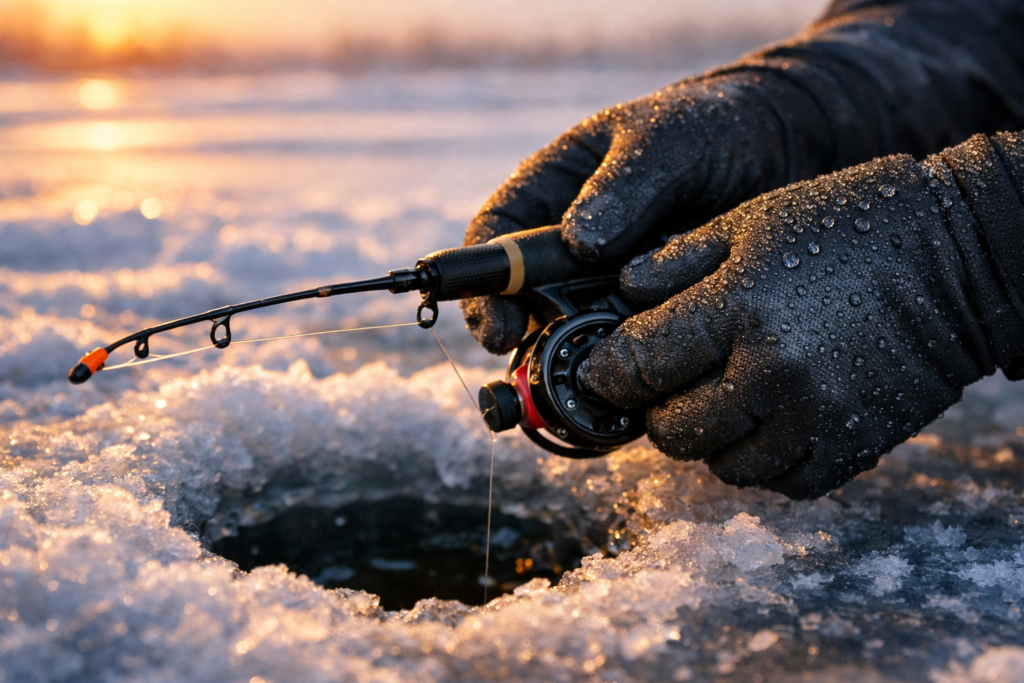
Your hands are the first thing to fail on the ice. Cold fingers mean fumbled knots, dropped jigs, and a short day. Finding the best ice fishing gloves 2026: balancing warmth, dexterity, and grip for all-day comfort comes down to three decisions: insulation type, waterproofing method, and how much finger access you need. The 2025/2026 season brought meaningful upgrades in materials from brands like Clam Outdoors, Glacier Glove, and Striker Ice. This guide breaks down what works, what doesn't, and how to pick the right pair for your conditions.
Key Takeaways
- Neoprene gloves with blind-stitch and glue construction deliver the most reliable waterproofing for wet, hands-on ice fishing.
- PrimaLoft and Thinsulate insulation offer warmth without bulk, but palm insulation should stay at 100g or less to preserve dexterity.
- Convertible “glomitts” give you mitten warmth plus finger access for knot-tying, but full-finger gloves handle immersion better.
- Textured PU palms and goatskin reinforcements improve grip on wet rods and slippery fish.
- The Clam Edge X, Glacier Glove Perfect Curve, and Striker Ice Apex lead the 2026 field for different use cases.
- Proper glove care (drying, re-treating DWR coatings) extends the life of your investment by multiple seasons.
- No single glove does everything. Carry two pairs: one for warmth, one for precision tasks.
Quick Answer
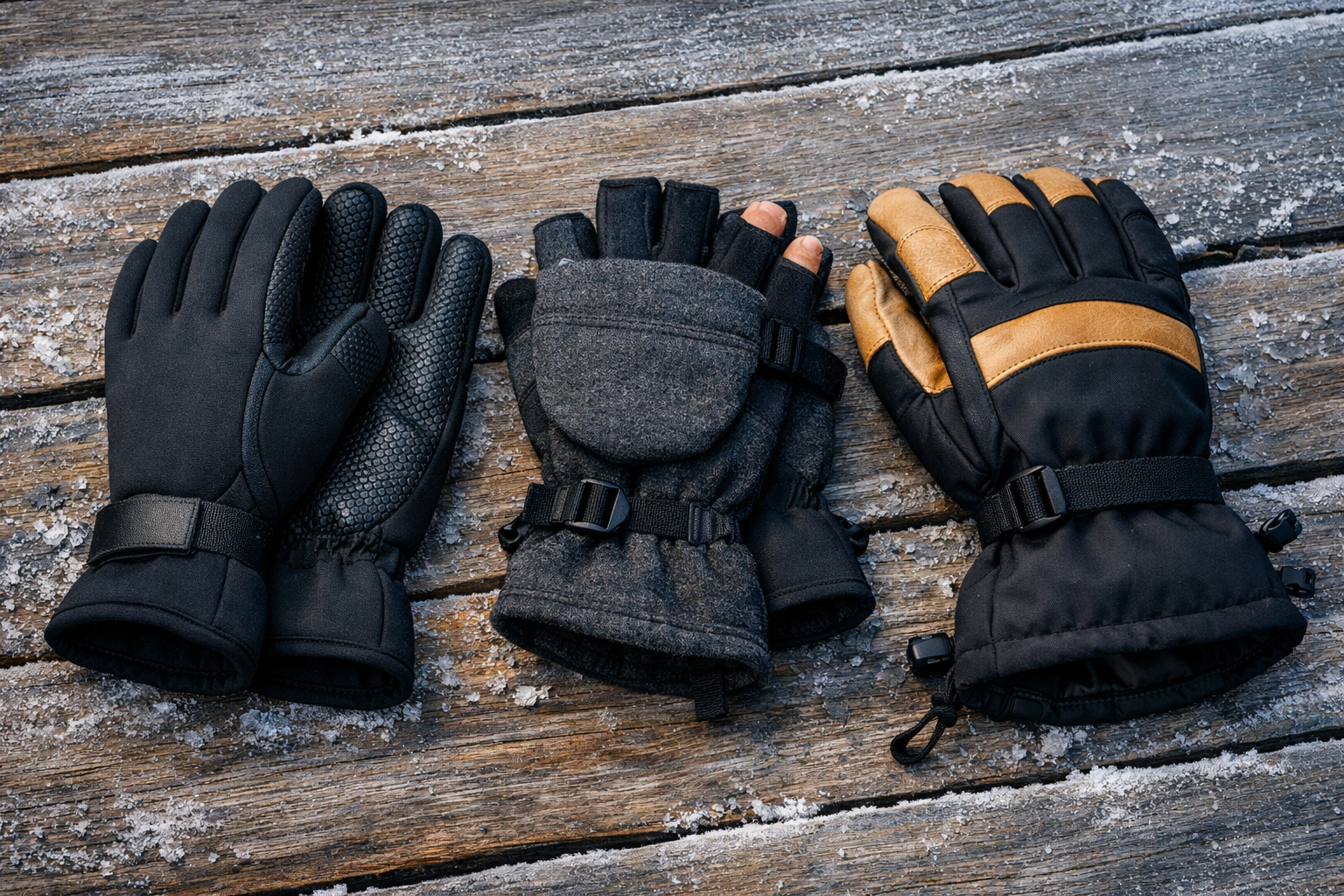
The best ice fishing gloves for 2026 depend on your primary activity. For all-around sub-zero performance, the Clam Edge X with 150g palm and 200g back Thinsulate insulation handles wet conditions well. For maximum dexterity and fish handling, the Glacier Glove Perfect Curve neoprene glove molds to your fingers without bunching. For extreme cold with wind exposure, the Striker Ice Apex with PrimaLoft Silver and Hipora membrane keeps hands warm without adding bulk. Most experienced ice anglers carry a rotation of two styles.
Why Do Ice Fishing Gloves Need a Different Design Than Standard Winter Gloves?
Standard winter gloves prioritize warmth alone. Ice fishing gloves must handle constant water contact, fine motor tasks like tying size 10 jigs, and gripping wet rod handles for hours. A ski glove keeps your hands warm on a chairlift. That same glove becomes a waterlogged, slippery liability the moment you grab a fish or re-bait a hook.
Ice fishing gloves address three problems at once:
- Water management. You handle wet line, slush, and fish throughout the day. Waterproofing must work from the outside in.
- Fine motor control. Tying knots, adjusting electronics, and setting tip-ups require fingertip sensitivity that thick insulation destroys.
- Sustained grip. Wet rod handles and thrashing fish demand textured palms that work when soaked.
The 2025/2026 product cycle reflects these demands. Clam Outdoors launched the Extreme Glove and Extreme Mitt featuring a three-layer softshell outer with DWR treatment and PrimaLoft Gold insulation at 100g. That 100g palm thickness is deliberate. Go higher and you lose the ability to feel your line. Go lower and your fingers go numb in 20 minutes.
Choose insulated membrane gloves if you fish in wind-exposed conditions above the ice. Choose neoprene if you spend significant time handling fish and wet gear with your hands near or in the water.
What Materials and Insulation Work Best for Ice Fishing Gloves in 2026?
Three insulation technologies dominate the 2026 market. Each has a specific strength.
| Insulation Type | Warmth Rating | Dexterity | Best For |
|---|---|---|---|
| Thinsulate (3M) | High (150-200g) | Moderate | All-day sits in sub-zero temps |
| PrimaLoft Gold/Silver | High (100-170g) | Good | Wind exposure, active fishing |
| Fleece-lined Neoprene | Moderate | Excellent | Wet handling, fish contact |
Thinsulate remains the workhorse. The Clam Edge X uses 150g in the palm and 200g on the back of the hand. This split insulation approach keeps your gripping surface thinner while protecting the more cold-sensitive back of your hand.
PrimaLoft compresses less than Thinsulate, so gloves maintain warmth even when you squeeze a rod handle. The Striker Ice Apex uses 170g PrimaLoft Silver on the back and 100g on the palm. The Hipora membrane underneath adds wind and water resistance without the stiffness of Gore-Tex.
Neoprene (2mm with fleece lining) works differently. Instead of trapping dead air like synthetic insulations, neoprene uses your body heat to warm a thin layer of moisture against your skin. Glacier Glove builds their ice fishing line around this principle. Their blind-stitch and glue seam construction eliminates needle holes that let water seep in. The HydroGrip Max, noted in early 2026 reviews, reinforces high-wear areas where traditional neoprene breaks down.
For the multi-season adventurer transitioning from saltwater kayak fishing to hardwater, neoprene gloves feel familiar. The fit and flexibility mirror what you wear paddling in cold conditions.
How Do You Choose Between Full-Finger, Fingerless, and Convertible Gloves?
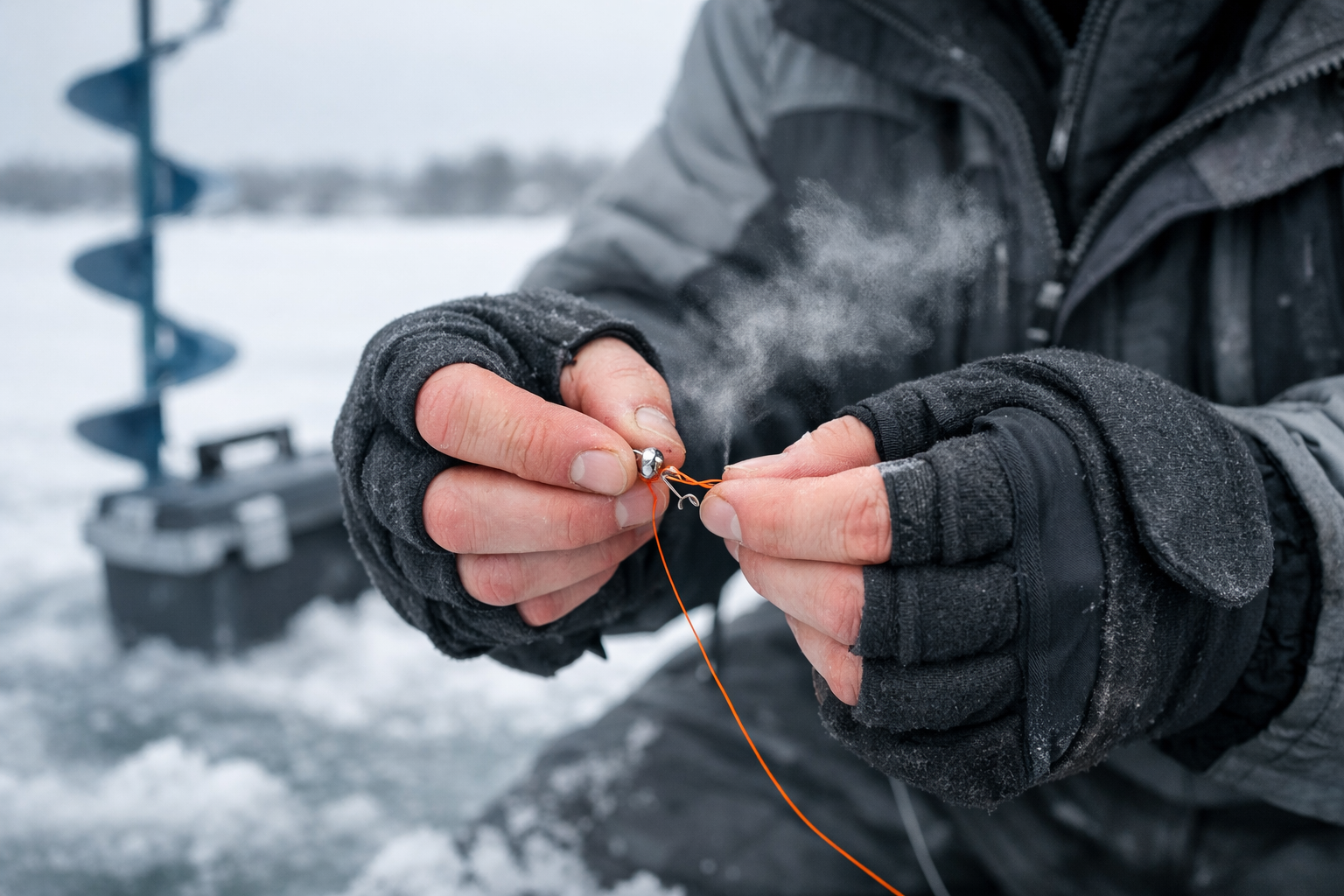
Pick your glove style based on your primary task, not your comfort preference.
Full-finger gloves protect every digit and handle water immersion. They work best for anglers who spend long stretches waiting on tip-ups or sitting over a hole with a flasher. The tradeoff is reduced fingertip feel. Tying a Palomar knot in full-finger gloves with 150g insulation takes practice.
Fingerless gloves expose your fingertips for maximum dexterity. They suit short bursts of precision work but fail in sustained cold. Your exposed fingertips lose heat fast, especially in wind. Use these as a secondary pair for quick re-rigging, not as your primary glove.
Convertible glomitts split the difference. The Clam Delta and Bass Pro Neoprene fold-back designs give you mitten warmth with a flip-back cap that exposes your fingers when needed. This design works well for anglers who alternate between waiting and active jigging.
One caution with convertibles: the Velcro or magnetic closure that holds the mitten cap back wears out over time. If the cap falls forward while you're handling a fish, you lose grip at the worst moment. Check the closure mechanism before buying. Magnetic closures hold up better than Velcro through repeated freeze-thaw cycles.
Decision rule: If you fish alone and handle everything yourself (drilling, rigging, unhooking), carry a convertible pair for general use and a thin neoprene pair for knot-tying. If you fish with a partner who handles rigging, full-finger insulated gloves keep you warmer longer.
Best Ice Fishing Gloves 2026: Balancing Warmth, Dexterity, and Grip, Model by Model
Here are the top performers for the 2026 season based on construction, insulation, and field performance.
Clam Edge X
The Clam Edge X earned “best overall” recognition from multiple outdoor reviewers for good reason. The 150g palm / 200g back Thinsulate split gives you warmth where you need protection and feel where you need control. The waterproof breathable insert handles slush and splash. Textured PU grip on the palm stays tacky when wet.
Best for: All-day sits in sub-zero conditions with moderate fish handling. Tournament-ready anglers who need reliable performance across varied conditions.
Limitation: The insulation thickness reduces fine knot-tying ability compared to thinner neoprene options.
Normark took over Clam distribution in Canada starting October 2025, so Canadian anglers now find the Edge X in more retail locations.
Glacier Glove Perfect Curve
Field & Stream testers named this the best overall neoprene ice fishing glove based on 2025 testing. The “perfect curve” name refers to the pre-curved finger construction. Your fingers sit in a natural gripping position without the bunching that plagues flat-cut neoprene gloves. The sharkskin-textured palm grips fish and rod handles without slipping.
Best for: Anglers who handle fish frequently and need maximum dexterity. The 2mm neoprene with fleece lining provides moderate warmth suitable for temperatures down to about 10°F with active use.
Limitation: Less warm than membrane-insulated gloves in extreme cold or high wind.
Striker Ice Apex
The Apex targets exposed-ice conditions where wind strips heat from your hands. PrimaLoft Silver at 170g on the back and 100g on the palm, paired with a Hipora waterproof membrane, blocks wind and moisture effectively. The construction runs slightly bulkier than the Edge X but compensates with superior warmth in the harshest conditions.
Best for: Anglers fishing open ice without a shelter in temperatures below 0°F with wind.
Limitation: The added bulk reduces dexterity for fine tasks.
Clam Extreme Glove (New for 2025/2026)
Launched in late August 2025, the Extreme Glove features a three-layer softshell outer with DWR treatment and PrimaLoft Gold insulation at 100g. Goatskin reinforcements on the palm add durability where you grip your auger and rods. The 100g insulation keeps the profile slim enough for good finger movement.
Best for: Active jiggers who need warmth and dexterity in a single glove. The DWR-treated softshell sheds water before it soaks through.
Glacier Glove HydroGrip Max
This 2026 addition uses blind-stitch and glue construction for 100% waterproofing. Reinforced high-wear zones on the thumb and forefinger address the common failure point of neoprene gloves. The waterproof neoprene body handles full immersion without leaking.
Best for: Anglers who reach into slush holes, handle fish barehanded alternatives, or fish in wet, sloppy conditions.
How Do Grip and Palm Construction Affect Your Fishing Performance?
Grip fails when you need it most: landing a fish, pulling an auger cord, or holding a rod during a hard hookset. The palm material on your gloves determines whether you maintain control in wet conditions.
Three palm constructions dominate in 2026:
- Textured PU (polyurethane). Used on the Clam Edge X and Extreme Glove. PU stays flexible in cold and provides consistent grip when wet. The textured pattern channels water away from the contact surface.
- Goatskin leather reinforcements. Found on the Clam Extreme Glove. Goatskin is thinner and more supple than cowhide, so reinforced areas don't create stiff spots. The leather wears in rather than wearing out.
- Sharkskin-textured neoprene. Glacier Glove uses this on models like the Ice Bay. The raised pattern mimics shark dermal denticles for multi-directional grip. This works well for fish handling because the grip pattern holds in any direction.
A common mistake is choosing gloves with smooth palms because they feel comfortable in the store. Smooth materials lose grip the moment they contact water, fish slime, or frozen rod handles. Always choose textured palms for ice fishing.
For anglers who maintain their own gear, the same attention to detail applies to keeping your equipment in top condition across all seasons. Rigging mastery extends to every piece of gear you touch.
What Common Mistakes Do Anglers Make When Buying Ice Fishing Gloves?
Buying one pair for everything. No single glove handles all ice fishing tasks well. Carry a warm pair for sitting and a thin pair for rigging.
Choosing too much insulation. Gloves with 200g+ insulation across the entire hand feel warm in the store but make you clumsy on the ice. You end up taking them off to tie knots, and bare hands in sub-zero air cool faster than gloved hands.
Ignoring waterproofing method. A “waterproof” label means different things. Membrane waterproofing (Gore-Tex, Hipora) blocks water from outside but allows vapor to escape. Neoprene waterproofing seals completely but traps some moisture inside. Know which method your gloves use and match that to your fishing style.
Skipping the fit check. Gloves that are too tight compress insulation and reduce warmth. Gloves that are too loose bunch in the palm and reduce grip. Try gloves while gripping a rod-diameter object. Your fingers should close naturally without gaps or pressure points.
Neglecting DWR maintenance. DWR (durable water repellent) coatings on softshell gloves wear off after 15 to 20 uses. Re-treat with a spray-on DWR product to maintain water shedding. Without retreatment, the outer fabric saturates and your hands get cold faster.
How Should You Care for Ice Fishing Gloves to Extend Their Life?
Proper care doubles or triples the useful life of quality ice fishing gloves.
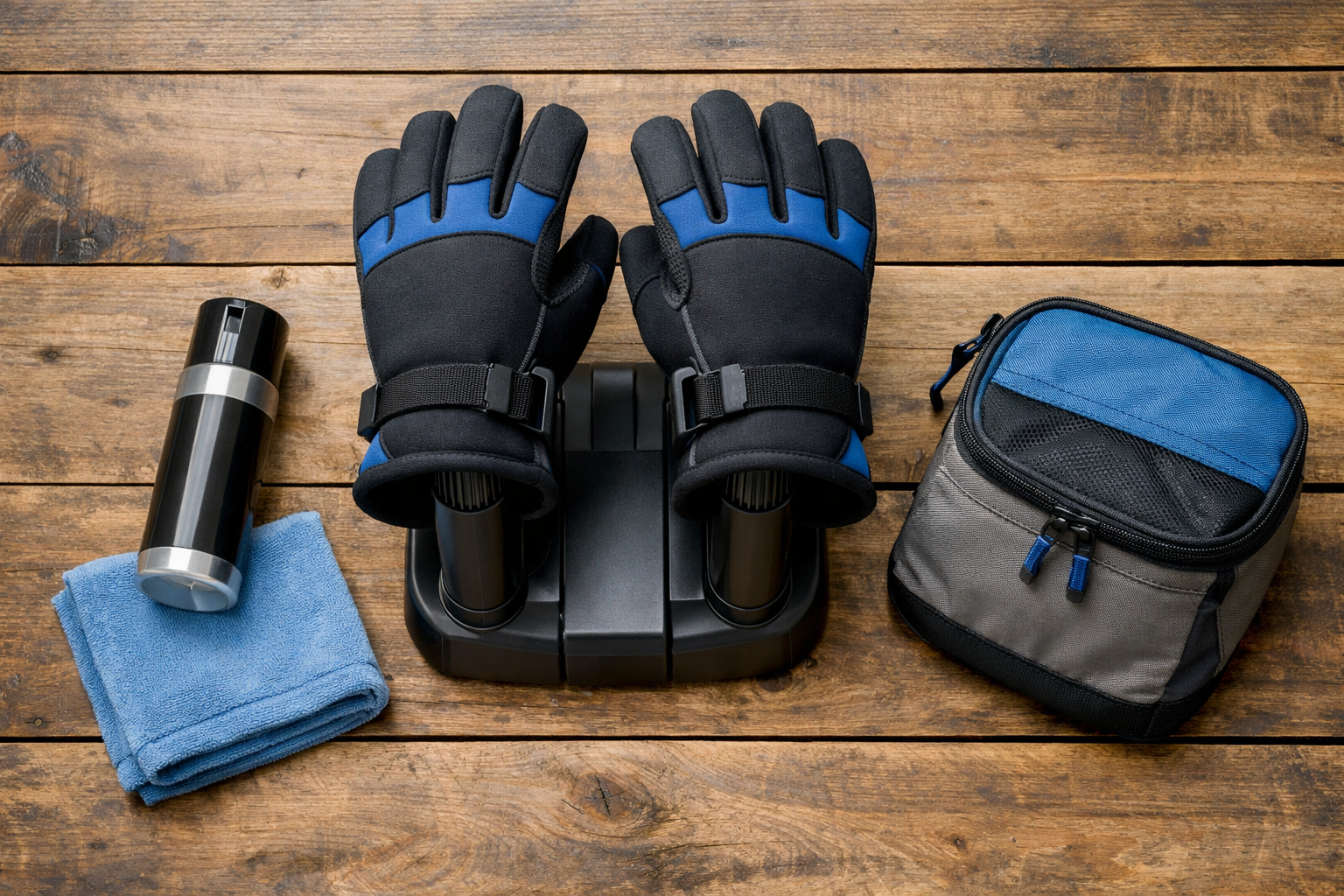
- Dry gloves after every use. Remove inserts if your gloves have them. Place gloves on a boot dryer or stuff them with newspaper. Never dry gloves on a direct heat source like a radiator. High heat damages adhesives and membrane layers.
- Rinse neoprene gloves in fresh water. Salt, fish slime, and bait residue break down neoprene over time. A quick rinse after each trip prevents degradation.
- Re-treat DWR coatings. Spray-on DWR products from Nikwax or Grangers restore water repellency to softshell gloves. Apply every 10 to 15 uses or when you notice the outer fabric wetting out instead of beading water.
- Store gloves flat or on a form. Stuffing gloves into a tackle bag compresses insulation and creates permanent thin spots. Store them flat in a dry location.
- Inspect seams regularly. Blind-stitch seams on neoprene gloves and taped seams on membrane gloves are the first failure points. Seal small separations with Aquaseal or similar flexible adhesive before they become leaks.
Maintaining your gear with this level of discipline reflects the same tactical angling mindset that separates casual anglers from those who perform consistently.
Best Ice Fishing Gloves 2026: Balancing Warmth, Dexterity, and Grip, a Quick Comparison
| Feature | Clam Edge X | Glacier Perfect Curve | Striker Apex | Clam Extreme | HydroGrip Max |
|---|---|---|---|---|---|
| Insulation | Thinsulate 150/200g | Fleece-lined 2mm neoprene | PrimaLoft Silver 100/170g | PrimaLoft Gold 100g | Fleece-lined neoprene |
| Waterproofing | Membrane insert | Blind-stitch neoprene | Hipora membrane | DWR softshell + membrane | Blind-stitch + glue |
| Palm Grip | Textured PU | Sharkskin neoprene | Textured synthetic | Goatskin + textured PU | Reinforced neoprene |
| Best Temp Range | -10°F to 20°F | 0°F to 25°F | -20°F to 10°F | -5°F to 20°F | 5°F to 30°F |
| Dexterity | Moderate | High | Low-Moderate | Good | High |
| Style | Full finger | Full finger | Full finger | Full finger | Full finger |
FAQ
What temperature rating should ice fishing gloves have? Match your gloves to your conditions. For 0°F to 20°F, gloves with 100 to 150g insulation work for active fishing. Below 0°F with wind, step up to 170g+ insulation or add a liner glove underneath.
Are neoprene gloves better than insulated membrane gloves for ice fishing? Neoprene excels at waterproofing and dexterity for fish handling. Membrane gloves with synthetic insulation provide more warmth in dry, windy conditions. Neither is universally better.
How tight should ice fishing gloves fit? Snug but not compressing. You should close your hand around a rod handle without feeling pressure on your knuckles or fingertips. A half-size too large is better than a half-size too small because compression kills insulation performance.
Do heated gloves work for ice fishing? Battery-heated gloves add warmth but also add weight and bulk. The battery packs reduce dexterity, and cold temperatures drain batteries faster. They work as a warming option between active fishing periods but are not ideal as primary fishing gloves.
How often should you replace ice fishing gloves? With proper care, quality ice fishing gloves last 2 to 4 seasons. Replace them when seams leak, insulation compresses permanently, or palm grip wears smooth.
Should you wear liner gloves under ice fishing gloves? Thin merino wool or silk liner gloves add warmth without much bulk. They also wick moisture from sweat, keeping your hands drier. Use liners in extreme cold or if your primary gloves run slightly large.
What is DWR and why does it matter for ice fishing gloves? DWR (durable water repellent) is a coating applied to fabric that causes water to bead and roll off instead of soaking in. When DWR wears off, the outer fabric absorbs water, making gloves heavier and colder. Re-treat regularly.
Are convertible glomitts worth buying? Yes, for anglers who alternate between waiting and active rigging. The mitten cap provides extra warmth during inactive periods. Check that the fold-back mechanism is secure before buying.
Picking the Right Gloves for Your Ice Season
The best ice fishing gloves for 2026 are the ones that match your specific conditions and fishing style. Build a two-glove system: a warm, insulated pair for sitting and waiting, and a thin, dexterous pair for rigging and fish handling. The Clam Edge X covers the broadest range of conditions. The Glacier Glove Perfect Curve gives you the best feel for hands-on work. The Striker Apex handles the worst cold.
Test your gloves before your first trip. Tie knots, grip your rod, and simulate fish handling while wearing them. Spend time with your gear so your hands perform when the bite turns on.
Kayak. Drill. Catch. Repeat.
See you on the water.