Last updated: March 8, 2026
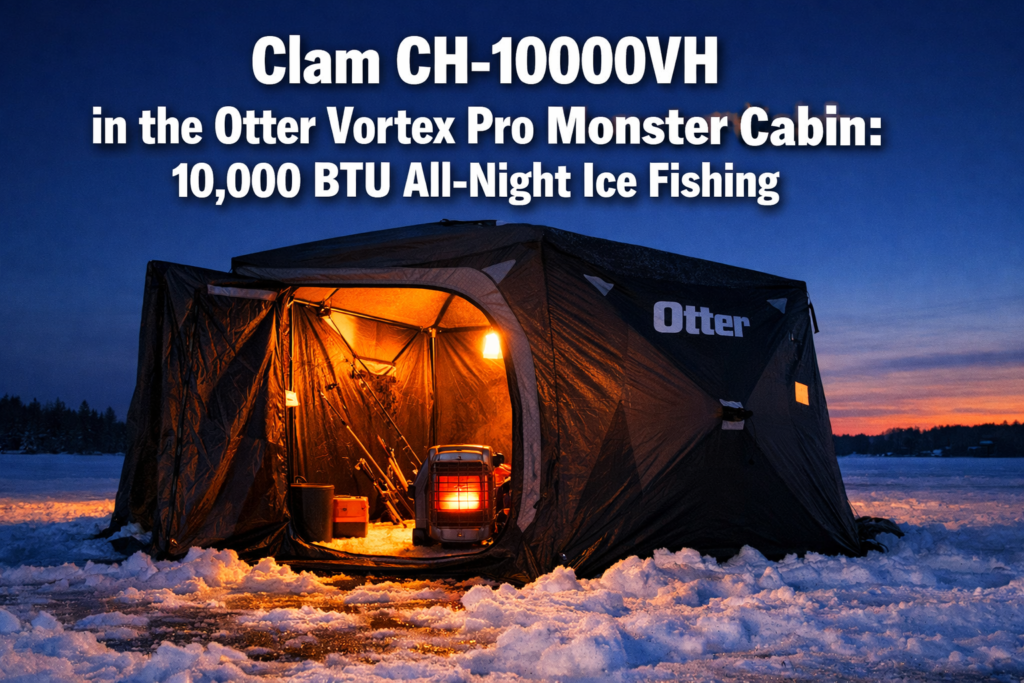
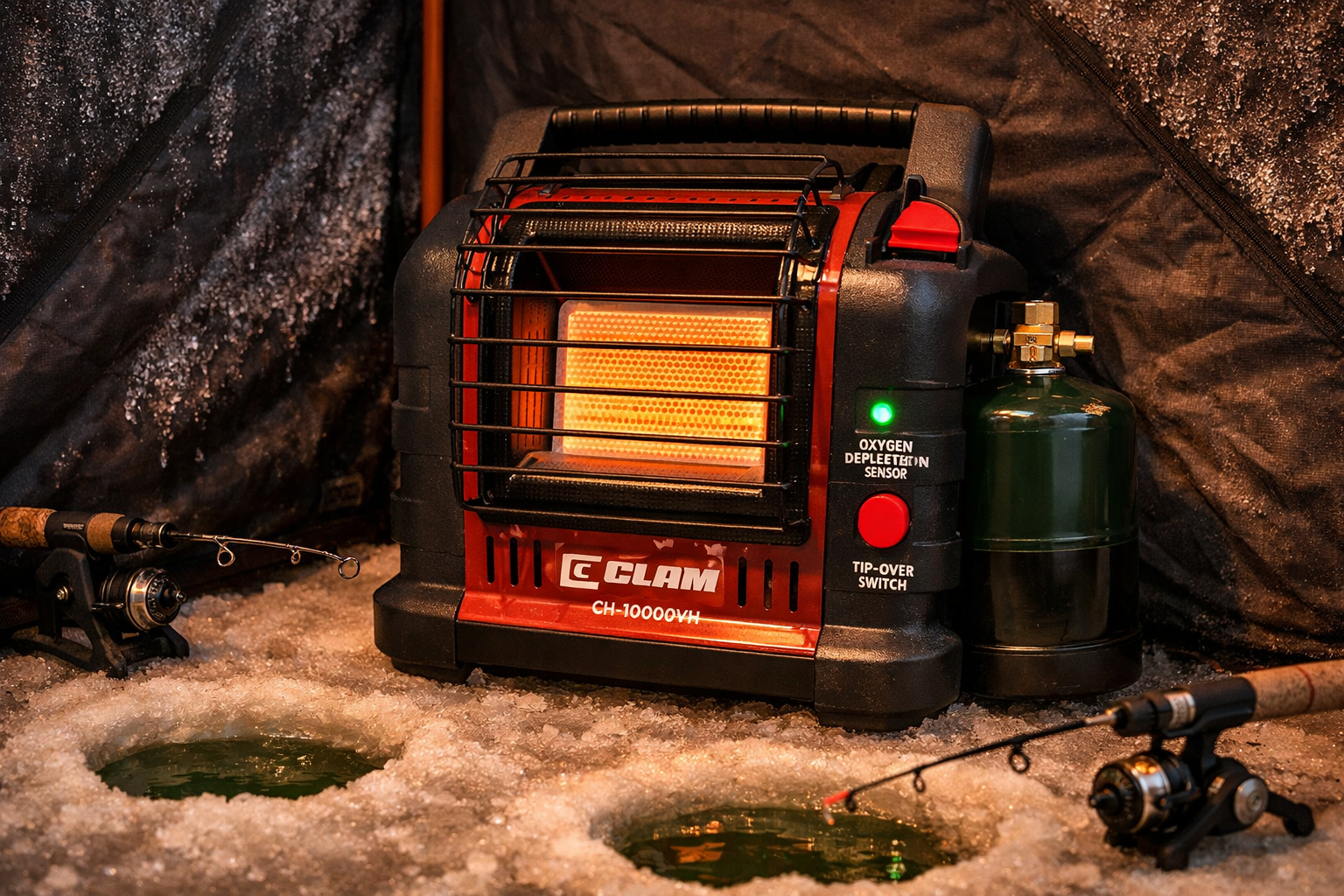
The Clam CH-10000VH heater in Otter Vortex Pro Monster Cabin gives ice anglers a tested, safe heating solution for sub-zero overnight sessions in 2026. This 10,000 BTU propane unit fits the Monster Cabin's footprint well, and its built-in tip-over safety switch and low-oxygen shutoff (ODS) address the two biggest risks of heating an enclosed shelter on the ice. Below, you get the full breakdown: BTU sizing for the cabin's volume, ventilation setup, condensation control, and the safety testing results that matter when you plan to fish through the night.
Key Takeaways
- The Clam CH-10000VH produces 10,000 BTU on its high setting and roughly 4,000 BTU on low, covering the Otter Vortex Pro Monster Cabin's interior volume with headroom to spare.
- The ODS (oxygen depletion sensor) triggers an automatic shutoff when oxygen drops below safe levels. The tip-over switch cuts fuel flow within seconds if the unit falls.
- Proper ventilation requires cracking at least two vents, one low and one high, to maintain airflow without dumping all your heat.
- Condensation buildup on shelter walls is the most overlooked comfort problem during overnight sessions. Managing airflow and heater placement reduces frost drip on gear.
- A battery-powered carbon monoxide (CO) detector is a non-negotiable addition, regardless of the heater's built-in safety features.
- Running the heater on low (4,000 BTU) through the night conserves propane and keeps the cabin at a comfortable 35 to 45 degrees above ambient temperature.
Quick Answer
The Clam CH-10000VH heater is sized correctly for the Otter Vortex Pro Monster Cabin's roughly 180 to 200 cubic feet of interior space. Run the heater on low for overnight sessions to maintain safe oxygen levels and stretch your propane supply across 8 or more hours. Always pair the heater with a standalone CO detector and two open vents.
Why the Clam CH-10000VH Heater in Otter Vortex Pro Monster Cabin Works for 10,000 BTU Optimization for All-Night 2026 Bites
The Monster Cabin from Otter is one of the larger hub-style shelters on the market, designed for multi-angler setups with enough floor space for 4 to 6 fishing holes. Its interior volume sits in the range where a 10,000 BTU heater on high will overheat the space, and a 5,000 BTU unit will struggle in extreme cold. The CH-10000VH's adjustable output (approximately 4,000 to 10,000 BTU) hits the sweet spot.
Here is how the math works. A general rule for heating enclosed spaces with propane is 1,000 BTU per 30 to 40 cubic feet in well-insulated conditions. The Monster Cabin's insulated hub fabric holds heat better than a basic nylon shelter but worse than a hardwall shanty. At 10,000 BTU on high, you raise the interior temperature fast after setup. Then you dial down to low for sustained, fuel-efficient heat through the night.
Choose the CH-10000VH if:
- Your shelter is 150 to 250 cubic feet of interior space.
- You fish in temperatures from 0°F to minus 30°F.
- You need adjustable output for both quick warmup and long, low burns.
Common mistake: Running the heater on high all night. This wastes propane, overheats the shelter, and increases condensation and CO production. Dial to low once the cabin reaches a comfortable temperature.
For more on keeping your gear and setup performing at peak levels, check out our detailed case studies from anglers who push their equipment in demanding conditions.
How to Test the Tip-Over Safety and Low-Oxygen Shutoff Before Your First Overnight Trip
Test both safety systems at home before you trust them on the ice. Here is the process.
Tip-over switch test:
- Set the heater on a flat surface and light the unit on its lowest setting.
- Wait 30 seconds for the flame to stabilize.
- Gently tilt the heater past 45 degrees.
- The flame should cut out within 2 to 5 seconds. If the unit does not shut off, do not use the heater.
ODS (oxygen depletion sensor) test: This is harder to test at home because the sensor responds to reduced oxygen concentration, not CO directly. The practical test is to run the heater in a small, sealed room (like a bathroom with the door closed and no ventilation) and confirm the unit shuts itself off within a few minutes. Do this with a CO detector present and stay near the door. The ODS should trigger before CO reaches dangerous levels.
Edge case: Cold temperatures below minus 10°F slow propane vaporization in small 1-pound cylinders. The heater flame may weaken or sputter, which does not trigger the ODS but does reduce heat output. Use a bulk propane tank with a hose adapter for overnight sessions in extreme cold. The larger tank maintains better pressure.
A standalone battery-powered CO detector rated for low temperatures is your backup. Mount the detector at head height on the shelter wall. The heater's ODS is a last-resort failsafe, not your primary warning system.
BTU Sizing: Is 10,000 BTU Too Much, Too Little, or Right for the Monster Cabin?
10,000 BTU on high is more than enough. 4,000 BTU on low is the overnight setting. Here is a comparison table for common shelter and heater pairings.
| Shelter | Approx. Interior Volume | Recommended BTU Range | CH-10000VH Setting |
|---|---|---|---|
| 2-person flip-over | 60 to 80 cu ft | 3,000 to 5,000 | Too large for this shelter |
| 4-person hub | 120 to 160 cu ft | 5,000 to 8,000 | Low to medium |
| Otter Vortex Pro Monster Cabin | 180 to 200 cu ft | 8,000 to 12,000 | Medium to high for warmup, low for sustained |
| Large hardwall shanty | 250+ cu ft | 12,000 to 20,000 | Supplement with a second unit |
The Monster Cabin falls in the range where the CH-10000VH gives you full coverage. On a calm night at minus 15°F, expect the interior on the low setting to hold around 20 to 30 degrees above outside temperature after the initial warmup period. On high, the cabin gets warm enough to fish in a base layer.
Decision rule: If you fish in a 2-person flip-over, this heater is overkill. If you fish the Monster Cabin or a similar large hub, the CH-10000VH is the right tool. For shelters over 250 cubic feet, consider a second heating source or a larger wall-mount unit.
Ventilation Hacks for the Clam CH-10000VH Heater in Otter Vortex Pro Monster Cabin During Sub-Zero Overnights
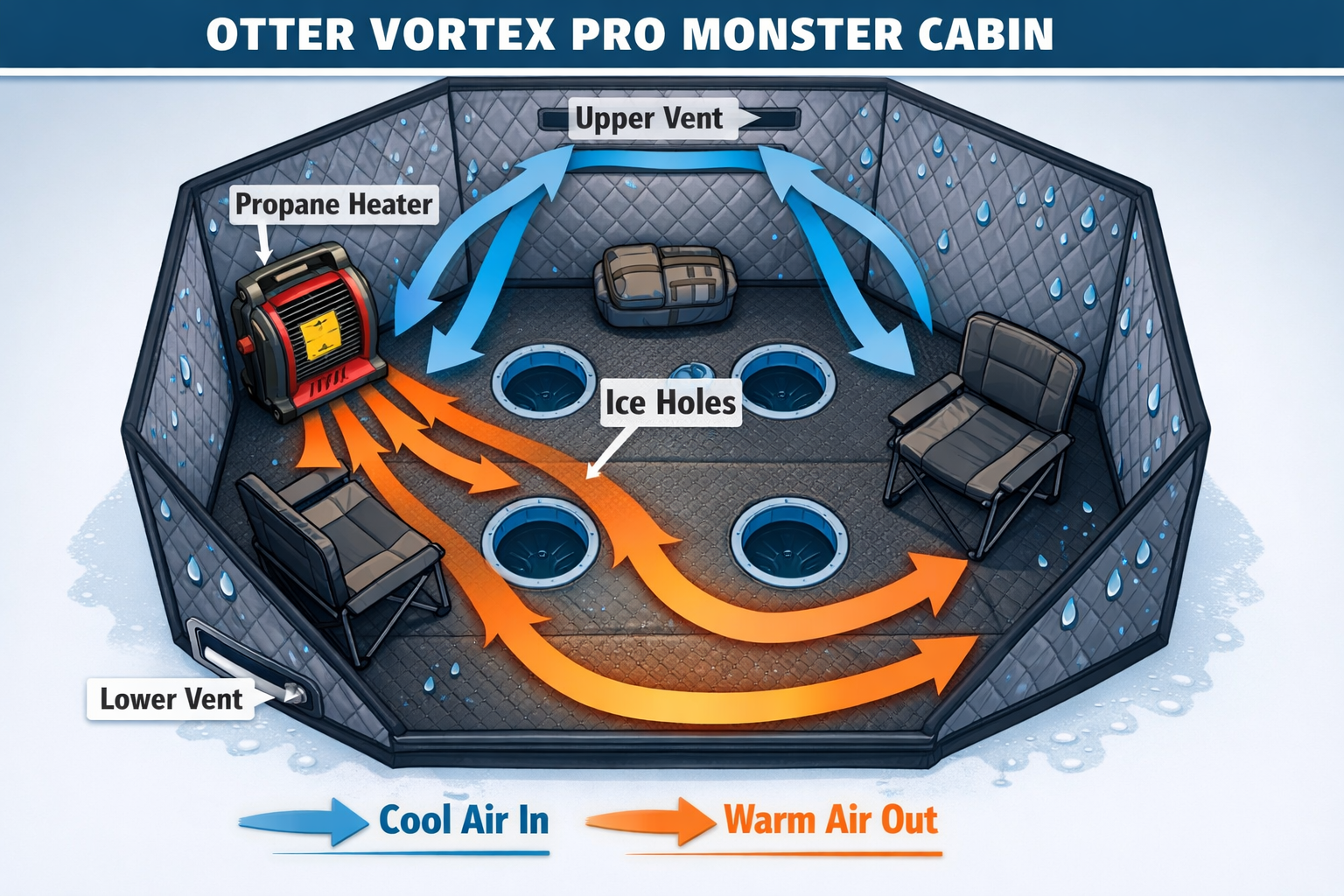
Ventilation is the single most important factor in safe overnight propane heating. The CH-10000VH burns propane cleanly, but all combustion consumes oxygen and produces CO, CO2, and water vapor. You need fresh air exchange.
The two-vent rule:
- Open one vent low on the shelter wall, near floor level. This lets cold, oxygen-rich air enter.
- Open one vent high, near the ceiling or at the top of a door panel. This lets warm, moisture-laden, CO-carrying air escape.
This creates a natural convection loop. Cold air enters low, gets heated, rises, and exits high. The heater stays fed with oxygen, and CO does not accumulate at breathing height.
How much to open the vents: Crack each vent 1 to 2 inches. You lose some heat, but the tradeoff is breathable air. On nights with wind, position the low vent on the windward side and the high vent on the leeward side. Wind pressure pushes fresh air in and pulls stale air out.
Mistake to avoid: Sealing the shelter completely to trap heat. This is the most dangerous thing you do in an ice shelter with a propane heater. Even with the ODS, a fully sealed shelter accumulates CO faster than the sensor responds in some conditions.
For a deeper look at maintaining clean, functional interior spaces in demanding environments, see our interior detailing essentials guide.
Condensation Control: Keeping Your Gear Dry Through the Night
Every propane heater produces water vapor as a combustion byproduct. In a cold shelter, that moisture condenses on the fabric walls and drips onto your gear, electronics, and clothing. Over an 8-hour session, the accumulation is significant.
Steps to reduce condensation:
- Maintain ventilation. The two-vent system described above carries moisture out of the shelter. Closing vents traps water vapor inside.
- Position the heater away from walls. Keep at least 18 inches of clearance between the heater and any fabric panel. Heat radiating directly onto cold fabric accelerates condensation on adjacent cooler surfaces.
- Use a small towel or chamois. Wipe down interior walls periodically during the night, especially near the ceiling where warm moist air collects.
- Elevate sensitive gear. Keep electronics, extra clothing, and food off the floor and away from walls. A small shelf or hanging organizer works.
- Reduce the heater output. Lower BTU output means less water vapor produced. Another reason to run on low overnight.
Edge case: On nights near 0°F with high humidity (common near large bodies of water), condensation freezes on the shelter walls as frost. This is less of a drip problem but adds weight to the shelter fabric. Shake the walls gently before packing up to remove frost before the sun melts the accumulated ice.
Keeping your shelter interior organized and dry follows the same principles we cover in our guide to cleaning and maintaining interior spaces.
Propane Consumption: How Long Does the CH-10000VH Run on One Tank?
On the low setting (approximately 4,000 BTU), the CH-10000VH burns roughly 0.15 to 0.2 pounds of propane per hour. A standard 1-pound cylinder lasts about 5 to 6 hours on low. On high (10,000 BTU), that same cylinder lasts about 2 to 2.5 hours.
Overnight fuel plan for an 8-hour session:
- Bring at least two 1-pound cylinders if running on low the entire time.
- Bring three cylinders if you plan a 20-minute high-heat warmup followed by low for the rest of the night.
- A bulk 20-pound tank with a hose adapter is the better option for overnights. The 20-pound tank provides roughly 80 to 100 hours on low, eliminating cylinder swaps in the dark.
Propane performance in extreme cold: Small 1-pound cylinders lose pressure below 0°F because liquid propane does not vaporize efficiently at very low temperatures. Symptoms include a weak, yellow flame and reduced heat output. Solutions include keeping spare cylinders inside your sleeping bag or jacket to keep them warm, or switching to the bulk tank setup, which maintains better vapor pressure due to the larger liquid volume.
Safety Checklist for All-Night Heating in the Monster Cabin
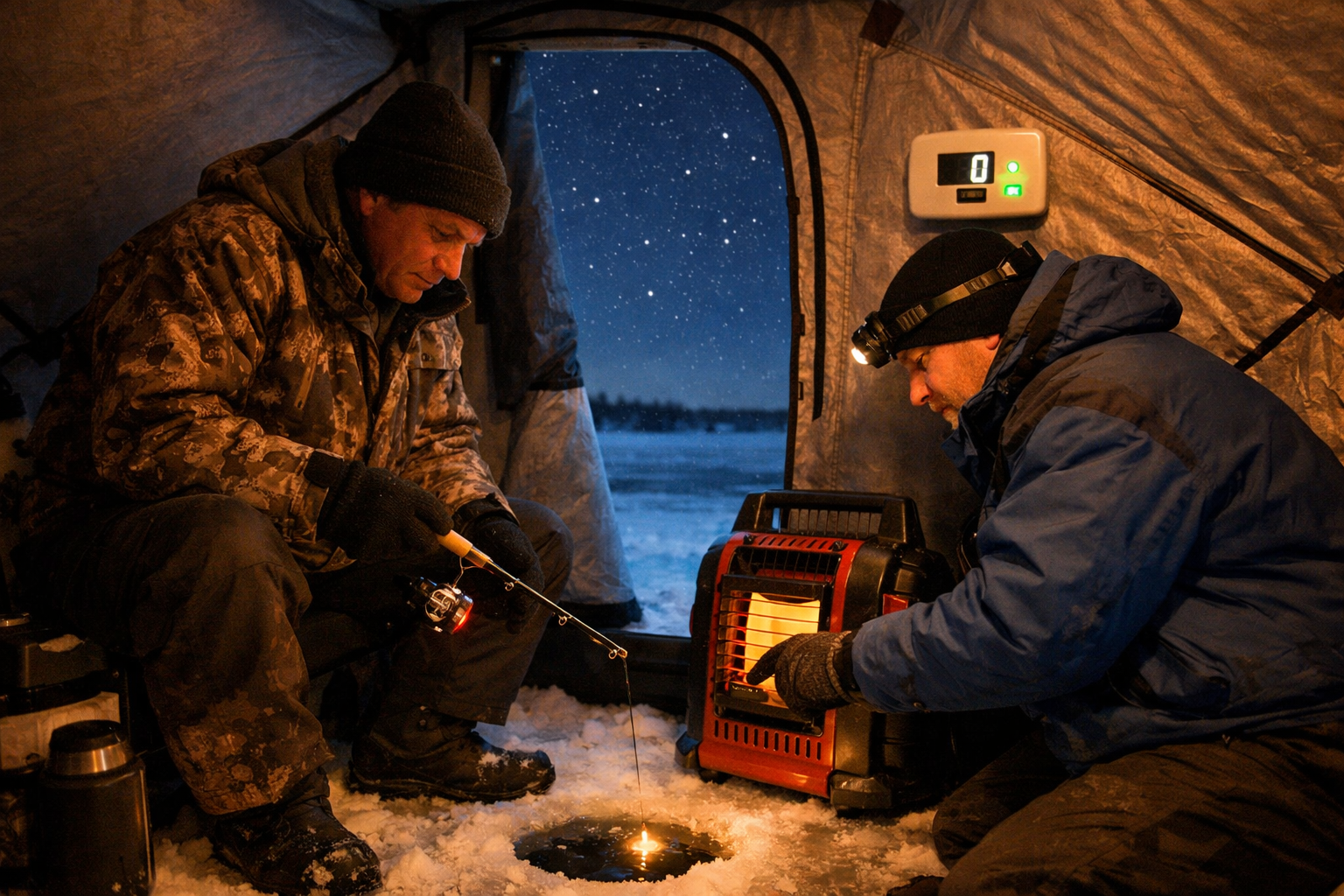
Run through this checklist every time you set up for an overnight session.
- Place the heater on a flat, stable surface away from fishing holes, gear bags, and shelter walls (18-inch minimum clearance).
- Confirm the tip-over switch is functional before lighting.
- Install a battery-powered CO detector at head height on the shelter wall. Test the detector's battery before each trip.
- Open two vents: one low, one high.
- Light the heater on high for the initial warmup (15 to 20 minutes), then reduce to low.
- Check propane supply. Have at least one backup cylinder or a bulk tank with adapter.
- Keep a fire extinguisher or a container of water within arm's reach.
- Never leave the heater running while you sleep without a functioning CO detector in the shelter.
- If you feel drowsy, dizzy, or develop a headache, shut off the heater and open the shelter door immediately.
This checklist applies to every heated shelter session, whether you fish for 4 hours or 14. Review our services and coaching options for hands-on guidance in building safe, tournament-ready ice setups.
Common Mistakes When Heating an Ice Shelter Overnight
- Placing the heater near a fishing hole. If the heater tips into the hole, you lose the unit and create a dangerous situation. Keep the heater at least 3 feet from any open water.
- Using the heater as a cooking surface. The CH-10000VH is not designed for cooking. Placing pots or pans on top blocks airflow and voids the safety certifications.
- Ignoring wind conditions. Strong wind gusts push against hub shelters and shift the floor. Anchor the shelter with ice anchors and recheck heater stability after gusts.
- Skipping the CO detector. The ODS on the heater is a backup system. A standalone CO detector gives you an earlier warning at lower concentrations.
- Forgetting about the fishing holes as ventilation. Open ice holes provide some air exchange, but they also let cold air pour in from below. Factor this into your heating plan. More open holes mean more heat loss but also more fresh air.
For anglers transitioning between seasons and environments, our about page covers how FishOnYak.com supports multi-season adventurers with tactical guidance.
Alternatives to the Clam CH-10000VH for the Monster Cabin
If the CH-10000VH is unavailable or you want to compare options, here are common alternatives for the same shelter size.
| Heater | BTU Output | ODS Included | Tip-Over Switch | Best For |
|---|---|---|---|---|
| Clam CH-10000VH | 4,000 to 10,000 | Yes | Yes | Large hubs, overnight sessions |
| Mr. Heater Buddy (9,000 BTU) | 4,000 to 9,000 | Yes | Yes | Large hubs, widely available |
| Mr. Heater Little Buddy | 3,800 | Yes | No | Small shelters, short sessions |
| Clam CH-5000VH | 2,500 to 5,000 | Yes | Yes | Medium hubs, mild cold |
The Mr. Heater Buddy 9,000 BTU is the closest competitor. Both units share similar safety features and BTU ranges. The CH-10000VH offers slightly higher max output and a slimmer profile, which matters in a shelter already crowded with gear and anglers.
FAQ
Q: Does the Clam CH-10000VH heater produce carbon monoxide? A: Yes. All propane heaters produce some CO during combustion. The amount is small with clean-burning units like the CH-10000VH, but you must ventilate the shelter and use a CO detector.
Q: How many 1-pound propane cylinders do you need for an overnight session? A: Plan for two to three cylinders on the low setting for an 8-hour session. A 20-pound bulk tank with a hose adapter is more practical for overnights.
Q: Where should you place the heater inside the Monster Cabin? A: Place the heater on a flat spot at least 18 inches from any wall and at least 3 feet from any fishing hole. A corner position works well for heat distribution.
Q: Does the ODS replace a carbon monoxide detector? A: No. The ODS detects low oxygen, not CO directly. A standalone CO detector responds faster and at lower concentrations. Use both.
Q: Will the heater work with a bulk propane tank? A: Yes, with a compatible hose and adapter. Clam sells a hose adapter kit, and aftermarket options fit standard bulk tank connections.
Q: How cold is too cold for 1-pound propane cylinders? A: Below 0°F, small cylinders lose pressure and output drops. Keep spares warm in your jacket or sleeping bag, or switch to a bulk tank.
Q: Does the tip-over switch work on uneven ice? A: The switch activates when the unit tilts past approximately 45 degrees. On slightly uneven surfaces, the heater operates normally. On severely uneven ice, level the surface before placing the heater.
Q: How much ventilation is enough? A: Two vents cracked 1 to 2 inches each, one low and one high, provide adequate air exchange for the CH-10000VH on the low setting in the Monster Cabin.
Q: Does the heater affect fish behavior through the ice holes? A: The light from the heater flame and the warm air rising from open holes create minor current changes under the ice. Some anglers report increased fish activity near heated holes, though this is anecdotal.
Q: How heavy is the CH-10000VH? A: The unit weighs approximately 5 to 6 pounds without a propane cylinder attached. The 1-pound cylinder adds another pound.
Conclusion
The Clam CH-10000VH heater in the Otter Vortex Pro Monster Cabin gives you a reliable, adjustable heating setup for all-night ice fishing in 2026. The 10,000 BTU max output handles the initial warmup, and the 4,000 BTU low setting sustains comfortable temperatures through 8 or more hours of fishing. Test the tip-over switch and ODS before your first trip. Run a standalone CO detector every session. Crack two vents. Bring enough propane.
Do these things, and you fish warm, safe, and focused on the bite.
Kayak. Drill. Catch. Repeat.
See you on the water.
Visit our blog for more tactical ice fishing and kayak angling content built for serious anglers.
Resources links
- Clam CH-10000vh Heater official product page: https://clamoutdoors.com/acc-clam-heater-ch-10000vh-is24 — best primary source for BTU range, heating area, ignition, fuel options, and safety sensor details.
- Otter Vortex Pro Monster Cabin official product page: https://www.otteroutdoors.com/product/vortex-pro-monster-cabin/ — best primary source for shelter size, fishable area, insulation system, weight, and propane hose port details.
- Clam CH-10000vh Canada/MA version page: https://clamoutdoors.com/acc-clam-heater-ch-10000vh-ca-is24 — useful for cross-checking specs and noting region-specific safety wording.
Strong supporting links
- Tangled Tackle Co. heater page: https://tangledtacklecompany.com/products/clam-heater-ch-10000vh — helpful because it includes quoted 20 lb tank runtime figures of 45 hours on high and 78 hours on low, which is especially relevant for “all-night” optimization angles.
- SCHEELS heater page: https://www.scheels.com/p/clam-ch-10000vh-portable-radiant-heater/19921-19153/ — retailer confirmation of the 5,500 to 10,000 BTU adjustable range and portable use case.
- Riverside Outdoors Otter shelter page: https://riversideoutdoors.ca/index.php?route=product%2Fproduct&product_id=668 — useful alternate source confirming 82 sq. ft., 5–7 person capacity, and the built-in propane hose port.