Last updated: March 16, 2026
Quick Answer
The debate between Electric vs. manual 8-inch Ice augers depends heavily on your physical stamina and typical ice conditions. Here is how they compare:
- Electric 8-Inch Augers: The winner for speed and efficiency. They drill significantly faster, demand less physical effort, and easily handle 8 to 24 inches of ice.
- Manual 8-Inch Augers: The winner for lightweight reliability. They cost less upfront, are easier to carry, and will never leave you stranded with a dead battery in freezing temperatures.
The Verdict: Rely on an electric auger for thick ice and high-mobility days, but always keep a manual auger in your sled for remote solo trips or as a dependable backup.
Key Takeaways
- Electric 8-inch augers drill through 12-inch ice in roughly 5-10 seconds. Manual augers take 45-90 seconds on the same ice.
- Premium electric models like the ION Alpha Plus cut over 2,000 inches of ice per charge under normal conditions.
- Lithium batteries lose 20-30% capacity at -10°F and up to 50-60% at -20°F, so cold management matters.
- Manual augers weigh 9-13 pounds. Gas augers weigh 28-35 pounds. Electric 8-inch models typically run 14-18 pounds.
- Electric augers have captured over 60% of new auger sales in the past three years.
- The global electric ice auger market sat at approximately $0.7 billion in 2026 and is projected to reach $0.9 billion by 2035.
- Manual augers carry near-zero mechanical failure risk, making them reliable backups for remote or solo fishing.
- Electric augers deliver 80% of gas auger performance at 60% less weight.
- Total cost of ownership favors electric over 3-5 seasons when you factor in fuel, maintenance, and time savings.
- For ice exceeding 28-30 inches, gas still holds a drilling speed advantage over electric.
How Do Electric and Manual 8-Inch Augers Actually Perform Across Different Ice Thicknesses?
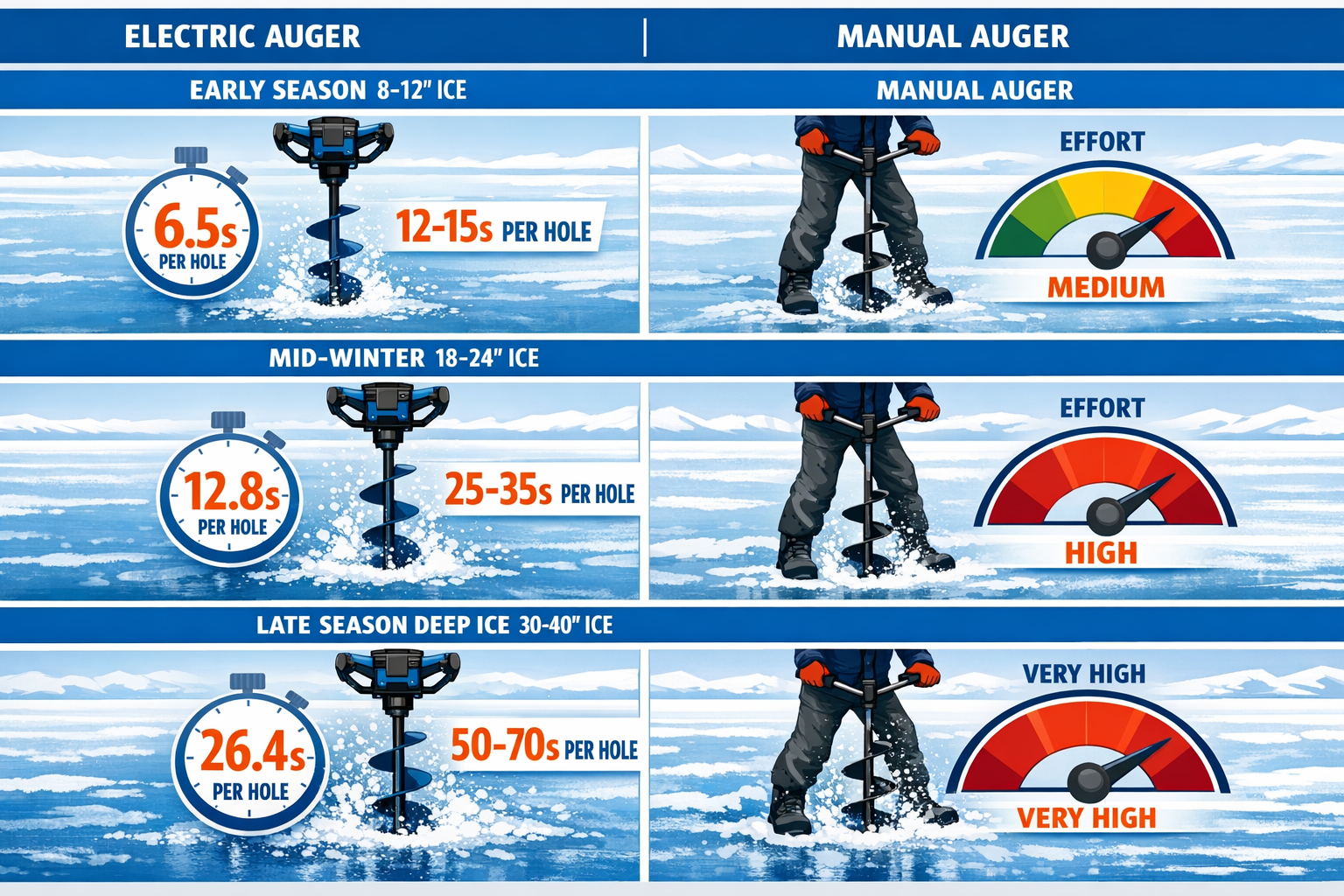
Electric augers outperform manual models at every ice thickness, but the gap widens significantly as ice gets thicker. On early-season ice of 8-12 inches, a manual auger is manageable. On mid-winter ice of 20-30 inches, a manual auger becomes a real physical challenge.
Early Season Ice (8-15 Inches)
At this thickness, a manual 8-inch auger is a legitimate option. Fit anglers drill a clean hole in 45-75 seconds. An electric auger like the ION Alpha Plus, which cuts at 3.4 inches per second, punches through 12-inch ice in roughly 3-4 seconds of actual cutting time.
The practical difference at this thickness is cumulative. Drill 10 holes manually and you feel it. Drill 30 holes manually and your shoulders remind you for two days. Electric handles 30 holes with no physical cost.
Mid-Winter Ice (16-28 Inches)
This is where the electric vs. manual 8-inch ice auger comparison becomes decisive. Manual drilling through 24 inches of hard blue ice takes real effort, 90-180 seconds of sustained torque per hole, depending on your conditioning and blade sharpness.
Electric augers cut 24-inch ice in 7-12 seconds. Brushless DC motors produce 100% of available torque from 0 RPM, so there is no warm-up or bogging. The motor delivers consistent power from the first rotation to the last.
Deep Ice (28-40+ Inches)
At this depth, gas augers still hold a speed edge over electric. Gas models drill through 36+ inches in 30-45 seconds. Premium electric models take 50-90 seconds at the same depth. Manual augers at 36 inches become a serious physical undertaking and are not practical for drilling multiple holes.
If you regularly fish water with 30+ inch ice, read our breakdown of the best electric auger for 30-inch ice before you buy.
Choose electric if: You drill 10+ holes per session on ice up to 28 inches. Choose manual if: You drill 3-5 holes on early-season ice and want a lightweight, no-fail option. Choose gas if: You consistently fish 30+ inch ice and drill 50+ holes per day.
What Is the Real Physical Effort Difference Between Electric and Manual Drilling?
Electric augers eliminate drilling fatigue almost entirely. Manual augers transfer all mechanical work to your arms, shoulders, and core.
The physical demand of manual drilling compounds across a session. Your first hole feels easy. Your twentieth hole, especially in hard, cold ice, taxes your grip and shoulder stability. Anglers wearing insulated float bibs face an added challenge because the gear restricts movement and shifts your center of gravity.
Electric augers reduce that physical load to almost nothing. You guide the tool. The motor does the work. This matters most for:
- Mobile anglers drilling 20-40 holes to locate fish
- Anglers fishing multiple days in a row
- Anglers wearing bulky safety gear like float bibs
- Older anglers or those with shoulder or wrist issues
Manual augers still have a physical advantage in one specific scenario: remote solo trips where carrying a dead battery or a broken motor is a real risk. At 9-13 pounds, a manual 8-inch auger is the lightest option on the ice and carries near-zero mechanical failure risk.
“For most anglers fishing 10+ days per season in ice thicker than 18 inches, electric augers offer the best compromise between drilling efficiency and safe operation in flotation gear.”
How Do Electric vs. Manual 8-Inch Ice Auger Costs Compare Over Multiple Seasons?
Upfront cost favors manual. Long-term cost of ownership favors electric for anglers who fish regularly.
Upfront Cost Comparison
| Auger Type | Entry-Level Price | Premium Price |
|---|---|---|
| Manual 8-inch | $40-$80 | $120-$200 |
| Electric 8-inch | $150-$250 | $350-$600 |
| Gas 8-inch | $300-$400 | $500-$700 |
The VEVOR 20V lithium-powered 8-inch electric auger, released in May 2025, enters the market at the lower end of the electric price range and drills up to 31.5 inches deep. This expansion of affordable electric options narrows the upfront cost gap.
Total Cost of Ownership (3-Season Estimate)
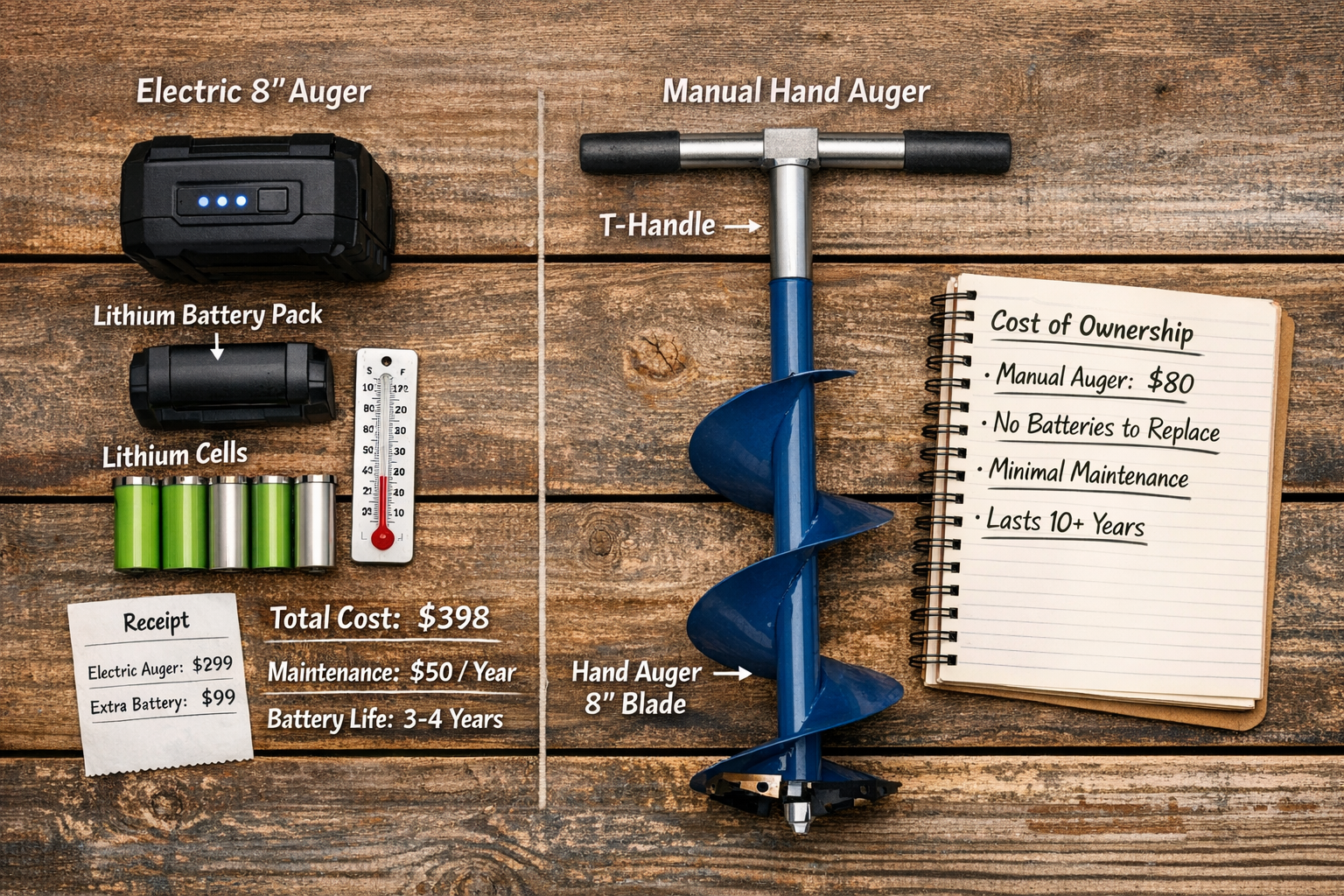
Manual augers require blade replacements every 1-3 seasons, typically $20-$50 per set. No fuel, no maintenance beyond blades.
Electric augers need replacement batteries every 3-5 seasons, typically $80-$150 per battery. No fuel costs. Minimal maintenance.
Gas augers require fuel each season ($15-$30 per season), annual tune-ups ($30-$60), and occasional carburetor work. The gas ice auger off-season storage and maintenance checklist outlines what proper gas auger upkeep actually involves.
Over three seasons, a premium electric auger typically costs less to operate than a comparable gas model, assuming you fish 10+ days per season.
Common mistake: Anglers buy manual augers to save money, then spend the same money on replacement blades and physical recovery time. If you fish more than 8-10 days per season, the electric option pays for itself in effort savings alone.
How Does Cold Weather Affect Electric Auger Battery Performance?
Battery performance drops in extreme cold, and this is the most important limitation of electric augers. Modern lithium batteries maintain 65-75% capacity at -10°F and 50-60% capacity at -20°F.
For a battery rated at 2,000 inches of ice per charge under normal conditions, that translates to roughly 1,000-1,300 inches at -20°F. That is still enough for most single-day sessions, but you need to manage it deliberately.
Battery Management in Extreme Cold
- Keep spare batteries inside your jacket or shelter between uses
- Start drilling with a warm battery from your vehicle
- Store batteries at room temperature the night before
- Carry at least two batteries for sessions below -10°F
The ION Alpha Plus 8-inch uses a 4Ah Gen 3 battery and weighs under 16 pounds. The StrikeMaster 40V Maven is another strong performer in extreme cold. See how these two compare in the Eskimo Outbreak 450XD vs. StrikeMaster 40V Maven head-to-head.
Manual augers have zero battery concerns. In extreme cold, that reliability matters. If your electric auger dies at -25°F five miles from the truck, a manual backup is not a luxury.
Which Auger Type Works Best for Mobile Ice Fishing vs. Stationary Setups?
Mobile fishing and stationary fishing have different demands. The right auger depends on how you fish, not just what ice you're on.
Mobile Fishing (Hole-Hopping)
Mobile anglers drill constantly. Finding fish means drilling 15-40 holes across a large area in a single session. Electric augers are built for this approach. The speed advantage compounds with every hole. You locate fish faster and spend more time with your line in the water.
Weight matters here too. Electric 8-inch models at 14-18 pounds are manageable. Gas models at 28-35 pounds become a burden when you're covering ground on foot. Manual augers at 9-13 pounds are the lightest option, but the physical cost of drilling 30+ holes manually defeats the purpose of mobile fishing.
For mobile anglers using electronics to pre-locate fish before drilling, the Garmin ECHOMAP CHIRP 73cv Panoptix ice bundle pairs well with an electric auger workflow.
Stationary Shelter Fishing
If you set up a permanent or semi-permanent shelter and drill 4-8 holes per session, the electric vs. manual 8-inch ice auger comparison shifts. A manual auger handles 6 holes per session without significant fatigue. An electric auger still finishes the job faster, but the efficiency gap matters less.
Choose electric for: Mobile fishing, 15+ holes per session, ice over 18 inches. Choose manual for: Stationary setups, 4-8 holes per session, early-season ice under 15 inches.
What Are the Top Electric 8-Inch Auger Options in 2026?
Three electric augers consistently lead the market for 8-inch performance. ION, StrikeMaster, and K-Drill rank as the top electric options based on field performance and retailer assessments.
ION Alpha Plus 8-Inch
The ION Alpha Plus delivers 3.4 inches per second cutting speed and up to 2,000 inches of ice per charge with its 4Ah Gen 3 battery. It weighs under 16 pounds. This is the benchmark for premium electric performance.
StrikeMaster 40V Maven
The Maven uses a 40V brushless motor and handles 30+ inch ice with consistent torque. The Otter Vortex Pro Monster Cabin paired with the StrikeMaster 40V Maven is a proven combination for deep-ice setups.
VEVOR 20V Electric Auger
Released in May 2025, the VEVOR 20V 8-inch auger drills up to 31.5 inches deep with cold-resistant steel spiral blades. It enters the market at a lower price point than ION or StrikeMaster, making it a strong option for anglers stepping up from manual for the first time.
Electric vs. Manual 8-Inch Ice Augers FAQ
Q: How fast does an electric 8-inch auger drill through 12-inch ice? A: A premium electric auger like the ION Alpha Plus cuts through 12-inch ice in roughly 3-5 seconds of actual cutting time at 3.4 inches per second. Total hole time including positioning runs 8-12 seconds.
Q: How long does a manual 8-inch auger take on 12-inch ice? A: A fit angler with sharp blades drills through 12-inch ice in 45-75 seconds. Dull blades or hard blue ice extend that to 90-120 seconds.
Q: Can an electric auger handle 36-inch ice? A: Yes, but with a performance trade-off. Premium electric models take 50-90 seconds through 36+ inches. Gas augers complete the same hole in 30-45 seconds. Electric is still functional at that depth, just slower.
Q: How many holes does an electric auger battery last? A: The ION Alpha Plus delivers up to 2,000 inches of ice per charge [4]. In 20-inch ice, that equals roughly 100 holes per charge under normal temperatures. Cold weather reduces that by 20-50% depending on conditions.
Q: Is a manual auger worth buying if you already own an electric? A: Yes. A manual auger serves as a reliable backup for remote solo trips where a dead battery or mechanical failure becomes a safety concern. At 9-13 pounds, it adds minimal weight to your sled.
Q: What is the weight difference between electric and manual 8-inch augers? A: Manual 8-inch augers weigh 9-13 pounds. Electric 8-inch models run 14-18 pounds. Gas 8-inch models weigh 28-35 pounds.
Q: Do electric augers work in extreme cold below -20°F? A: They work, but battery capacity drops to 50-60% of rated capacity at -20°F. Keep spare batteries warm inside your jacket or shelter and start with a fully charged battery from a warm vehicle.
Q: What is the cheapest electric 8-inch auger available in 2026? A: The VEVOR 20V 8-inch electric auger represents one of the most affordable entry points, with a 4000mAh battery and cold-resistant blades capable of drilling to 31.5 inches.
Q: Is an electric auger safer to use than a gas auger while wearing float bibs? A: Yes. Electric augers weigh significantly less and eliminate the awkward pull-start motion that can throw operators off balance on slippery ice. Windrider's analysis confirms electric models are safer to operate in flotation gear.
Q: How do I extend electric auger battery life in cold weather? A: Store batteries at room temperature the night before fishing. Keep spares inside your jacket between uses. Start drilling immediately after removing the battery from warmth. Carry two batteries for sessions below -10°F.
Conclusion
The electric vs. manual 8-inch ice auger comparison comes down to how you fish and where you fish. Electric augers win on speed, physical efficiency, and long-term value for anglers drilling in ice thicker than 15 inches or covering ground on mobile sessions. Manual augers win on simplicity, weight, and upfront cost for anglers drilling a handful of holes on early-season ice.
Here are your next steps:
- Count how many holes you drill per session and how thick your local ice gets by mid-winter.
- If you average 10+ holes in ice over 18 inches, budget for an electric model. The ION Alpha Plus or StrikeMaster 40V Maven are proven choices.
- If you fish 5 or fewer days per season on thin early-season ice, a quality manual auger with sharp blades gets the job done.
- Always carry a manual auger as a backup if you fish remote locations alone. Equipment failure on deep ice in extreme cold is a safety issue, not just an inconvenience. Review safe ice travel in variable conditions before heading out on unfamiliar ice.
- Manage your batteries in cold weather. Keep spares warm and start every session with a full charge.
Drill smart. Fish more. Kayak. Drill. Catch. Repeat.
See you on the water.
References
[1] Vevor 20V Electric Ice Auger 8 Inch – https://www.vevor.com/auger-drill-bit-c_12389/vevor-20v-electric-ice-auger-8-inch-diameter-2-in-1-cordless-ice-fishing-augers-and-earth-auger-with-ices-earth-drill-bit-cold-resistant-post-hole-digger-turbo-high-speed-cutting-system-p_010325017696
[2] Ice Auger Selection: Power Vs Manual For Float Suit Mobility – https://windrider.com/blogs/tips-and-tricks/ice-auger-selection-power-vs-manual-for-float-suit-mobility
[3] ION Alpha Plus 8-Inch – https://ioniceaugers.com/products/ion%C2%AE-alpha-plus-8
[4] Auger Fishing – https://beyondbraid.com/blogs/news/auger-fishing
[5] Watch (Kyle Heim / Jason Mitchell Outdoors) – https://www.youtube.com/watch?v=YG25lrMog-8
[6] The Power Play On Ice: A Technical Comparison Of Electric Vs Gas Ice Augers – https://www.reelschematic.com/the-power-play-on-ice-a-technical-comparison-of-electric-vs-gas-ice-augers/
[7] Electric Ice Auger Market – https://www.businessresearchinsights.com/market-reports/electric-ice-auger-market-103450