Last updated: March 9, 2026
Key Takeaways
- FishPro leads in battery life (up to 20 hours) and IR performance in stained water, making it the strongest pick for full-day ice sessions or extended kayak outings.
- Eyoyo offers the largest screen options (up to 9 inches) at the lowest price point (around $300), but picture quality scores around 7/10 in murky conditions.
- FourQ's auto-reel system with 100 feet of retractable cable adds a hands-free convenience factor that the other two brands lack.
- All three cameras struggle when visibility drops below a few inches due to heavy suspended sediment. IR helps, but physics still wins in extreme murk.
- DVR recording separates FishPro and newer Eyoyo models from basic setups, letting you review footage after the trip.
- Budget cameras in the $300 to $500 range use 1000 to 1200 TVL sensors, which fall well short of professional systems ($800+) that use back-illuminated CMOS and AI-powered image processing.
- IR LEDs outperform white LEDs in murky water because they illuminate the scene without spooking fish in dark or stained conditions.
Quick Answer
For murky water fishing in 2026, FishPro delivers the best combination of IR clarity, battery endurance, and DVR recording at a mid-range price. Eyoyo wins on budget and screen size. FourQ wins on convenience with its auto-reel cable system. Choose FishPro if you fish long days in stained water. Choose Eyoyo if you want the biggest monitor for the least money. Choose FourQ if hands-free deployment matters more than raw image quality.
Why Does the Eyoyo vs FishPro vs FourQ Comparison Matter for Murky Water Anglers?
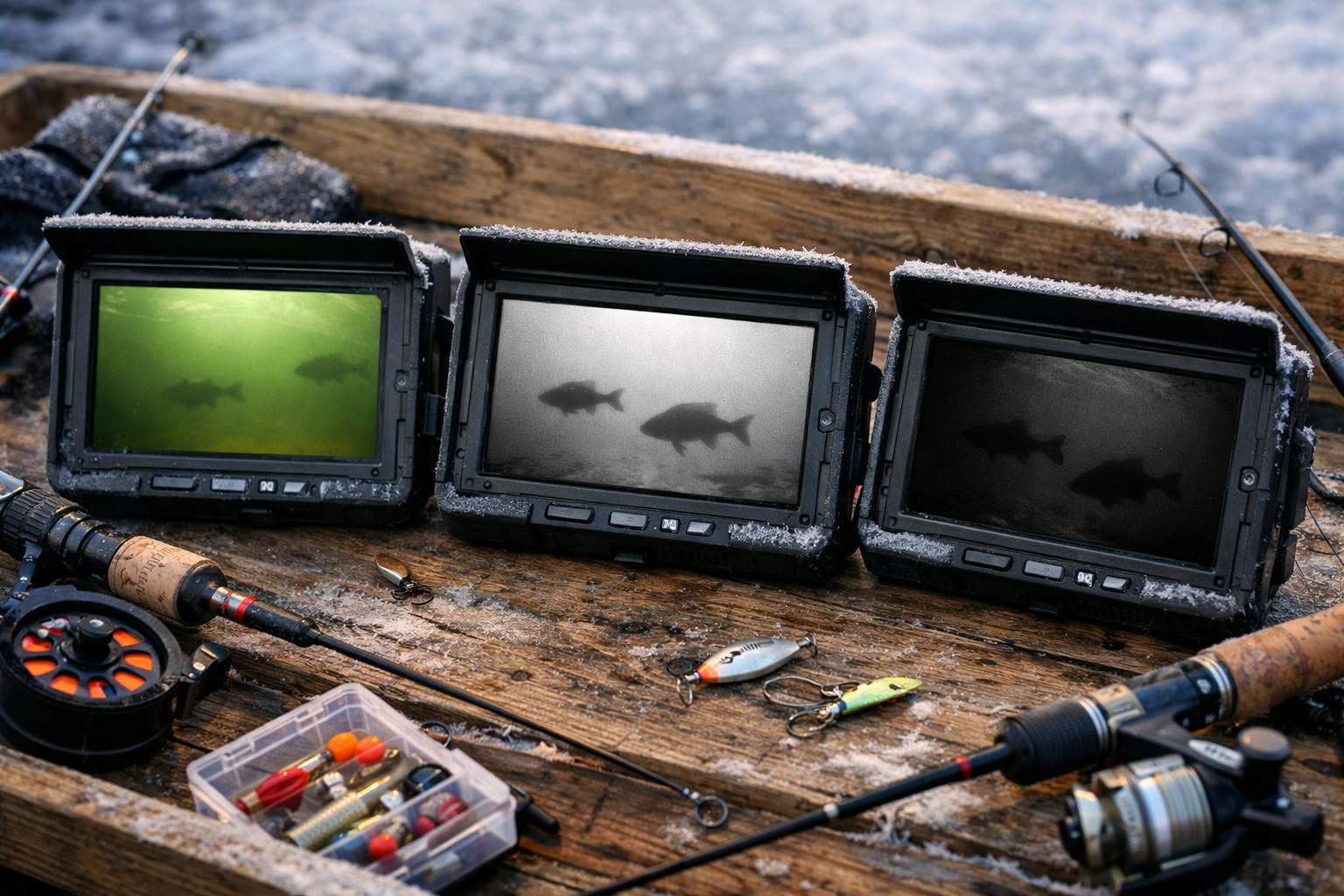
Murky water makes or breaks an underwater camera purchase. A camera that looks great in clear lake demos will produce useless green fog when you drop it into tannin-stained shallows or silt-heavy ice fishing holes. The Eyoyo vs FishPro vs FourQ matchup matters because these three brands dominate the sub-$500 underwater fishing camera market, and each handles low-visibility water differently.
IR (infrared) LEDs are the critical feature here. Unlike white LEDs, infrared light illuminates the water column without creating the bright glare that scatters off suspended particles and spooks fish. All three cameras offer IR modes, but the number of IR LEDs, their placement, and the camera sensor's sensitivity to IR light vary between models.
If you fish stained coastal flats from a kayak or drill through ice over muddy-bottom lakes, your camera choice directly affects whether you see fish or stare at a cloudy screen. For anglers building a tournament-ready kayak setup, the right underwater camera adds a tactical edge that sonar alone does not provide.
How Do IR LEDs Perform in Murky Water Across All Three Cameras?
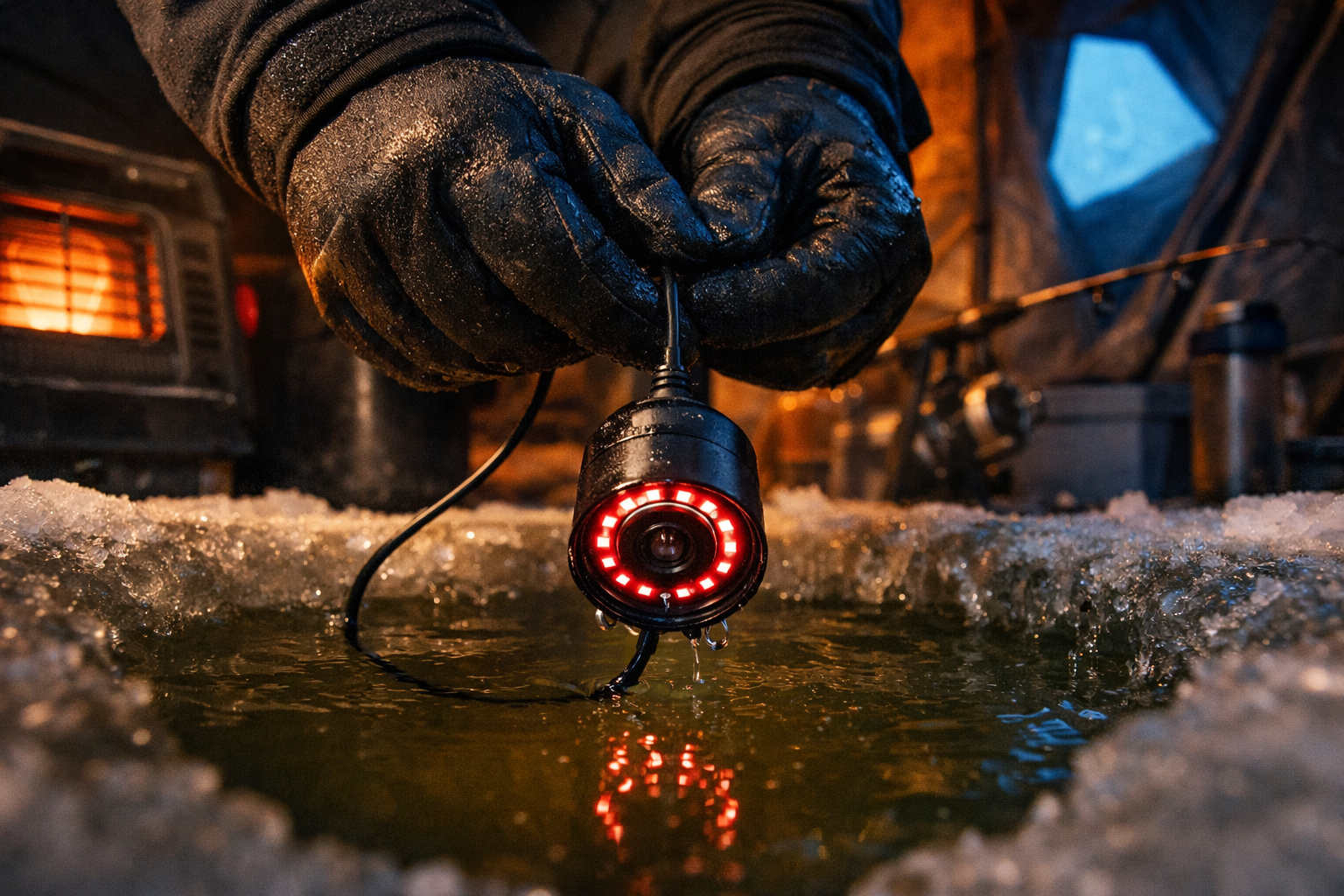
IR performance is the single biggest differentiator in stained water. FishPro equips its 7-inch models with 12 IR LEDs and 12 white LEDs, giving you the option to switch between modes or run both [8]. In murky conditions, running IR-only mode produces noticeably less backscatter than white LED mode. FishPro's IR LEDs sit in a ring pattern around the lens, which distributes light evenly and reduces hot spots.
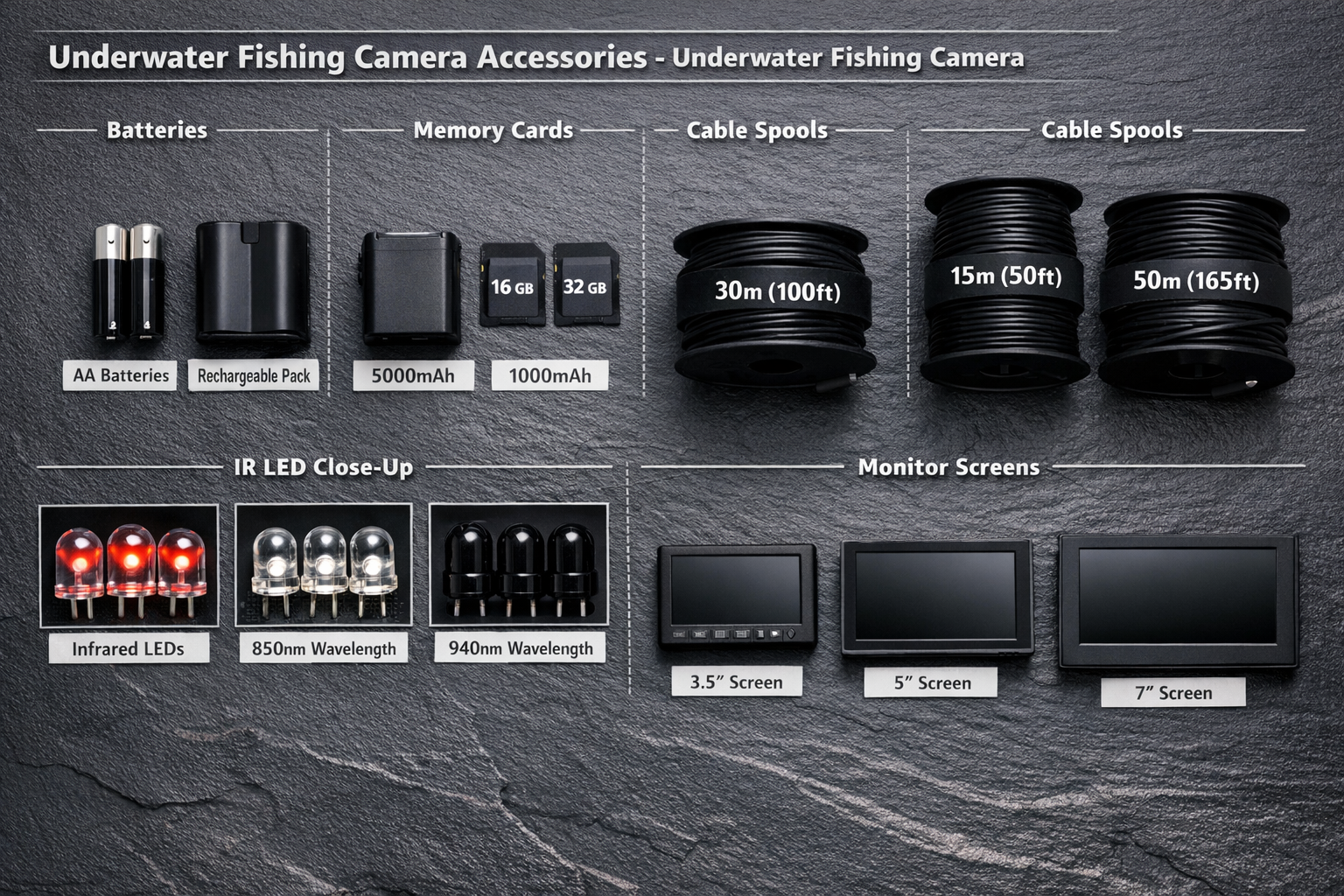
Eyoyo's standard 7-inch model uses 24 total LEDs split between infrared and white. The higher LED count sounds better on paper, but the 1000 TVL sensor limits how much detail the camera resolves in low light. In practice, Eyoyo's IR mode produces a usable image for identifying fish species and structure, though fine details like bait presentation get lost in heavy murk.
FourQ's 2026 auto-reel model runs 4 IR night vision lights. That is significantly fewer IR LEDs than either competitor. The trade-off is clear: FourQ prioritizes its auto-reel mechanism and battery capacity over raw illumination power. In moderately murky water (visibility of 12 to 18 inches), FourQ performs adequately. In heavy murk (under 6 inches of visibility), the limited IR output becomes a real weakness.
Decision rule: Choose FishPro if you regularly fish water with under 12 inches of visibility. Choose Eyoyo if you fish moderately stained water and want a bigger screen. Choose FourQ only if your water clarity stays above 12 inches most of the time.
What Are the Key Specs? Eyoyo vs FishPro vs FourQ Head-to-Head Comparison Table
| Feature | Eyoyo EF09R-15 | FishPro DVR 7-inch | FourQ Auto-Reel |
|---|---|---|---|
| Monitor Size | 9-inch TFT | 7-inch LCD | 4.3-inch HD |
| Resolution | 1000 TVL | 1080p HD | 1000 TVL (estimated) |
| IR LEDs | 12 IR + 12 white | 12 IR + 12 white | 4 IR |
| Battery Life | 6 to 8 hours | Up to 20 hours | 10+ hours |
| Cable Length | 15m (49 ft) standard | 30m (98 ft) options | 100 ft auto-retractable |
| DVR Recording | Yes (newer models) | Yes, 32GB SD included | No confirmed DVR |
| Price Range | ~$300 | ~$400 to $500 | ~$400 to $500 |
| Best For | Budget-conscious anglers | Long sessions, serious murky water | Hands-free convenience |
How Long Do the Batteries Last During a Full Day on the Ice or Water?
FishPro dominates battery life with up to 20 hours of runtime. That is enough for a full weekend of ice fishing without a recharge. For anglers who set up in a shelter and fish dawn to dark, this eliminates the need to carry backup power. If you're running a mobile ice fishing setup and hole-hopping all day, that battery cushion matters.
FourQ's 5000mAh battery delivers 10+ hours. That covers a solid day on the water with room to spare. The auto-reel motor draws additional power during deployment and retrieval, so expect the actual runtime to land closer to 8 to 9 hours with frequent use.
Eyoyo's 6 to 8 hour battery life is the weakest of the three. For a half-day kayak trip or a morning ice session, that is fine. For tournament-length days or overnight shelter fishing, you will need a portable power bank or spare battery.
Common mistake: Running white LEDs and IR LEDs simultaneously drains batteries 30 to 40% faster on all three cameras. In murky water, switch to IR-only mode to conserve power and reduce backscatter at the same time.
Does DVR Recording Matter for Murky Water Fishing?
Yes. DVR recording turns your underwater camera from a live-view tool into a scouting database. FishPro includes a 32GB SD card and built-in DVR, letting you capture footage for later review. After a trip, you review structure, fish behavior, and bait response at your own pace. This is valuable for tournament preparation, where understanding fish positioning on specific structure saves time during competition.
Eyoyo added DVR capability to its newer 9-inch models. The recording quality reflects the 1000 TVL sensor limitation. Footage works for identifying species and structure patterns but lacks the sharpness for detailed analysis.
FourQ has not confirmed DVR recording on its auto-reel model. If recording matters to you, this is a significant gap.
For anglers who treat fishing as a disciplined, data-driven pursuit, DVR recording pays for itself. Review your footage. Identify patterns. Adjust your approach. That is how you build a tactical advantage.
Which Camera Works Best for Kayak Fishing in Murky Saltwater?
Kayak anglers face unique constraints: limited deck space, exposure to salt spray, and the need for quick deployment. The FourQ auto-reel system addresses deployment speed better than any competitor. Drop the camera, watch the screen, press a button to retract. No hand-over-hand cable management while balancing on a kayak in current.
FishPro's longer cable options (up to 98 feet) suit deeper water applications, but on a kayak in shallow coastal flats, 30 to 50 feet of cable is more than enough. The 7-inch screen offers a good balance between visibility and deck footprint.
Eyoyo's 9-inch screen is the easiest to read in bright sunlight, which is a real advantage on open water. The larger monitor does take up more space on a kayak. If you've built a rigged-out inshore saltwater setup, mounting a 9-inch screen requires planning your rail space carefully.
Edge case: Saltwater corrodes electronics fast. None of these three cameras are marketed specifically as saltwater-rated. Rinse the camera head with fresh water after every saltwater session. Store the unit in a dry bag between uses. Anglers who fish both saltwater kayak trips and ice fishing seasons should budget for replacement cables every 1 to 2 seasons.
Which Camera Works Best for Ice Fishing in Murky Conditions?
Ice fishing in murky water is where IR cameras earn their keep. You're fishing a fixed hole with a stationary camera, which means image stability is high and you get extended viewing time to identify what is below you.
FishPro's 20-hour battery and strong IR output make it the top pick for ice fishing in stained water. Set the camera in your hole at dawn and fish until dark without worrying about power. The 12 IR LEDs provide enough illumination to see fish at 2 to 3 feet of range even in moderately murky conditions.
FourQ's auto-reel is less useful through an 8-inch ice hole than it is on a kayak. The retractable cable system adds weight and complexity without a clear ice-specific advantage. The 4.3-inch screen is also harder to read inside a dim shelter.
Eyoyo performs well in shelter setups where you mount the monitor on a bracket and leave the camera deployed for extended periods. The larger screen makes it easy to spot fish approaching your jig. Pair the camera with an organized tackle system inside your shelter, and you create an efficient station where you watch the screen and react to fish in real time.
What Are the Limits of Budget IR Cameras in Murky Water?
All three cameras share fundamental limitations. Their 1000 to 1200 TVL sensors and basic IR LED arrays fall far short of professional underwater imaging systems. Research from Beyond Cams (2025) shows that next-generation cameras using back-illuminated CMOS sensors and AI-powered de-scattering algorithms achieve 62% higher contrast in low-visibility water compared to standard consumer fishing cameras.
Professional systems in the $800+ range (like the Aqua-Vu HD71-125 Pro or Vexilar FS800IR) use higher-grade optics and more sophisticated image processing. If you fish exclusively in heavy murk and need reliable identification at distances beyond 2 feet, a budget camera will frustrate you.
Honest assessment: When suspended sediment drops visibility below 3 to 4 inches, no camera in the sub-$500 range produces a useful image. At that point, sonar becomes your primary tool and the camera becomes supplementary. Budget accordingly.
For anglers who fish a mix of clear and moderately murky water, these three cameras deliver solid value. Expect usable footage in 6 to 18 inches of visibility. Below that threshold, manage your expectations.
How Should You Choose Between These Three Cameras?
Match the camera to your fishing style:
- You fish long days in stained water and want recording capability. Buy the FishPro DVR. The 20-hour battery and strong IR array justify the higher price.
- You want the biggest screen for the lowest price. Buy the Eyoyo 9-inch. The 1000 TVL sensor is adequate for species ID, and the price point leaves budget for other gear upgrades.
- You fish from a kayak and value fast, hands-free deployment. Buy the FourQ auto-reel. The 100-foot retractable cable and 10-hour battery suit mobile anglers who move between spots frequently.
- You fish extreme murk (under 6 inches visibility) regularly. Save up for a premium system. Budget cameras will disappoint in those conditions.
Conclusion
The Eyoyo vs FishPro vs FourQ matchup comes down to priorities. FishPro wins on performance and endurance for serious murky water work. Eyoyo wins on value and screen size. FourQ wins on deployment convenience. None of them replace sonar in truly opaque water, but each adds a visual dimension to your fishing that sonar alone does not provide.
Pick the camera that fits your fishing conditions, mount it to your rig, and start building a library of underwater footage that sharpens your approach trip after trip. Kayak. Drill. Catch. Repeat.
See you on the water.
FAQ
Q: Do IR underwater cameras spook fish in murky water? A: IR light sits outside the visible spectrum for most freshwater and saltwater species. Fish do not react to IR illumination the way they react to white LED light, making IR the preferred mode in dark or stained water.
Q: How deep do these cameras work? A: Eyoyo models reach 15 to 30 meters depending on cable length. FishPro offers cables up to 30 meters. FourQ provides 100 feet (about 30 meters) of auto-retractable cable.
Q: Are these cameras waterproof enough for saltwater use? A: The camera heads on all three brands carry IP68 ratings for submersion. The monitors and cable connections are the weak points. Rinse everything with fresh water after saltwater exposure.
Q: Which camera has the best screen for bright sunlight? A: Eyoyo's 9-inch TFT monitor offers the largest viewing area and performs well in daylight. FishPro's 7-inch LCD is adequate. FourQ's 4.3-inch screen is the hardest to read outdoors.
Q: Do I need DVR recording on an underwater fishing camera? A: DVR recording helps you review structure and fish behavior after the trip. FishPro includes a 32GB SD card for this purpose. If you fish competitively or want to improve your approach over time, DVR adds meaningful value.
Q: How do these cameras compare to premium models like Aqua-Vu or Vexilar? A: Premium systems ($800+) use higher-resolution sensors, better optics, and more durable construction. Budget cameras in the $300 to $500 range work well in moderate conditions but fall short in extreme murk or for high-quality recording.
Q: What is the biggest mistake anglers make with underwater cameras in murky water? A: Running white LEDs in murky water. White light scatters off suspended particles and creates a washed-out image. Switch to IR-only mode for the clearest picture in stained conditions.
Q: How do I mount an underwater camera on a fishing kayak? A: Use a RAM mount or similar articulating arm attached to your kayak's track system. Position the monitor where you see it without turning away from your rod. Route the cable along the gunwale to prevent tangles. Check our complete kayak rigging guide for detailed mounting instructions.
References
[1] Eyoyo Underwater Fishing Camera 24 Infrared Amp White LEDs 7 Inch LCD Monitor 1000 TVL Waterproof Camera 30m Cable – https://www.eyoyousa.com/eyoyo-underwater-fishing-camera-24-infrared-amp-white-leds7-inch-lcd-monitor1000-tvl-waterproof-camera30m98ft-cable-p00141p1.html
[2] FishPro HD 1080p Underwater Fishing Camera 7 Review – https://nationalparkshops.com/fishpro-hd-1080p-underwater-fishing-camera-7-review/
[3] FourQ Auto Reel Launch Video – https://www.dailymotion.com/video/x9yxsee
[4] Eyoyo Underwater Fishing Camera 7 Inch Color Screen 1000TVL Waterproof IR Camera – https://www.eyoyousa.com/eyoyo-underwater-fishing-camera-7-inch-color-screen-1000tvl-waterproof-ir-camera-for-lake-boat-sea-ice-fishing-7quot-15m-p00337p1.html
[7] Eyoyo Underwater Fishing Camera – https://eyoyomall.com/products/eyoyo-underwater-fishing-camera
[8] FishPro 7 Underwater Fishing Camera W Bracket 12pcs IR 12pcs LED Light – https://www.fishprocam.com/products/7-underwater-fishing-camera-w-bracket-12pcs-ir-12pcs-led-light
[10] Eyoyo Underwater Fishing Camera Ice Fishing Camera Portable Video Fish Finder – https://eyoyomall.com/products/eyoyo-underwater-fishing-camera-ice-fishing-camera-portable-video-fish-finder-1