Last updated: March 11, 2026
Quick Answer: Floodlight and night vision modes for underwater fishing cameras give you clear visibility during the low-light windows when fish feed most aggressively. Infrared (IR) night vision works best in murky or deep water because fish cannot see the light, while white LED floodlights deliver full-color footage in shallower, clearer conditions. Dual-mode cameras like the 2026 FishPRO 1080P let you switch between both, making them the strongest choice for early morning and late afternoon sessions when natural light fades fast.
Key Takeaways
- IR night vision produces black-and-white footage but does not spook fish, making it the go-to for pressured water and murky conditions.
- White LED floodlights provide color video in clear, shallow water (under 15 feet) but create backscatter in murky environments and attract baitfish.
- The 2026 FishPRO upgrade features switchable LED and IR lights, manual focus from 2 to 18 inches, and a 10,000mAh battery for all-day use.
- Battery performance drops roughly 30% when temperatures fall below 50 degrees F, so plan your power supply for cold early mornings.
- Cameras with 12 far-IR LEDs outperform standard LED counts for piercing dark water at dawn and dusk.
- Pair your underwater camera with a flasher or sonar for the most complete picture of what is happening below.
- Floodlights attract baitfish at night docks and structure, but IR keeps predators behaving naturally for observation.
Why Do Floodlight and Night Vision Modes for Underwater Fishing Cameras Matter During Low-Light Fishing?
Fish feed hardest during low-light periods. Early morning and late afternoon produce the best bite windows because reduced sunlight gives predators a visual advantage over prey. Your underwater camera needs to keep up with those conditions, or you lose the ability to see fish behavior, lure presentation, and bottom structure when it matters most.
Standard underwater cameras rely on ambient light. When that light drops below a usable threshold, the image turns dark or grainy. Floodlight and night vision modes solve this problem in two different ways:
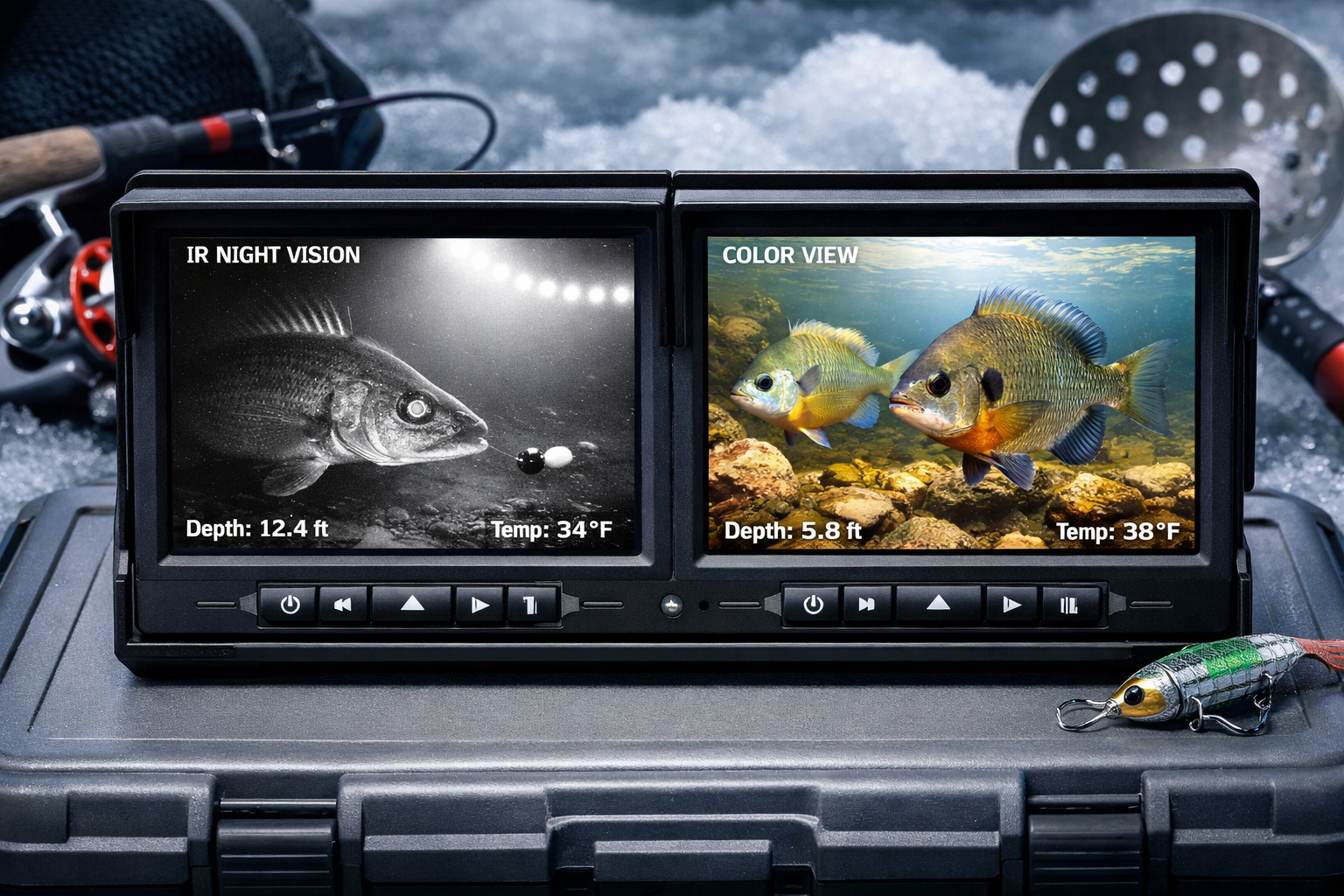
- White LED floodlights project visible light into the water column, restoring color and detail. They work well in clear water under 15 feet. The trade-off: visible light creates backscatter in murky water and draws attention from baitfish and panfish.
- Infrared (IR) night vision emits light outside the visible spectrum for fish. The camera sensor picks up the reflected IR light and produces a black-and-white image. Fish behave naturally because they do not detect the illumination.
Choose IR if you fish stained or deep water, pressured lakes, or want to observe natural feeding behavior. Choose white LEDs if you fish clear, shallow flats and want color detail for species identification.
How Do IR Night Vision and White Floodlights Compare for Early Morning and Late Afternoon Sessions?
IR night vision wins for stealth. White floodlights win for color. The table below breaks down the practical differences.
| Feature | IR Night Vision | White LED Floodlight |
|---|---|---|
| Image output | Black and white | Full color |
| Fish disturbance | Minimal to none | Moderate to high |
| Best water clarity | Murky to moderate | Clear to moderate |
| Effective depth | 15 to 60+ feet | 5 to 20 feet |
| Backscatter risk | Low | High in murky water |
| Baitfish attraction | None | Yes |
| Best time of day | Pre-dawn, post-sunset, deep midday | Dawn, dusk with some ambient light |
| Price range (camera) | $80 to $400 | $60 to $300 |
For early morning sessions starting before sunrise, IR gives you usable footage immediately. White LEDs become practical once ambient light starts filtering into the water column, typically 20 to 30 minutes after first light in clear water. During late afternoon, you will want to switch from white LEDs to IR as the sun drops below the treeline.
Dual-mode cameras eliminate the guesswork. The FishPRO 1080P model released in 2026 features both IR and white LED arrays with a physical switch, so you adapt in seconds as light conditions change.
Common mistake: Running white LEDs in murky water during low light. The particles in the water reflect the light back at the camera lens, washing out your image. Switch to IR and the backscatter disappears.
What Camera Features Should You Prioritize for Low-Light Fishing?
Focus on five features when shopping for a low-light underwater fishing camera.
1. LED count and type. Cameras with 12 far-IR LEDs outperform models with 6 or 8 standard LEDs for piercing dark water. The Eyoyo and MOOCOR lines use 12-LED arrays that perform well during dawn and dusk ice fishing sessions.
2. Manual focus. The 2026 FishPRO introduced manual focus adjustable from 2 to 18 inches. This matters in low light because autofocus systems hunt and blur when contrast drops. Manual focus locks your image sharp on the zone you care about.
3. Battery capacity. A 10,000mAh battery, like the one in the FishPRO 2026 upgrade, supports extended late-afternoon sessions without dying at the worst moment. Keep a backup battery in an insulated pocket during cold weather. Expect roughly 30% less runtime below 50 degrees F.
4. Screen quality. An IPS display with high brightness matters when you are viewing footage in changing ambient light. A 7-inch IPS screen gives you enough size to read details from your seat in a kayak or next to your ice hole.
5. Cable length. The FishPRO 2026 ships with 82 feet of cable, enough for deep structure work in reservoirs or through thick ice. Shorter cables (30 to 50 feet) work for shallow flats and inshore kayak fishing.
For a broader comparison of IR camera performance in murky water, check out the Eyoyo vs FishPRO vs FourQ head-to-head test.
How Do You Set Up an Underwater Camera for Early Morning Ice Fishing?
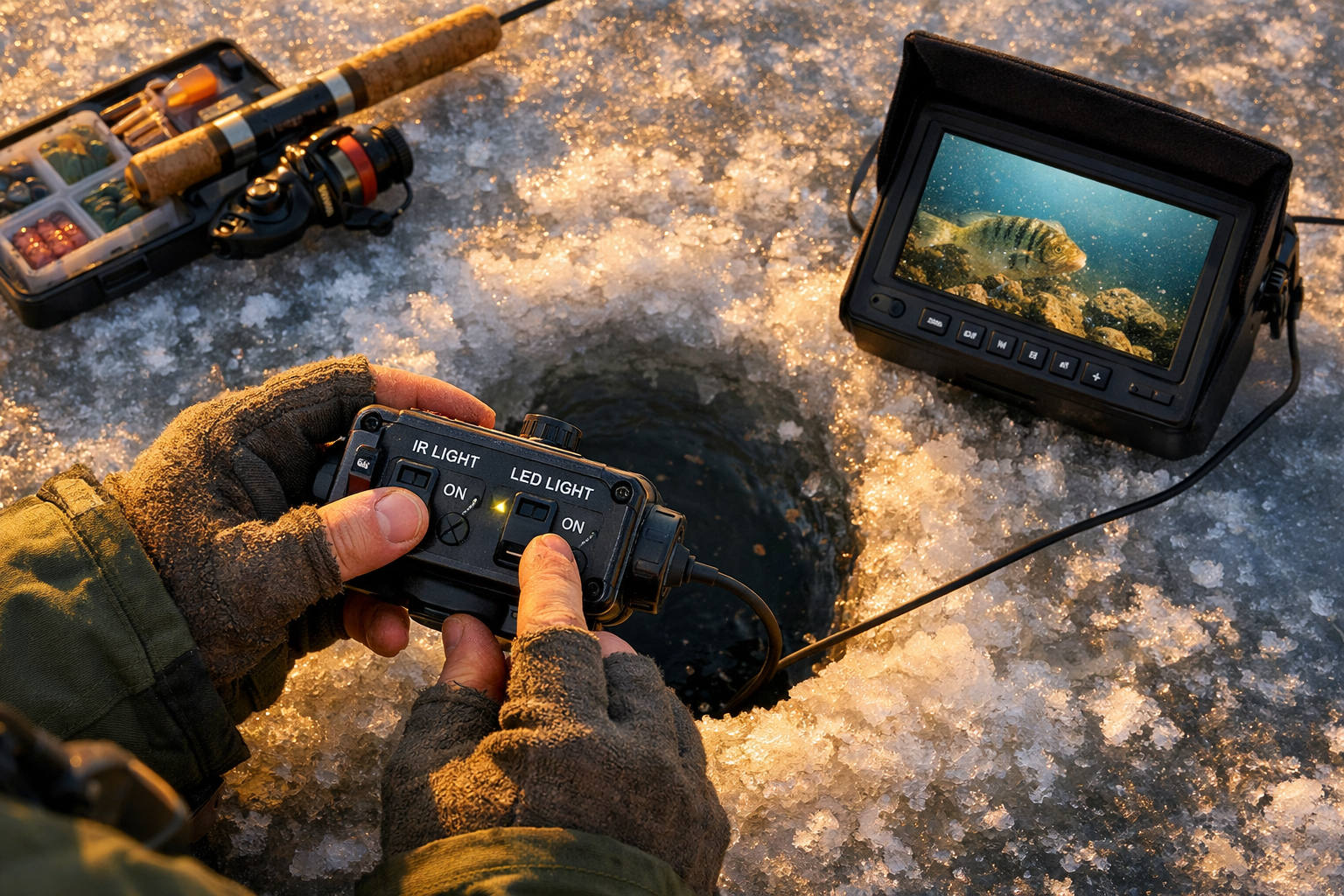
Deploy your camera before first light to catch the earliest feeding activity. Follow these steps:
- Drill your hole and clear slush. A clean hole prevents ice chips from floating in front of the lens.
- Power on the camera in IR mode. Pre-dawn conditions have zero usable ambient light underwater. Start with IR.
- Lower the camera to your target depth slowly. Fast drops create bubbles that cloud the image for 30 to 60 seconds.
- Set manual focus to match your jig distance. If your lure sits 8 inches from the camera, set focus to 8 inches.
- Angle the camera slightly downward (10 to 15 degrees). This captures both approaching fish and your lure presentation.
- Switch to white LEDs after sunrise if water clarity allows. You will see color return to the image as ambient light increases.
- Monitor battery level every hour. Cold temperatures drain power faster than you expect.
For wireless camera setups that simplify this process, read the wireless underwater camera setup guide for ice fishing.
Edge case: If you fish a shelter with interior lights, turn them off or cover the hole. Light leaking through the ice hole creates a bright spot that washes out your camera image and draws panfish directly to the hole rather than your presentation.
What About Low-Light Camera Strategies for Saltwater Kayak Fishing?
Kayak anglers face a different set of challenges. You are mobile, space is limited, and saltwater conditions add corrosion risk.
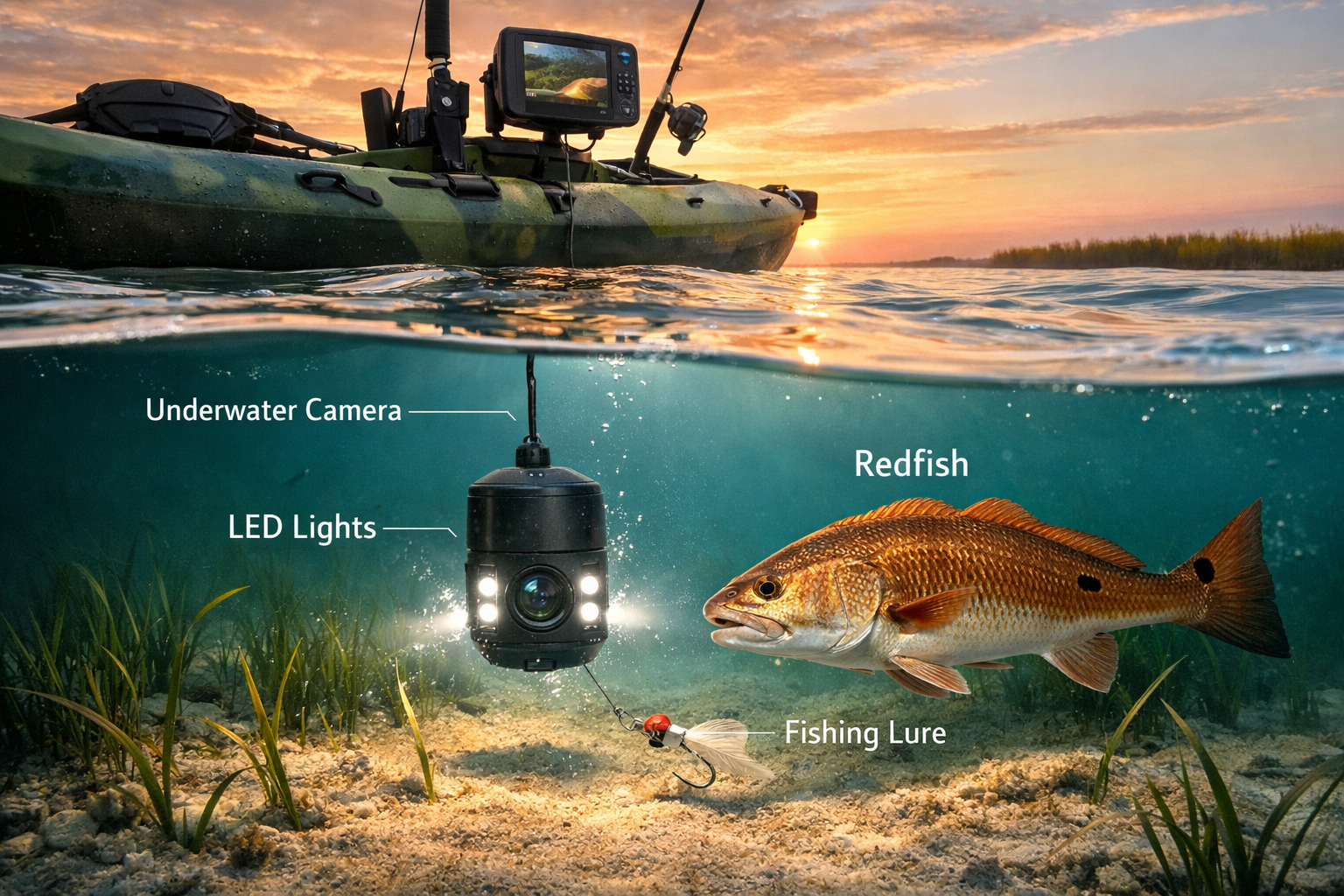
For inshore saltwater kayak sessions during early morning or late afternoon, mount a compact underwater camera with a short cable (30 to 50 feet) and run white LEDs in the clear flats. Switch to IR when working deeper channels, dock pilings, or stained water near river mouths.
Practical tips for kayak deployment:
- Secure the camera cable to a cleat or rod holder to prevent tangles with your paddle.
- Use a camera with a weighted housing so current does not push the lens off target.
- Store the monitor in a waterproof case or mount it to a RAM ball for hands-free viewing.
- Run IR mode near structure where predators hold. White light near docks attracts baitfish, which changes fish positioning and behavior.
If you are rigging your kayak for the first time, the inshore saltwater fishing kayak setup guide covers mounting options and cable management in detail. For broader kayak rigging principles, see how to rig a kayak for saltwater fishing.
Should You Use a Camera or a Flasher for Low-Light Conditions?
Both tools serve different purposes. A flasher or sonar unit reads depth, bottom hardness, and fish presence in real time. A camera shows you species, size, behavior, and how fish react to your lure.
Choose a camera when:
- You need to identify species before committing to a spot.
- You want to watch how fish respond to jigging cadence changes.
- Water depth is under 60 feet and you have enough light (natural or artificial) for a usable image.
Choose a flasher when:
- You need fast depth readings while hole-hopping.
- Water is too murky for any camera to produce a clear image.
- You want minimal gear weight for mobile fishing.
Use both when:
- You are fishing a tournament and need every edge.
- You are targeting specific species in a mixed fishery.
- You are sitting on a known spot and have time to deploy both.
The Vexilar FS800IR Fish Scout combines a flasher with an IR camera in one unit, which reduces gear clutter for anglers who want both capabilities.
What Are the Best Budget Cameras With Floodlight and Night Vision for 2026?
You do not need to spend $400 or more to get usable low-light performance. Several cameras under $300 deliver solid IR and LED capability for dawn and dusk fishing.
Top budget picks:
- FishPRO 1080P MF (2026): 7-inch IPS screen, switchable IR and white LED, manual focus, 82-foot cable, 10,000mAh battery. Street price around $180 to $220.
- Eyoyo 7-inch IR camera: 12 far-IR LEDs, 1000TVL resolution, 30-meter cable. Strong murky water performance. Typically $90 to $130.
- MOOCOR 7-inch underwater camera: 12 IR LEDs, sun visor on monitor, 30-meter cable. Budget-friendly at $80 to $120.
For a full breakdown of budget options tested in 2026, see the best wireless underwater cameras under $300 for ice fishing.
Decision rule: If you fish primarily in murky water or deep ice, prioritize IR LED count (12 LEDs minimum). If you fish clear saltwater flats, prioritize color quality and screen brightness.
How Do You Avoid Common Mistakes With Low-Light Underwater Cameras?
Mistake 1: Leaving white LEDs on in murky water. Backscatter ruins your image. Switch to IR.
Mistake 2: Ignoring battery temperature. Cold weather kills battery life. Keep spare batteries warm inside your jacket or shelter. A 10,000mAh battery rated for 6 hours at room temperature delivers closer to 4 hours at 20 degrees F.
Mistake 3: Deploying the camera too fast. Bubbles from a fast drop cloud the lens area. Lower the camera at a steady pace, roughly one foot per second.
Mistake 4: Pointing the camera straight down. A slight angle (10 to 15 degrees off vertical) captures approaching fish and gives you a wider field of view.
Mistake 5: Using floodlights on pressured fish. In heavily fished lakes, predators associate light with danger. IR keeps your observation invisible.
Mistake 6: Forgetting to clean the lens. Saltwater residue, algae, and mineral deposits build up on the lens housing. Wipe the lens with a soft cloth before every session.
Frequently Asked Questions
Do fish see infrared light from underwater cameras? No. Fish lack the photoreceptors to detect infrared wavelengths. IR light is invisible to freshwater and saltwater species, which is why IR mode does not alter their behavior.
How many IR LEDs do you need for early morning fishing? Twelve far-IR LEDs provide strong coverage in dark or murky water. Cameras with 6 LEDs work in moderate conditions but struggle in heavy stain or deep water.
Will white LED floodlights scare fish away? White light attracts baitfish and small panfish. Predators in pressured water often avoid the lit area. In unpressured water, the baitfish attraction draws predators closer.
How long do batteries last in cold weather? Expect a 25% to 30% reduction in battery life below 50 degrees F. A 10,000mAh battery rated for 6 hours at 70 degrees F will run closer to 4 to 4.5 hours at 25 degrees F.
What cable length do you need for kayak fishing? A 30 to 50 foot cable covers most inshore saltwater and shallow freshwater applications. For deep structure or ice fishing over 40 feet, choose 80 feet or longer.
Are thermal cameras worth the cost for fishing? Thermal cameras (FLIR-type) cost $1,500 or more and struggle with the low thermal contrast found underwater. IR fishing cameras at $100 to $300 deliver better results for the money in fishing applications.
What is the best time to switch from IR to white LEDs? Switch when you see ambient light reaching your target depth on the camera screen. This typically happens 20 to 30 minutes after sunrise in clear water, later in stained water.
Do underwater cameras work in saltwater? Yes, provided the housing is rated for saltwater use. Rinse the camera and cable with fresh water after every saltwater session to prevent corrosion.
What screen size works best for kayak-mounted cameras? A 7-inch screen offers the best balance of visibility and portability. Smaller 4.3-inch screens save space but make species identification harder in low-light footage.
How deep does IR light reach? Most 12-LED IR camera arrays provide usable visibility to 10 to 15 feet from the camera head. Beyond that range, the image darkens. The Aqua-Vu Multi-Vu Pro maintains clarity to approximately 60 feet with its adjustable IR system.
Kayak. Drill. Catch. Repeat. Master your low-light camera setup and you will fish the most productive windows of the day with confidence.
See you on the water.
References
[1] Watch – https://www.youtube.com/watch?v=SnLfnJzKjQo
[2] Watch – https://www.youtube.com/watch?v=VVEAcr6DsAM
[3] Lumitec Vs Lumishore Vs Seavision Best Underwater Fishing Lights Compared 2025 – https://www.drsa.com/blogs/news/lumitec-vs-lumishore-vs-seavision-best-underwater-fishing-lights-compared-2025
[4] Underwater Cameras – https://www.aquavu.com/aqua-vu-shop/underwater-cameras