Last updated: February 21, 2026
Your gas ice auger drilled through hundreds of holes this season. Now the ice is gone, and that two-stroke engine needs proper care before you stash it for months. A thorough gas ice auger off-season storage maintenance checklist prevents carburetor failure, corroded internals, and the frustrating no-start scenario when the first hard freeze arrives next season.
This guide covers every step, from fuel stabilization to blade care, so your auger fires up on the first pull when you need it most. Whether you're a multi-season adventurer transitioning between saltwater kayak fishing and ice or a dedicated hardwater angler, these steps protect your investment and keep you tournament-ready.
Key Takeaways
- Stabilize fuel and run the engine for 5 minutes before storage. Never store a gas auger with untreated fuel.
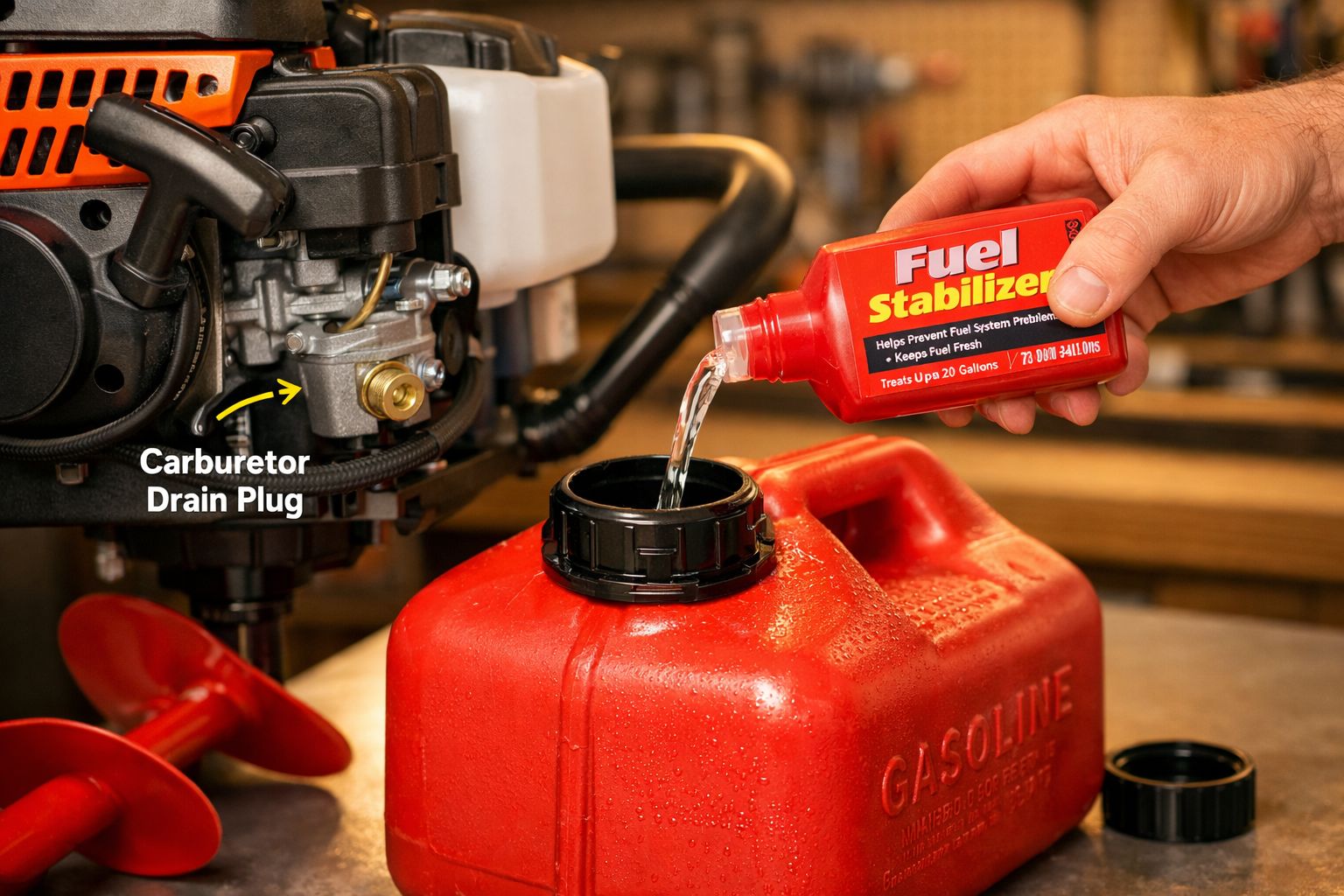
- Drain the carburetor through the drain plug or run the engine dry if you choose dry storage.
- Store the auger vertically (hanging) in a cool, dry location with blade guards installed.
- Run the engine monthly for 5 to 10 minutes during the off-season to prevent internal seals from drying out.
- Schedule a professional tune-up every 3 to 4 years, including fuel system flush and spark plug replacement.
Quick Answer
A gas ice auger off-season storage maintenance checklist should include fuel stabilization, carburetor draining, spark plug inspection, blade sharpening, lubrication of moving parts, and proper vertical storage in a dry space. The entire process takes about 30 to 45 minutes. Performing monthly 5-minute engine runs with stabilized fuel during the off-season is the single most effective step to extend your auger's lifespan.
Why Does Your Gas Ice Auger Need Off-Season Maintenance?
Gas ice augers use two-stroke engines that are sensitive to fuel degradation and moisture. Untreated gasoline begins to break down within 30 days. Ethanol-blended fuels attract moisture, which corrodes fuel lines, gums up carburetors, and damages internal seals. A gas auger stored without preparation for 6 to 8 months will likely develop starting problems or reduced power output.
StrikeMaster Lead Technician Jason Culp recommends hanging gas augers upright in a cool, dry place and performing monthly 5-minute runs with stabilized fuel to extend engine life. Nancy Rowe from Crown Maintenance advises draining carburetors via drain plugs at season end and scheduling professional tune-ups every 3 to 4 years.
The cost of prevention is small. A bottle of fuel stabilizer runs about $8 to $12. A new carburetor costs $40 to $100 plus labor. The math is straightforward.
Common problems from skipping off-season maintenance:
- Clogged carburetor jets from varnished fuel
- Dried-out gaskets and seals
- Corroded fuel lines
- Dull blades that bind in ice
- Stuck recoil starter mechanisms
- Failed spark plugs
What Is the Complete Gas Ice Auger Off-Season Storage Maintenance Checklist?
Here is the full checklist, broken into categories. Complete each step before storing your auger for the warm months.
Fuel System
- Add fuel stabilizer to the tank at the manufacturer-recommended ratio.
- Run the engine for 5 minutes to circulate stabilized fuel through the entire system.
- Decide between wet storage (keeping stabilized fuel in the tank) or dry storage (draining all fuel). RAZR guidelines prefer wet storage with monthly runs over dry storage to avoid carburetor drying.
- If choosing dry storage, drain the carburetor through the drain plug or run the engine until it dies.
- Use 91 octane premium gasoline with the correct 2-stroke oil mix ratio specified by your manufacturer.
Engine and Spark Plug
- Remove the spark plug and inspect the electrode for wear, carbon buildup, or damage.
- Clean the spark plug with a wire brush or replace it if the gap is out of spec.
- Apply a small amount of fogging oil into the cylinder through the spark plug hole.
- Pull the starter cord 2 to 3 times slowly to distribute fogging oil across cylinder walls.
- Reinstall the spark plug (finger-tight plus a quarter turn with a wrench).
Air Filter and Intake
- Remove the air filter and clean or replace it.
- Inspect the intake for debris, dirt, or insect nests.
- Wipe down the air filter housing with a clean rag.
Blades and Cutting Head
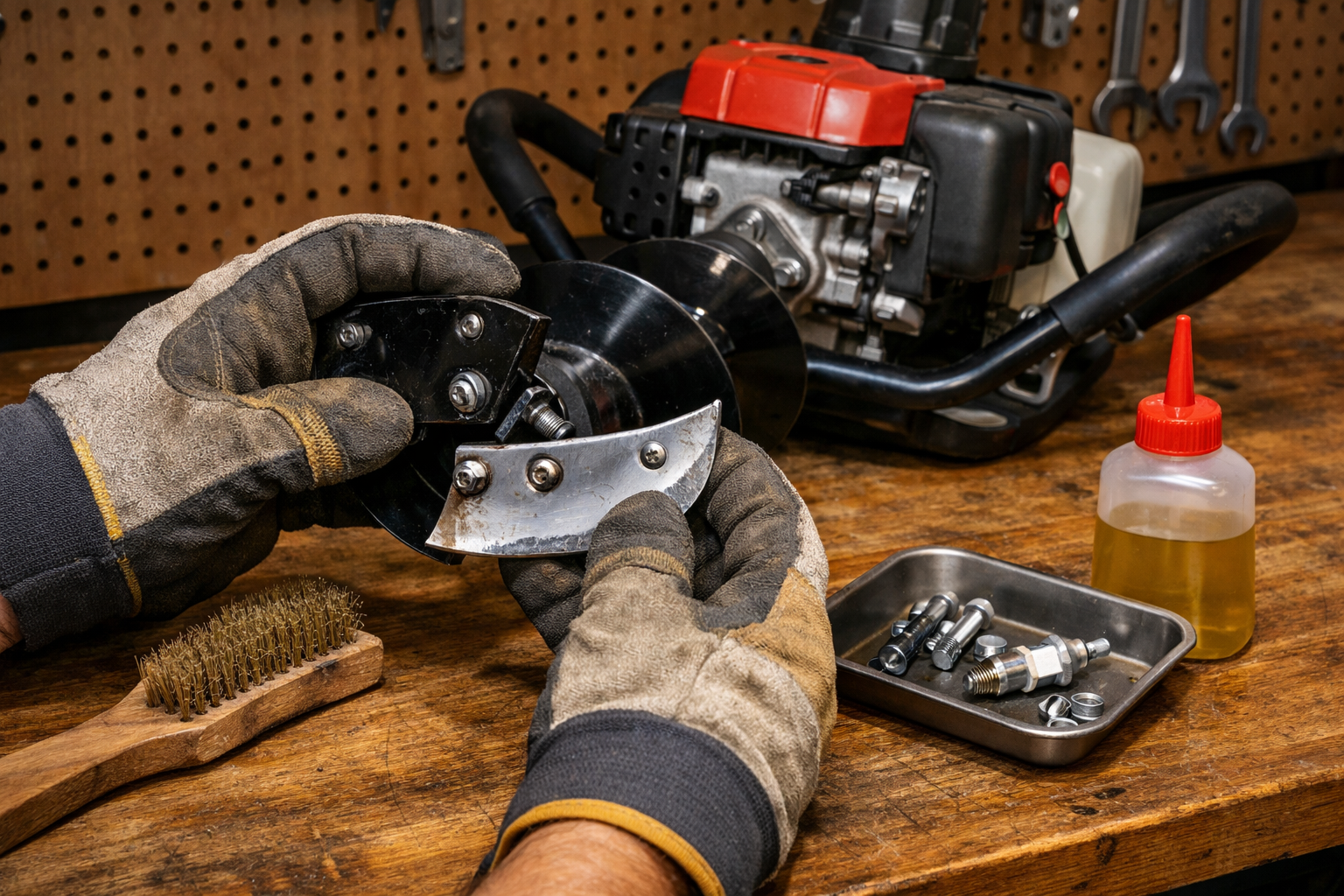
- Remove the blades and inspect for chips, dull edges, or bent tips.
- Sharpen blades with a flat file or send them out for professional sharpening.
- Apply a thin coat of light machine oil to blade surfaces to prevent rust.
- Reinstall blades or store them separately in blade guards.
- Inspect the cutting head for cracks, loose bolts, or stripped threads.
Exterior and Hardware
- Clean the entire auger body with warm soapy water. Remove all ice fishing residue, salt, and grime.
- Dry the auger thoroughly. Moisture left on metal surfaces causes rust.
- Apply a light coat of corrosion-inhibiting spray (WD-40 or similar) to all exposed metal.
- Inspect the flighting (spiral) for dents or bends.
- Check all bolts, nuts, and fasteners for tightness.
- Lubricate the gearbox if your model has a grease fitting.
Recoil Starter
- Pull the starter cord fully and inspect for fraying or wear.
- Clean the recoil housing of debris.
- Apply a drop of light oil to the recoil spring mechanism.
Storage
- Hang the auger vertically from a wall bracket or ceiling hook.
- Install blade guards.
- Store in a cool, dry location away from direct sunlight.
- Keep away from fertilizers, pool chemicals, or other corrosive substances.
How Should You Handle Fuel for Off-Season Storage?
Fuel management is the most important part of your gas ice auger off-season storage maintenance checklist. You have two approaches: wet storage or dry storage. Each has trade-offs.
Wet Storage (Recommended)
Keep about a quarter tank of stabilized fuel in the auger. Run the engine monthly for 5 to 10 minutes. This keeps seals lubricated, prevents carburetor components from drying out, and circulates oil through the engine.
Choose wet storage if:
- You have garage or shed access for monthly runs
- Your auger will be stored less than 8 months
- You want the least risk of carburetor issues
Dry Storage
Drain all fuel from the tank and carburetor. Run the engine until it dies to burn off residual fuel. This eliminates fuel degradation risk but leaves internal components unlubricated.
Choose dry storage if:
- You store the auger in a location where running the engine is not possible
- Storage will exceed 8 months
- You plan to do a full pre-season tune-up before first use
| Factor | Wet Storage | Dry Storage |
|---|---|---|
| Carburetor protection | Better (seals stay lubricated) | Risk of dried gaskets |
| Monthly effort | 5 to 10 minute engine run | None |
| Fuel degradation risk | Low with stabilizer | None (no fuel present) |
| Pre-season prep needed | Minimal | Full fuel system check |
| Best for storage under 8 months | Yes | No |
| Best for storage over 8 months | With fresh stabilizer top-off | Yes |
Common mistake: Adding stabilizer but not running the engine afterward. The stabilizer must circulate through the carburetor and fuel lines to protect them. Pour the stabilizer in, then run the engine for at least 5 minutes.
Always use 91 octane premium gasoline with the proper 2-stroke oil mix ratio. Lower octane fuels and incorrect oil ratios accelerate carbon buildup and increase the chance of engine damage.
For more guidance on maintaining your gear between seasons, check out the FishOnYak blog for additional multi-season fishing equipment tips.
How Do You Properly Store a Gas Ice Auger During the Off-Season?
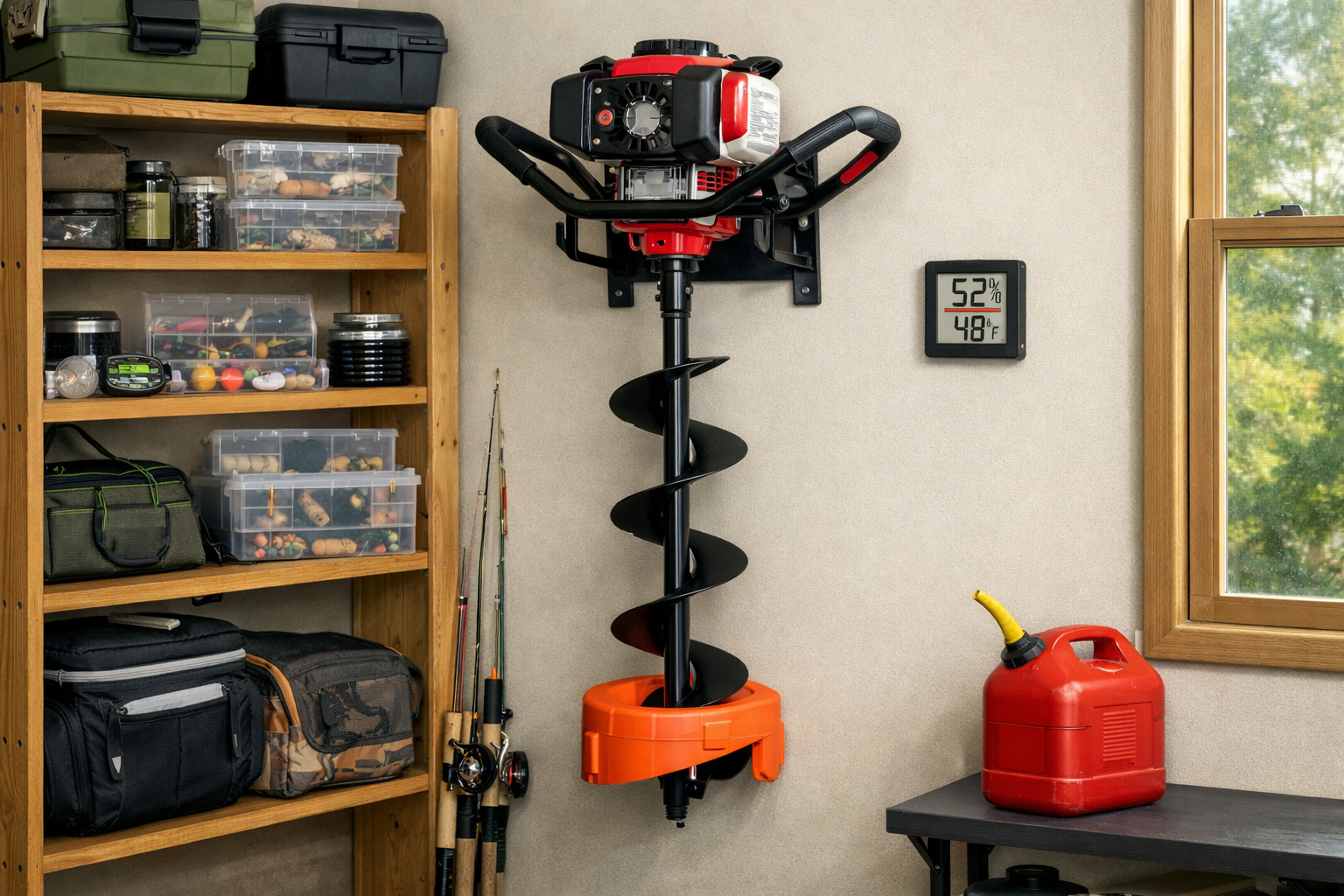
Store your gas ice auger vertically. Hang it from a wall-mounted bracket or ceiling hook with the blades pointing down and blade guards installed. Vertical storage prevents fuel and oil from pooling in areas where they cause seal damage or leaks.
Storage environment requirements:
- Cool temperature (ideally 40 to 70 degrees Fahrenheit)
- Low humidity
- No direct sunlight exposure
- Away from corrosive chemicals
- Protected from dust and debris (a breathable cover works well)
Do not store the auger on a concrete floor. Concrete sweats moisture, and direct contact accelerates rust on metal components. If wall or ceiling mounting is not an option, place the auger on a wooden pallet or shelf.
Edge case: If you store your auger in an unheated shed or detached garage, temperature swings cause condensation inside the fuel tank. This is another reason wet storage with stabilized fuel works better. The stabilizer includes anti-moisture agents that combat condensation.
Keep the auger away from your kayak rigging workspace and saltwater gear. Salt residue from coastal fishing equipment accelerates corrosion on auger components if stored in close proximity.
What Monthly Off-Season Maintenance Should You Perform?
Monthly maintenance during the off-season takes less than 15 minutes and prevents the most common storage-related failures.
Monthly off-season routine:
- Start the engine and run it for 5 to 10 minutes at varying RPMs. Do this outdoors or in a well-ventilated area. Gas augers produce carbon monoxide.
- Check the fuel level. Top off with properly mixed, stabilized fuel if needed.
- Inspect the pull cord for fraying.
- Look for any fuel leaks around the carburetor, fuel lines, and tank cap.
- Wipe down exposed metal surfaces if you notice any moisture or early rust spots.
Why monthly runs matter: Two-stroke engines rely on the fuel-oil mixture to lubricate internal components. When the engine sits idle for months, seals and gaskets dry out, shrink, and crack. Running the engine recirculates oil through the system and keeps everything pliable.
If you skip monthly runs and choose dry storage instead, plan for a more thorough pre-season startup procedure. This includes a full fuel system inspection, fresh spark plug, and a slow break-in period before drilling at full throttle.
For anglers who split their year between ice fishing and saltwater kayak adventures, this monthly check takes minimal time and keeps your equipment ready for the next season. Kayak. Drill. Catch. Repeat.
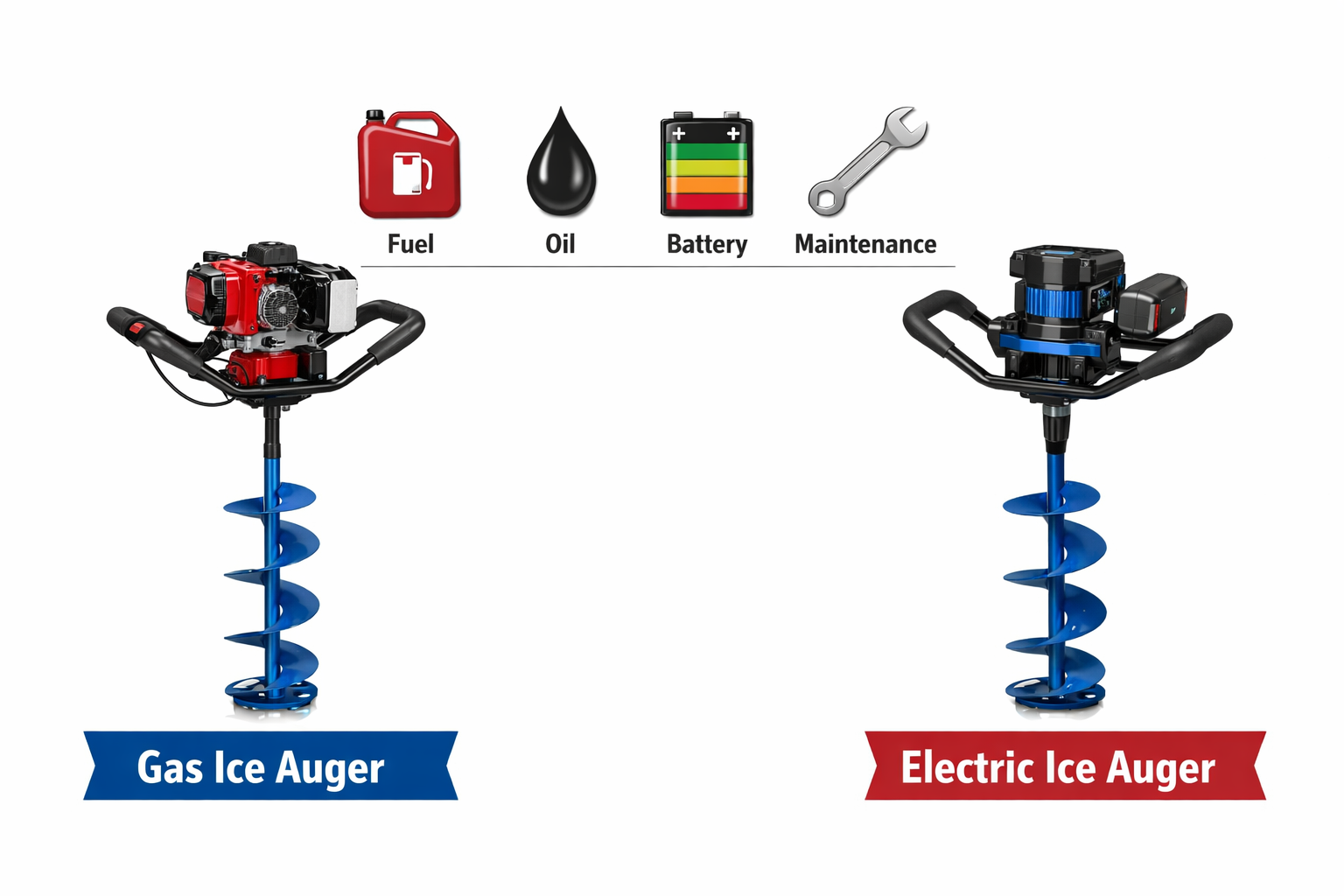
Gas vs. Electric vs. Hand Auger: How Does Off-Season Maintenance Compare?

Understanding how gas auger maintenance stacks up against alternatives helps you decide if the extra effort is worth the performance.
| Maintenance Task | Gas Auger | Electric Auger | Hand Auger |
|---|---|---|---|
| Fuel stabilization | Required | N/A | N/A |
| Monthly engine runs | Recommended (5 to 10 min) | N/A | N/A |
| Battery maintenance | N/A | Monthly charge cycle | N/A |
| Blade care | Sharpen and oil | Sharpen and oil | Sharpen and oil |
| Spark plug service | Every season | N/A | N/A |
| Air filter service | Every season | N/A | N/A |
| Carburetor service | Every 3 to 4 years | N/A | N/A |
| Professional tune-up | Every 3 to 4 years | Rarely needed | Never needed |
| Off-season storage prep time | 30 to 45 minutes | 10 to 15 minutes | 5 minutes |
| Drilling speed (12 inches of ice) | Approximately 45 seconds per hole | Approximately 60 seconds per hole | 3 to 5 minutes per hole |
| Holes per fuel load or charge | 60 to 80 per tank | 40 to 60+ per charge (varies by battery) | Unlimited (manual effort) |
Choose a gas auger if: You drill through thick ice (12 to 30+ inches) regularly, need to cut 60 or more holes per outing, or fish in remote areas where battery charging is not available. The extra maintenance is the trade-off for sustained power and fast drilling.
Choose an electric auger if: You want minimal maintenance, fish in moderate ice thickness, and prefer a lighter, fume-free tool. Monthly battery charging is the only off-season requirement.
Choose a hand auger if: You fish casually, drill fewer than 10 holes per trip, and want zero maintenance obligations.
Gas augers demand more off-season attention than any other type. But for high-volume drilling in thick ice conditions, they remain the most reliable power source. The maintenance checklist exists to protect that reliability.
What Are the Most Common Gas Ice Auger Storage Mistakes?
Knowing what to avoid is as valuable as knowing what to do. These mistakes account for most off-season failures.
1. Storing with untreated fuel. This is the number one cause of carburetor failure. Ethanol-blended gasoline absorbs moisture and forms varnish deposits within 30 days. Always add stabilizer.
2. Laying the auger flat. Horizontal storage causes fuel and oil to leak into areas they shouldn't reach. Hang the auger vertically.
3. Skipping blade maintenance. Dull or rusty blades force the engine to work harder, increasing fuel consumption and wear. A few minutes with a file and oil prevents this.
4. Storing near corrosive chemicals. Fertilizers, pool chlorine, and road salt stored in the same space release fumes that corrode metal components over time.
5. Ignoring the air filter. A clogged air filter restricts airflow and causes the engine to run rich, leading to carbon buildup and poor performance.
6. Never running the engine during storage. Even with stabilized fuel, a 6-month idle period without any engine runs risks dried seals and stuck components.
7. Using the wrong fuel mix. Too much oil fouls the spark plug. Too little oil causes premature engine wear. Follow your manufacturer's exact ratio.
If you're the type of angler who maintains your fishing equipment with the same precision as your kayak rigging, these mistakes are easy to avoid with a structured checklist.
Pre-Season Startup: How to Bring Your Gas Auger Back to Life
When fall temperatures drop and ice season approaches, follow this pre-season procedure before your first outing.
- Remove the auger from storage and inspect all components visually.
- Check the fuel. If you used wet storage, smell the fuel for staleness. Replace if it smells sour or looks dark.
- Remove and inspect the spark plug. Replace if worn or fouled.
- Check the air filter. Clean or replace as needed.
- Inspect fuel lines for cracks, brittleness, or leaks.
- Check the primer bulb for cracks. Replace if it doesn't hold pressure.
- Inspect blades for sharpness. Reinstall with proper torque.
- Fill the tank with fresh 91 octane fuel mixed at the correct 2-stroke ratio.
- Prime the engine and attempt to start. Allow 2 to 3 minutes of warm-up at low RPM before full-throttle operation.
- Test drill a hole in a safe area if possible (or run the engine for 5 to 10 minutes to verify smooth operation).
If the engine won't start after proper storage: Check the spark plug gap, verify fuel flow to the carburetor, and inspect the kill switch. If none of these resolve the issue, the carburetor likely needs cleaning or rebuilding.
For multi-season anglers who move between kayak fishing and ice fishing, building a seasonal transition routine ensures all your gear is ready when conditions change.
Frequently Asked Questions
How long does it take to complete a gas ice auger off-season storage maintenance checklist? Plan for 30 to 45 minutes for the full end-of-season process. Monthly runs during the off-season take 10 to 15 minutes each.
Should I drain all the fuel or leave some in the tank? Wet storage with stabilized fuel is preferred for most anglers. Keep about a quarter tank of stabilized fuel and run the engine monthly. Choose dry storage only if you cannot perform monthly runs.
What type of fuel stabilizer should I use? Use a stabilizer designed for small engines and ethanol-blended fuels. STA-BIL and Sea Foam are two widely available options. Follow the dosage instructions on the bottle.
How often should I replace the spark plug? Inspect the spark plug at the end of every season. Replace it if the electrode is worn, the gap is out of spec, or heavy carbon deposits are present. At minimum, replace the spark plug every 2 to 3 seasons.
Do I need to fog the engine for off-season storage? Fogging oil provides an extra layer of corrosion protection inside the cylinder. Apply it through the spark plug hole before storage. This step is especially valuable if you choose dry storage.
How do I sharpen ice auger blades? Use a flat mill file and maintain the original blade angle. File in one direction only (push strokes, not back and forth). If blades are severely chipped or bent, replace them. Professional sharpening services typically cost $10 to $20 per set.
What is the correct fuel-to-oil ratio for my gas ice auger? This varies by manufacturer. Common ratios include 50:1 and 40:1. Check your owner's manual. RAZR models specify 91 octane premium gasoline with their recommended 2-stroke oil.
How often should I get a professional tune-up? Every 3 to 4 years. A professional tune-up includes a fuel system flush, carburetor cleaning or rebuild, spark plug replacement, and general inspection. Budget $50 to $100 for this service.
Where should I store my gas ice auger? Hang it vertically in a cool, dry, well-ventilated space. A garage, basement, or shed works well. Avoid areas with temperature extremes, high humidity, or chemical fumes.
What happens if I skip off-season maintenance entirely? The most likely outcome is a clogged carburetor and hard starting. Worst case, corroded internals require an engine rebuild or replacement. Prevention costs far less than repair.
Are there any safety concerns with running the engine during storage? Yes. Always run the engine outdoors or in a fully ventilated space. Two-stroke engines produce carbon monoxide, which is odorless and dangerous in enclosed areas. Never run a gas auger inside a closed garage.
Key Takeaways
- A complete gas ice auger off-season storage maintenance checklist covers fuel, engine, blades, hardware, and storage environment.
- Fuel stabilization is the single most important step. Add stabilizer and run the engine for 5 minutes to circulate it.
- Wet storage with monthly engine runs is the preferred method for most anglers.
- Store the auger vertically in a cool, dry location with blade guards installed.
- Inspect and sharpen blades before storage. Apply a thin coat of oil to prevent rust.
- Remove, clean, and inspect the spark plug and air filter at the end of every season.
- Schedule a professional tune-up every 3 to 4 years for fuel system and carburetor service.
- Gas augers require more off-season maintenance than electric or hand augers, but they deliver superior drilling performance in thick ice.
- Monthly 5 to 10 minute engine runs during the off-season prevent dried seals and stuck components.
- A 30 to 45 minute investment at season's end saves hours of troubleshooting and hundreds of dollars in repairs.
Your gas auger is a precision tool that earns its keep on the hardwater. Treat it right during the off-season, and it will fire up clean when the ice calls. For more gear maintenance tips and multi-season fishing strategies, visit the FishOnYak homepage or reach out to the team with your questions.
See you on the water.