Last updated: March 3, 2026
Key Takeaways
- Active anglers who hole-hop need articulated sleeves and zoned insulation to maintain range of motion without freezing.
- Flotation jackets add safety on early and late ice but reduce mobility compared to non-flotation options like the Simms Challenger.
- Zoned insulation (heavier in the core, lighter in the arms) is the best design approach for anglers who move frequently between holes.
- Full suits provide 34% better thermal protection than bibs alone, but bibs work for mild conditions above 10°F.
- Budget options like the Ice Runner ($200) offer flotation and basic warmth, while premium picks like the WindRider Boreas Pro ($450) deliver better waterproofing and a lifetime warranty.
- Layering strategy matters as much as jacket choice. A breathable base layer prevents sweat buildup that causes rapid heat loss.
- Temperature, activity level, and ice conditions should drive your jacket decision, not brand loyalty.
Quick Answer
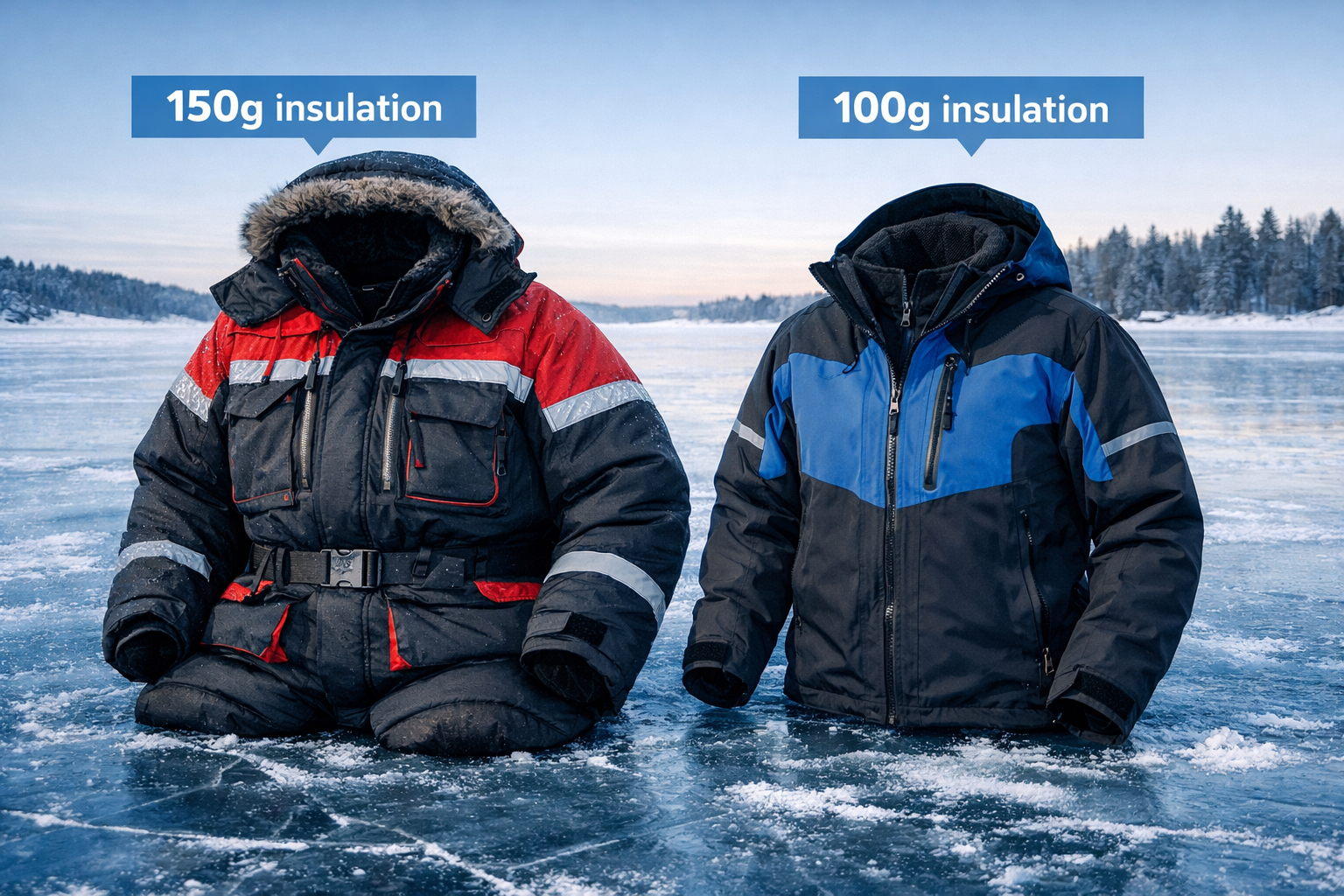
The tension between ice fishing jacket mobility and warmth comes down to insulation weight, jacket construction, and your activity level. If you hole-hop or fish tournaments, choose a jacket with 100g to 150g zoned insulation, articulated sleeves, and at least 10,000mm waterproofing. If you sit in a shanty most of the day, prioritize heavier insulation and worry less about range of motion. Your body generates significant heat when you drill, walk, and reset. That heat becomes your enemy if your jacket traps moisture instead of venting it.
Why Ice Fishing Jacket Mobility vs. Warmth Matters for Active Anglers
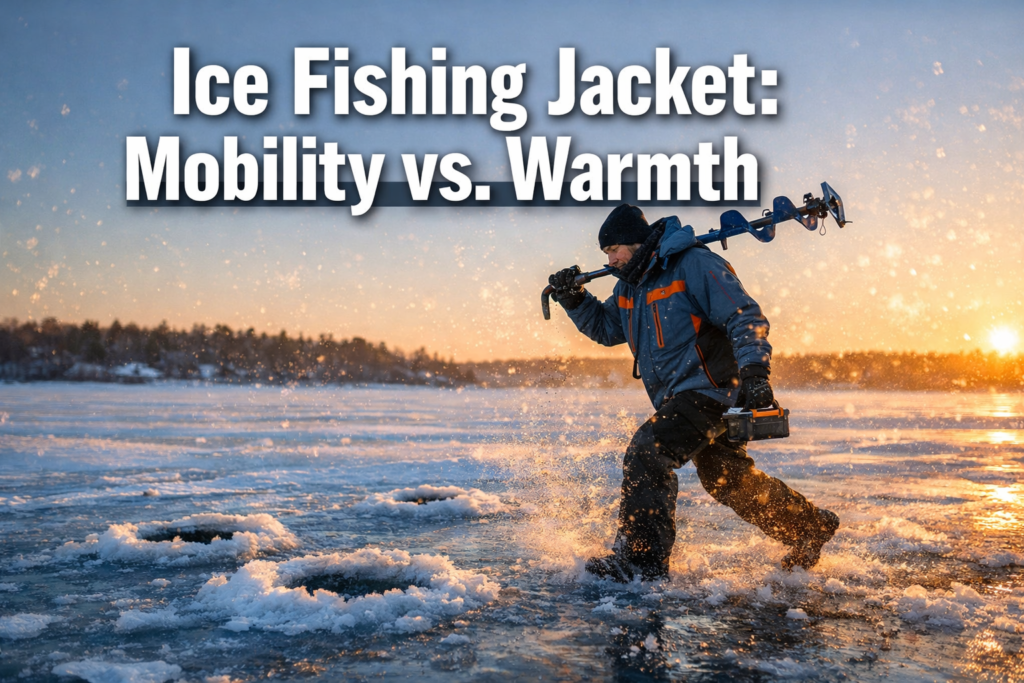
Every angler who has drilled 30 holes in a morning knows the problem. You start cold. You drill and walk. You overheat. You stop moving. You freeze. The cycle repeats.
This is the core tension in ice fishing jacket mobility vs. warmth: finding your sweet spot for active anglers requires understanding how your body responds to shifting activity levels on the ice.
A jacket built for stationary fishing in a heated shelter will restrict your arms when you drill. A lightweight shell that lets you move freely will leave you shivering during a 20-minute dead spell between bites. The goal is to find the jacket that handles both scenarios, or to build a layering system that adapts.
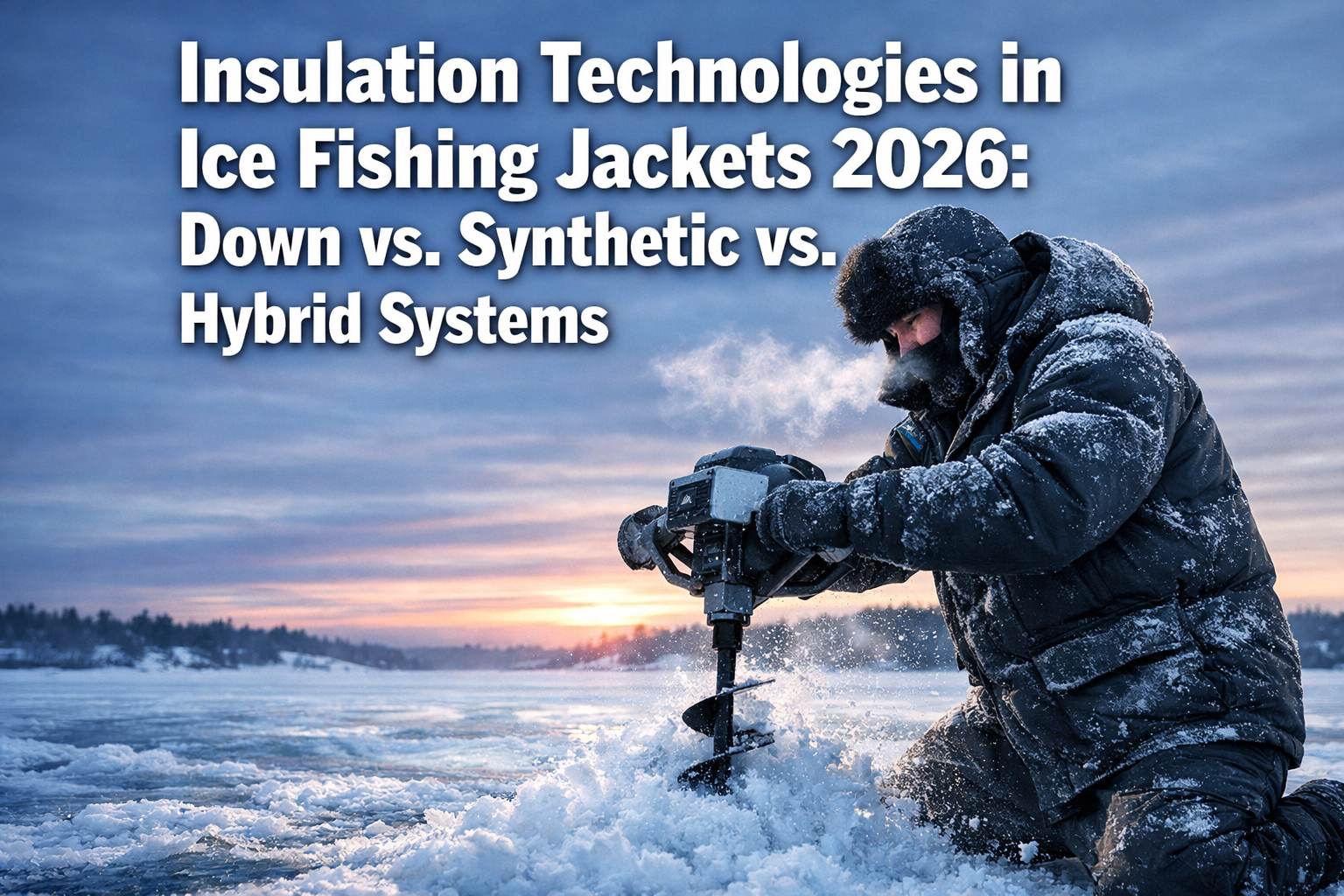
NAIFC competitor Shawn Bjonfald describes this tradeoff when discussing the Norfin Explorer 2. He praises its lightweight design, articulated knees and sleeves, and pocket placement that supports mobile tournament fishing at -5°F without the bulk that slows you down between holes [1].
The right jacket keeps you warm when you stop and lets you work when you move. That balance depends on three factors: insulation type and weight, jacket construction, and breathability.
How Much Insulation Do Active Ice Anglers Need?
For most active anglers, 100g to 150g of synthetic insulation hits the right range. Heavier insulation (200g+) suits stationary fishing. Lighter insulation (under 100g) demands aggressive layering.
Here is how popular options compare:
| Jacket/Suit | Insulation Weight | Waterproofing | Best For | Price Range |
|---|---|---|---|---|
| Striker Climate 3-in-1 | 150g Thermadex | High | Versatile, all conditions | ~$500+ |
| Simms Challenger | 120g PrimaLoft | 20,000mm | Active anglers, sub-zero | ~$400+ |
| WindRider Boreas Pro | 150g core / 100g sleeves | 10,000mm | Hole-hopping, arm mobility | ~$450 |
| Clam IceArmor | 100g | 5,000mm | Budget, mild conditions | ~$549 |
| Ice Runner | 100g polyfill | Basic | Value seekers, flotation | ~$200 |
Sources: [1][2]
The WindRider Boreas Pro uses zoned insulation, placing 150g in the core where you lose the most heat and 100g in the sleeves where you need the most freedom [2][1]. This design philosophy directly addresses the mobility vs. warmth problem.
The Simms Challenger takes a different approach. Testers report 15% better casting range through articulated sleeves and high breathability rated at 20,000mm/15,000 g/m². For anglers who generate body heat through constant movement, that breathability prevents the sweat-then-freeze cycle [1].
Choose 150g insulation if: You fish in temperatures below 0°F or take long breaks between moves. Choose 100g insulation if: You stay active most of the day and layer a quality midlayer underneath.
Flotation vs. Non-Flotation: Does Safety Cost You Mobility?
Flotation suits save lives on early and late ice. They also add bulk. The question is whether that safety tradeoff is worth the reduced range of motion.
Flotation suits like the Striker Sureflote and WindRider Boreas build buoyancy into the jacket and bib panels. This means thicker materials in the torso and legs. For anglers who walk long distances between spots, that extra material creates friction and restricts stride length.
Non-flotation options like the Simms Challenger offer superior range of motion and breathability. Testers consistently rank them higher for active fishing where you generate body heat through drilling, walking, and jigging [1].
Here is a decision framework:
- Early ice (first 4 inches): Wear flotation. The ice is unpredictable. Mobility loss is a reasonable tradeoff for survival.
- Mid-ice (solid, thick ice): Non-flotation jackets give you better performance. Pair with ice picks and a float-assist PFD if you want backup safety.
- Late ice (thaw conditions): Return to flotation. Honeycombed ice fails without warning.
Full flotation suits provide 67% superior safety compared to bibs alone [2]. For tournament anglers who fish aggressive early-ice patterns, flotation is non-negotiable. For mid-season anglers on 18 inches of solid ice, the mobility advantage of a non-flotation jacket makes a measurable difference in how many holes you fish per hour.
Visit the FishOnYak homepage for more tactical angling content built around performance in demanding conditions.
What Jacket Construction Features Improve Mobility?
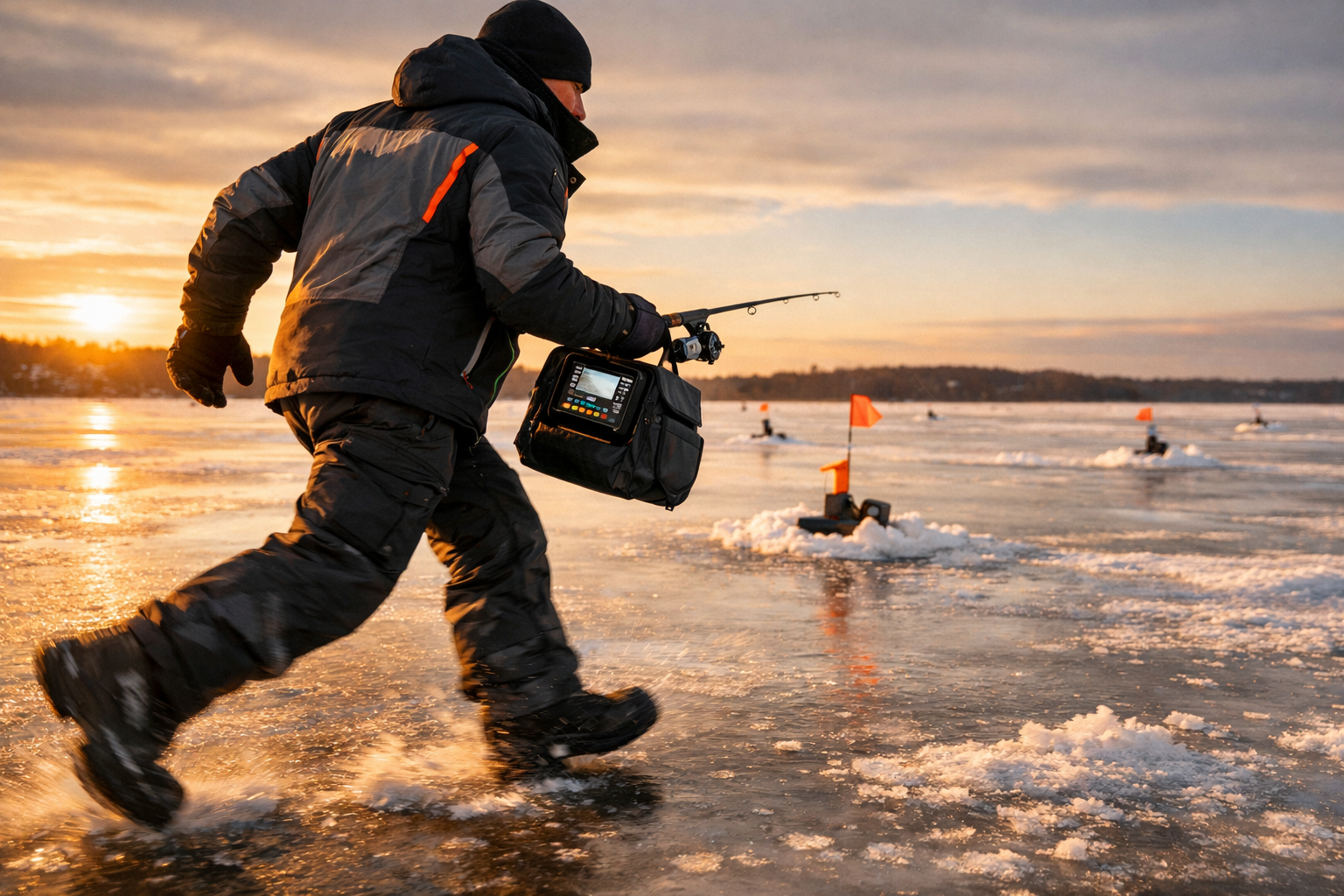
Articulated sleeves, gusseted underarms, and stretch panels are the three construction features that separate a mobile ice fishing jacket from a stiff one.
Articulated sleeves are pre-shaped to match the natural bend of your arm. Instead of fighting against flat fabric when you reach forward to set a hook or drill a hole, the sleeve moves with you. The Simms Challenger and Norfin Explorer 2 both use this design [1].
Gusseted underarms add a diamond-shaped fabric panel where the sleeve meets the torso. This gives you a wider range of motion overhead and to the sides without pulling the jacket up from your waist.
Stretch panels placed in the back, elbows, or sides allow the jacket to flex during dynamic movements. Look for jackets that use 4-way stretch fabric in high-movement zones.
Other features that affect mobility for active anglers:
- Shorter jacket length (hip-length vs. thigh-length) reduces restriction when walking or kneeling
- Adjustable cuffs that seal against wind but release quickly when you need dexterity
- Chest pockets positioned high enough that bib straps do not block access
- Hood designs that turn with your head instead of staying fixed
Shawn Bjonfald specifically calls out pocket placement on the Norfin Explorer 2 as a factor in tournament performance. When you need to grab a jig, check your Vexilar, or swap baits, fumbling through poorly placed pockets costs time and exposes your hands to cold [1].
How Does Layering Change the Mobility vs. Warmth Equation?
A smart layering system lets you buy a more mobile jacket and add warmth underneath. This gives you flexibility that a single heavy jacket does not.
The three-layer system for active ice fishing:
Base layer: Moisture-wicking synthetic or merino wool. This layer pulls sweat away from your skin. Cotton kills warmth. Avoid it completely. Choose a snug fit that does not bunch under your midlayer.
Midlayer: Fleece or synthetic puffy (100g to 200g depending on temperature). This traps body heat. For active anglers, a lighter midlayer (100g fleece) paired with a 150g insulated jacket provides enough warmth down to about -10°F during moderate activity.
Outer layer: Your ice fishing jacket. This blocks wind, repels water, and provides the final insulation layer.
The advantage of this approach: you remove the midlayer when you overheat during a drilling session, then add it back when you sit down to jig. A single heavy jacket does not offer that flexibility.
Common mistake: Wearing too many layers from the start. You begin the day cold, so you overdress. Within 30 minutes of drilling, you sweat through your base layer. That moisture then chills you for the rest of the day. Start slightly cool. Your activity will warm you up. Add layers during rest periods.
For anglers who transition between saltwater kayak fishing and ice environments, the layering principle stays the same. Manage moisture first. Add insulation second.
Ice Fishing Jacket Mobility vs. Warmth: Finding Your Sweet Spot by Temperature Range
Different temperatures demand different strategies. Here is a breakdown based on real-world conditions.
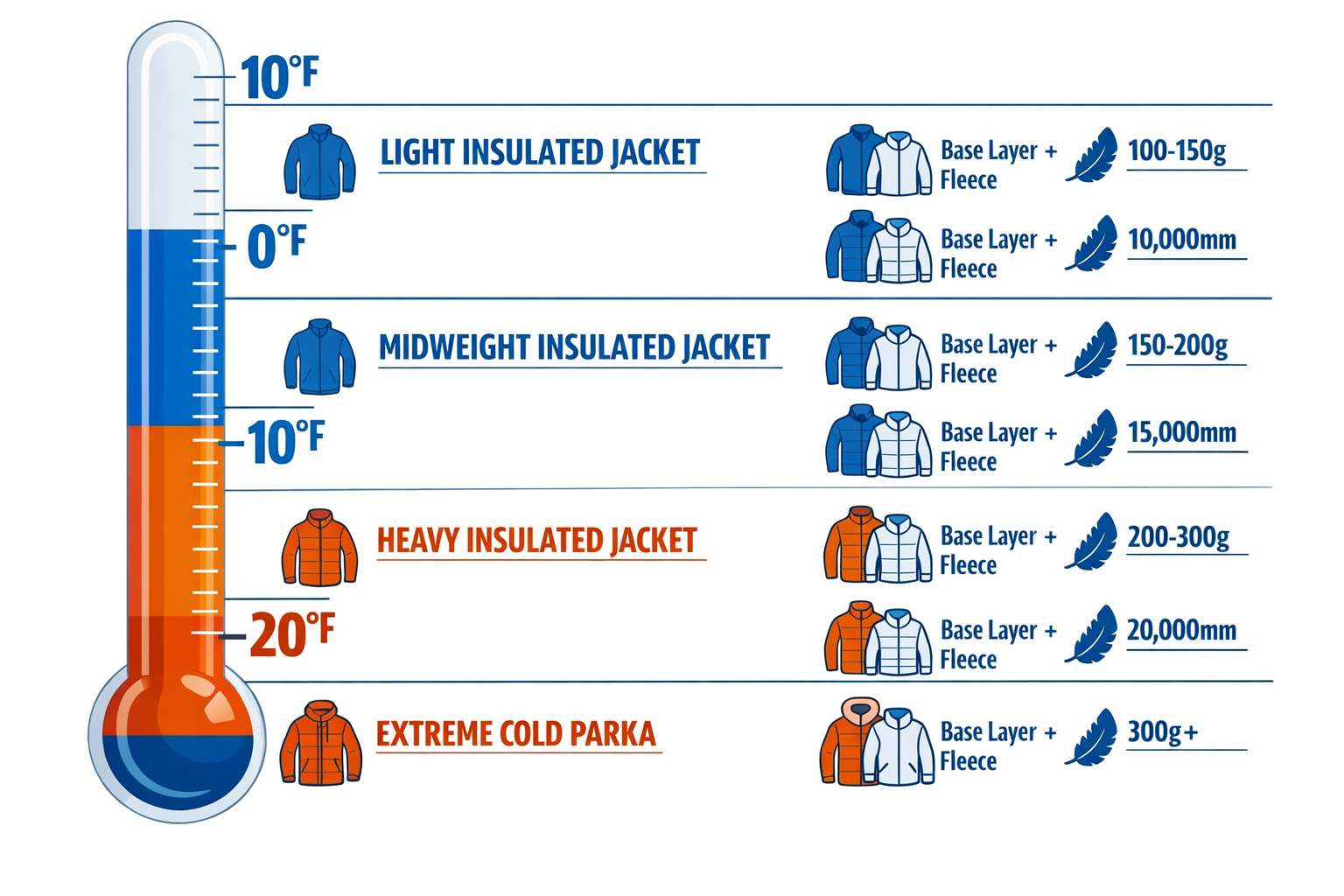
Above 20°F (mild ice fishing days): Wear a lightweight shell or softshell jacket with 100g insulation. Prioritize breathability and mobility. You will generate enough body heat through activity to stay comfortable. A single midlayer fleece handles the rest. Bibs alone work for lower-body coverage in these conditions [2].
10°F to 20°F (standard conditions): This is where zoned insulation jackets like the WindRider Boreas Pro perform best. The 150g core insulation keeps your torso warm while 100g sleeves maintain arm freedom [2][1]. Add a medium-weight base layer.
0°F to 10°F (cold but manageable): Step up to a full suit with 150g insulation throughout. The Striker Climate 3-in-1 system lets you add or remove the inner liner based on activity level [1]. Wear a heavier midlayer. Protect your extremities with quality gloves and boot systems.
Below 0°F (extreme cold): Prioritize warmth over mobility. Suits rated for -20°F with 200g+ insulation become necessary. Accept reduced range of motion. Plan shorter sessions with warming breaks. The Norfin Explorer 2 handles -5°F while maintaining better mobility than most competitors at this temperature [1].
Below -20°F: Stay home or fish from a heated shelter. No jacket solves the mobility vs. warmth problem at these temperatures for extended outdoor exposure.
Check the FishOnYak blog for more seasonal gear recommendations across fishing disciplines.
Budget vs. Premium: What Do You Get for the Extra Money?
The Ice Runner at $200 and the Striker Predator at $549 both keep you warm on the ice. The difference shows up in durability, waterproofing, and long-term value.
Budget option (Ice Runner, ~$200):
- 100g polyfill insulation
- Basic flotation capability
- Fewer pockets and adjustment points
- Adequate for anglers fishing 10 to 15 days per season
- Requires more aggressive layering in extreme cold [1]
Mid-range option (WindRider Boreas Pro, ~$450):
- 150g core / 100g sleeve zoned insulation
- 10,000mm waterproofing
- Lifetime warranty
- Built for 30+ days per season
- Best value for active anglers who fish regularly [2][1]
Premium option (Striker Climate, ~$500+):
- 150g Thermadex insulation
- 3-in-1 system with removable liner
- Full flotation certification
- Tournament-grade construction
- Built for daily use across a full season [1]
Decision rule: If you fish fewer than 10 days per season, a budget jacket with good layering works fine. If you fish 15+ days or compete in tournaments, invest in the mid-range or premium tier. The waterproofing, breathability, and warranty pay for themselves over two to three seasons of hard use.
The Clam IceArmor sits at $549 with only 100g insulation and 5,000mm waterproofing. Compare that to the WindRider Boreas Pro at $450 with 150g insulation and 10,000mm waterproofing plus a lifetime warranty. Price does not always indicate performance. Read the specs [1][2].
Common Mistakes When Choosing an Ice Fishing Jacket
Buying based on temperature rating alone. Manufacturer temperature ratings assume you are stationary. Active anglers generate 2 to 3 times more body heat than someone sitting in a shelter. A jacket rated to -30°F will overheat you during a drilling session at 10°F.
Ignoring breathability. A jacket with 5,000mm waterproofing and low breathability traps sweat inside. That moisture drops your core temperature faster than cold air alone. Look for breathability ratings of 10,000 g/m² or higher for active use.
Choosing the wrong size. Buy your jacket with room for one midlayer underneath. Too tight restricts blood flow and movement. Too loose creates air gaps that reduce insulation efficiency and catch wind.
Skipping the bib. Your jacket handles the top half. Without proper lower-body protection, cold creeps up from your legs and core temperature drops. Full suits outperform jacket-only setups by a significant margin in thermal protection [2].
Forgetting about wind. A 10 mph wind at 15°F creates a wind chill of about 0°F. Your jacket's wind resistance matters as much as its insulation weight. Check for sealed seams, storm flaps over zippers, and adjustable hems that lock out drafts.
For multi-season adventurers who move between different fishing environments, building a modular gear system prevents these mistakes.
Conclusion
The ice fishing jacket mobility vs. warmth debate has a clear answer for active anglers: choose zoned insulation, articulated construction, and a breathable shell, then build your warmth through layering. A 150g core with 100g sleeves handles the widest range of conditions for hole-hopping anglers. Add flotation for early and late ice. Drop to a lighter, more mobile non-flotation jacket during mid-season on solid ice.
Match your jacket to your activity level, not the coldest temperature on the forecast. Start with a quality base layer. Add a removable midlayer for flexibility. Choose a jacket with at least 10,000mm waterproofing and high breathability.
Kayak. Drill. Catch. Repeat.
See you on the water.
FAQ
What insulation weight is best for hole-hopping anglers? Between 100g and 150g of synthetic insulation. Zoned designs with heavier core insulation and lighter sleeve insulation give the best balance of warmth and arm mobility [2][1].
Do I need a flotation jacket for ice fishing? On early ice (under 4 inches) and late ice (thaw conditions), yes. Flotation suits provide 67% better safety than bibs alone [2]. On solid mid-season ice, non-flotation jackets offer better mobility.
How do I prevent overheating while drilling holes? Start your day dressed slightly cool. Use a layering system with a removable midlayer. Open pit zips and vents during high-activity periods. Choose a jacket with breathability rated at 10,000 g/m² or higher.
Is a full suit better than a jacket and bibs? Full suits deliver 34% better thermal protection than bibs alone [2]. For temperatures below 10°F or sessions longer than 4 hours, full suits perform better. Bibs work for mild days and short trips.
What waterproof rating do I need for ice fishing? A minimum of 10,000mm for active anglers. Budget jackets at 5,000mm will wet out when you kneel on slushy ice or handle wet fish. Higher ratings (20,000mm like the Simms Challenger) handle the worst conditions [1].
How much should I spend on an ice fishing jacket? Budget anglers fishing under 10 days per season do fine with the Ice Runner at $200. Regular anglers benefit from the WindRider Boreas Pro at $450 for its warranty and performance. Tournament anglers should invest $500+ in systems like the Striker Climate [1][2].
What is the best ice fishing jacket for tournaments? The Norfin Explorer 2 and Striker Climate both perform well in tournament settings. The Norfin's articulated design and pocket placement support fast-paced, mobile fishing [1].
Does jacket color matter for ice fishing? Bright colors (orange, yellow) improve visibility for safety on the ice, especially in low-light conditions. Dark colors absorb more solar heat but are harder to spot in emergencies.
How do I care for my ice fishing jacket to maintain waterproofing? Wash with a DWR-safe detergent. Tumble dry on low heat to reactivate the durable water repellent coating. Avoid fabric softeners. Reapply DWR spray every 20 to 30 wash cycles.
When should I replace my ice fishing jacket? When the waterproofing no longer repels water after DWR treatment, when insulation compresses and no longer lofts, or when seam tape peels. Budget jackets last 2 to 3 seasons of heavy use. Premium jackets with lifetime warranties (like WindRider) get repaired or replaced by the manufacturer [2].
References
[1] Best Ice Fishing Suits – https://www.outdoorlife.com/gear/best-ice-fishing-suits/ [2] Ice Fishing Float Suit Comparison – https://windrider.com/blogs/tips-and-tricks/ice-fishing-float-suit-comparison [3] Top New Gear For Your 2025 26 Ice Angling Campaign – https://www.outdoornews.com/2025/11/01/top-new-gear-for-your-2025-26-ice-angling-campaign/ [4] New Products For February 2026 – https://igfa.org/2026/02/12/new-products-for-february-2026/ [5] The 7 Best Ice Fishing Coats Review – https://www.bwfishingclothing.com/the-7-best-ice-fishing-coats-review/