Last updated: February 22, 2026
Early 2026 ice reports across the northern United States show thickness readings swinging between 8 and 12 inches on many popular fishing lakes, with slush hazards complicating travel decisions. Understanding safe ice travel in variable conditions, and knowing when to walk vs. drive on early-season ice, separates a productive day on the hardwater from a life-threatening mistake. A major winter storm in late January 2026 dumped heavy snow and sleet across multiple regions, creating uneven ice formation patterns that persist into late February. This guide breaks down the decision-making process for anglers who want to fish hard and get home safe.
Key Takeaways
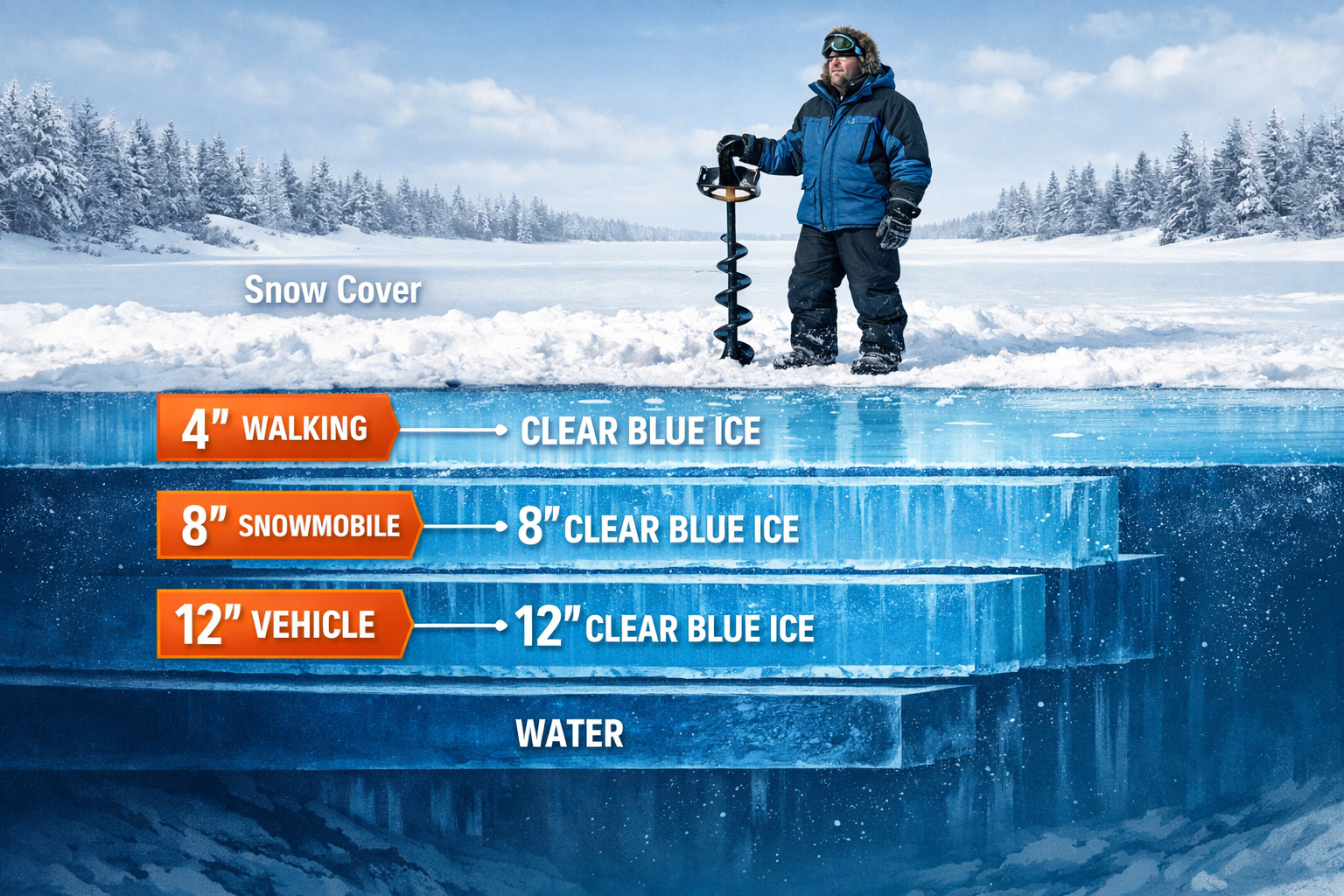
- Walk on a minimum of 4 inches of clear, solid ice. Drive a full-size vehicle on a minimum of 12 to 15 inches.
- Early-season ice varies in thickness across the same lake due to currents, springs, and snow insulation. Spot-checking with an auger does not guarantee uniform safety.
- Walking gives you the widest margin of error. Driving demands 2 to 3 times the ice thickness and carries higher consequences if the ice fails.
- Slush layers, pressure ridges, and creek inlets are the most common hazards in variable conditions during the 2026 season.
- Local bait shops, fishing clubs, and outfitters provide the most current ice condition reports. State DNR agencies do not monitor ice thickness.
Quick Answer
Choose to walk when ice thickness measures between 4 and 7 inches of clear ice and conditions are variable or uncertain. Choose to drive only when you have confirmed 12 to 15 inches of solid ice along your entire travel route, verified by multiple auger checks spaced no more than 50 yards apart. When in doubt, walk. The Wisconsin DNR reported six fatalities last season from recreational vehicles breaking through ice, with UTVs (approximately 3,000 pounds) identified as the heaviest offenders. Lt. Jacob Holsclaw of the Wisconsin DNR stated plainly: “No ice is safe ice.” Work from that baseline, then apply the thickness guidelines below to make your call.
How Thick Does Ice Need to Be for Safe Travel on Foot vs. by Vehicle?
The thickness thresholds for safe ice travel differ based on your mode of transportation and the total weight on the surface. Here are the widely accepted minimums for clear, solid ice.
| Travel Method | Minimum Clear Ice Thickness | Approximate Load |
|---|---|---|
| Walking (single person) | 4 inches | Up to 200 lbs |
| Snowmobile or ATV | 5 to 7 inches | 600 to 1,000 lbs |
| Car or light truck | 8 to 12 inches | 2,000 to 4,000 lbs |
| Full-size pickup or SUV | 12 to 15 inches | 4,000 to 8,000 lbs |
These numbers apply to clear, blue, or black ice. White or opaque ice (formed from refrozen snow or slush) has roughly half the load-bearing strength of clear ice. If you measure 10 inches of white ice, treat it as 5 inches of clear ice for safety calculations.
Common mistake: Measuring ice at the access point and assuming the rest of the lake matches. Ice thickness changes across a single body of water. Currents, underwater springs, and areas with heavy snow cover create thin spots that an access-point check will miss. CRREL researcher Dr. Meghan Quinn has noted that traditional auger-and-measure methods have significant drawbacks because “ice varies in thickness and strength,” and checking a few spots will miss thinner, unsafe areas.
For anglers who want to go deeper on preparation and planning, the FishOnYak blog covers seasonal strategy across both saltwater and ice environments.
What Makes Early-Season Ice So Unpredictable in 2026?
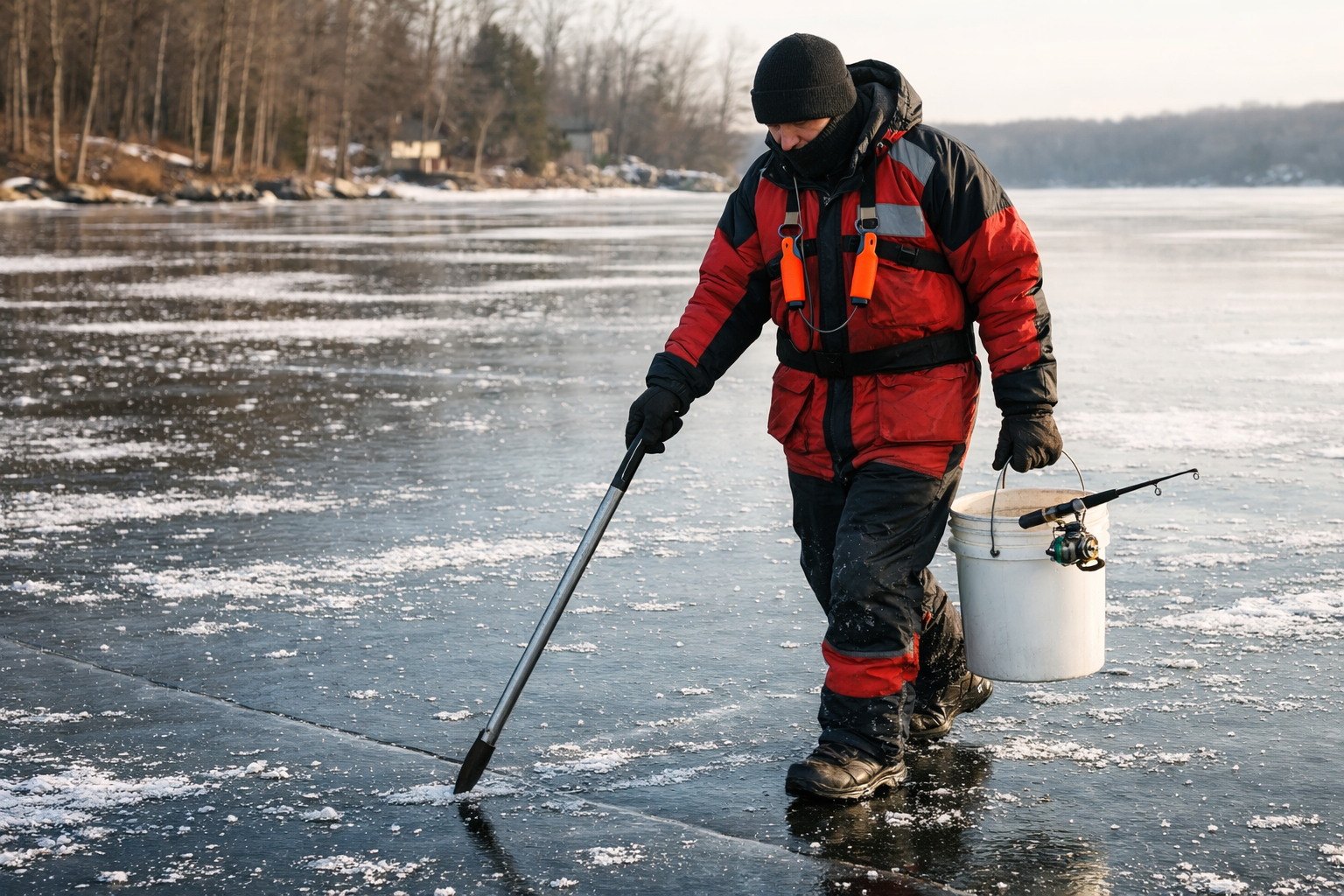
Early-season ice in 2026 is more variable than usual because of the late January storm system that dropped heavy snow and sleet across the eastern and central United States. That storm triggered State of Emergency declarations in 109 Kentucky counties and disrupted normal freeze-thaw cycles on lakes throughout the Midwest and Northeast.
Three factors drive the unpredictability this season:
1. Snow insulation effect. Heavy snowfall on thin, newly formed ice acts as a blanket. The snow insulates the ice surface and slows further thickening. Worse, the weight of the snow pushes water up through cracks, creating a slush layer between the ice and snow. This slush refreezes into weak, white ice that looks solid but carries half the strength of clear ice.
2. La Nina collapse and temperature swings. Forecasters noted in early February 2026 that La Nina is collapsing into a potential El Nino transition. Colder-than-normal conditions are expected to persist through late February and into March across the eastern and northeastern United States. This means ice will continue forming, but the temperature swings during this transition create inconsistent freeze-thaw patterns. One warm afternoon followed by a hard freeze produces layered ice with varying structural integrity.
3. Pressure ridges and current zones. Moving water under the ice, whether from inlet creeks, outlet flows, or underwater springs, thins ice from below. You will not see this thinning from the surface. Pressure ridges form when ice sheets expand and collide, creating visible cracks and buckled sections. Both hazards are more common during early-season formation when the ice sheet is still settling.
The South Haven, Michigan rescue in early February 2026 highlighted these dangers. Safety experts issued warnings about ice shelf integrity after a close-call incident involving structural failure near shore. These shelf breaks happen when warming air or wave action erodes ice from the edges inward.
When Should You Walk on Early-Season Ice?
Walk when ice conditions are uncertain, when thickness readings fall between 4 and 8 inches of clear ice, or when you have not verified the route with multiple auger checks. Walking is the default safe choice for early-season ice fishing.
Advantages of walking:
- You distribute approximately 200 pounds across your two feet (and even less with snowshoes), requiring only 4 inches of clear ice for safe travel.
- You hear and feel warning signs, including cracking sounds, flexing, and water seeping up through surface cracks, more easily on foot.
- You stop faster and change direction faster than any vehicle.
- If ice fails, self-rescue from a walking breakthrough is more manageable than escaping a sinking vehicle.
Walk when these conditions apply:
- Ice thickness measures between 4 and 7 inches of clear ice.
- You are fishing a new lake or a section you have not scouted this season.
- Snow cover is heavy and you have not been able to verify ice beneath the snow.
- Temperatures have been above freezing for more than 24 hours in the past week.
- You are near inlets, outlets, bridges, or points where current flows.
Tactical approach for walking on variable ice:
- Carry a spud bar and strike the ice ahead of you every few steps. If the bar punches through on a single strike, stop and turn back.
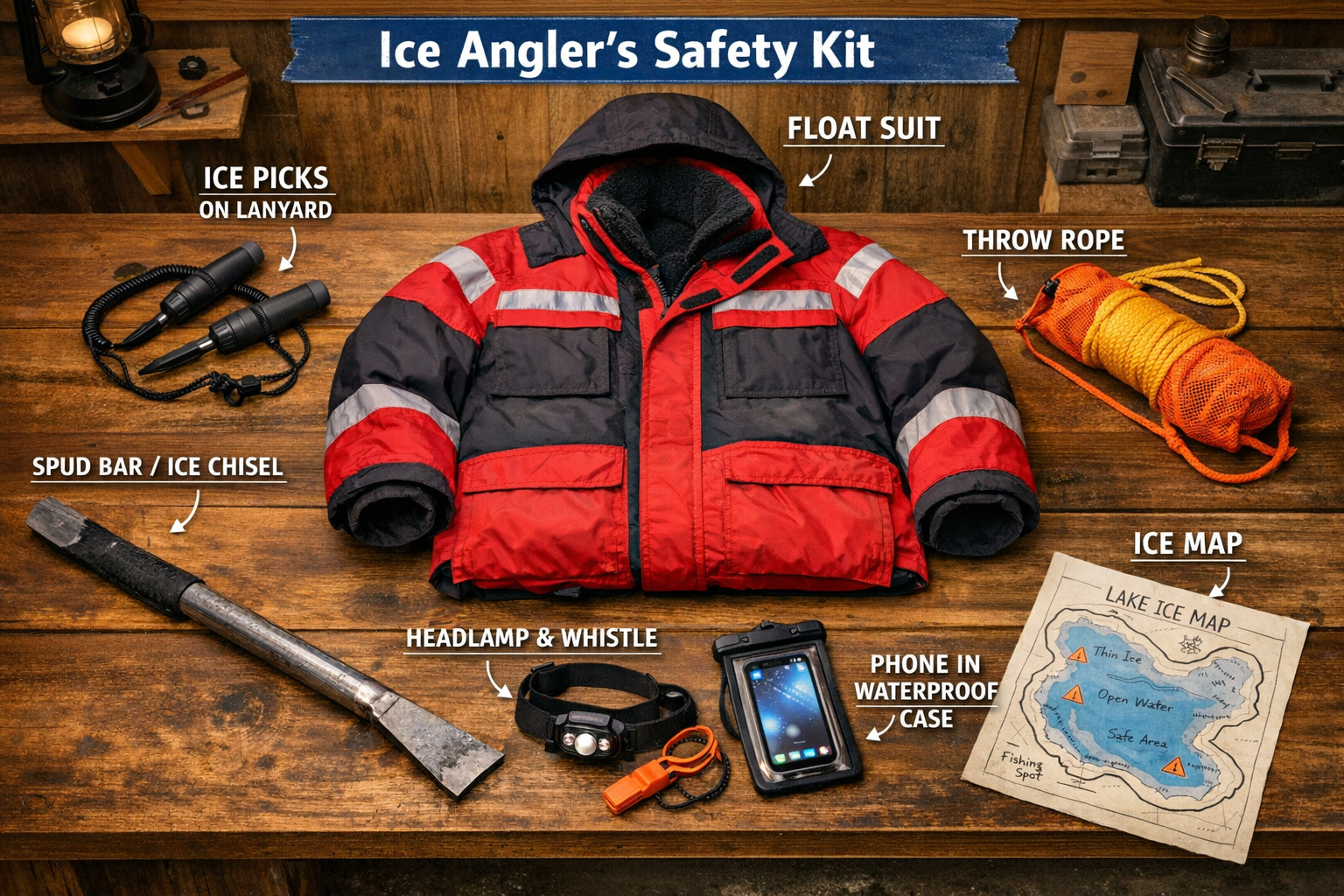
- Wear a float suit or inflatable PFD. Carry ice picks on a lanyard around your neck.
- Drill test holes every 50 yards along your route. Record the thickness at each hole.
- Travel with a partner. Space yourselves 30 feet apart so you do not concentrate weight on the same section.
- Carry a throw rope (at least 50 feet) accessible in an outer pocket, not buried in your sled.
The multi-season adventurer who transitions from saltwater kayak fishing to ice fishing will find that the same risk-assessment mindset applies. You check conditions before you launch. You carry safety gear. You respect the environment. Fluid Safety is the principle: adapt your approach to the conditions in front of you, not the conditions you expected. Learn more about the FishOnYak approach to safety and skill-building on the About page.
When Is Driving on Early-Season Ice the Right Call?
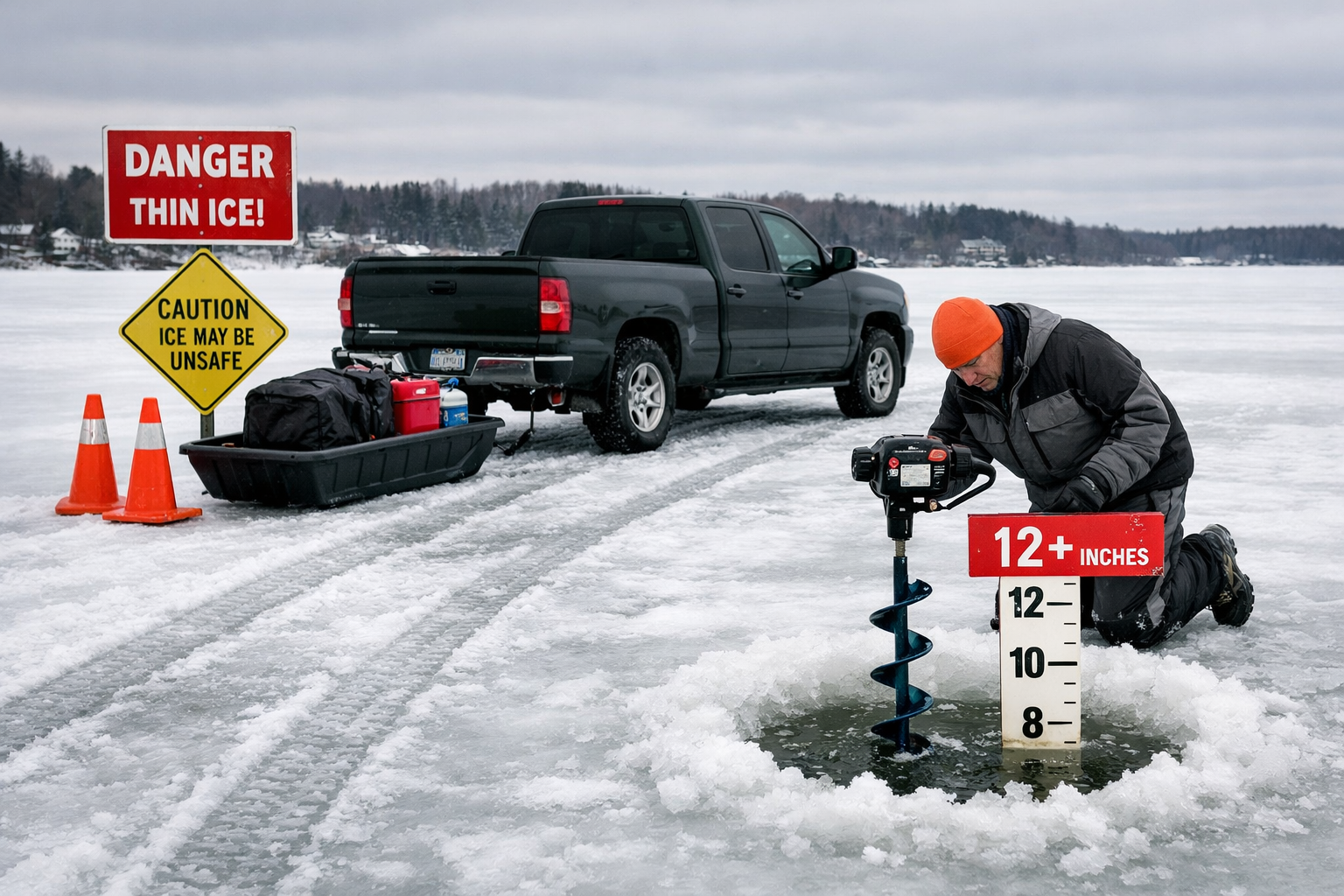
Drive on early-season ice only when you have confirmed 12 to 15 inches of clear, solid ice along the entire route from shore to your fishing spot. Driving is appropriate when the ice is well-established, the route has been verified by local reports and your own auger checks, and temperatures have been consistently below freezing for an extended period.
Advantages of driving:
- You transport heavier gear, including portable shelters, power augers, and electronics, with less physical effort.
- You cover more water and reach productive spots farther from shore.
- If ice begins to fail, a vehicle provides faster escape speed than walking (assuming you have a clear path to shore).
Drive only when all of these conditions are met:
- A minimum of 12 inches of clear ice (15 inches for full-size trucks) confirmed at multiple points along your route.
- Local fishing clubs, outfitters, or bait shops report safe driving conditions on the specific lake you plan to fish.
- No significant warming trend (above 32 degrees F) in the past 48 hours.
- No heavy snow load on the ice surface that could mask slush layers.
- You have a clear, established route with no pressure ridges, cracks, or dark spots.
Decision rule: If any single condition above is not met, walk. The consequences of a vehicle breakthrough are severe. Last season's six recreational vehicle fatalities in Wisconsin alone demonstrate the stakes. A UTV at 3,000 pounds applies concentrated force through four small tire contact patches. Compare that to a 200-pound angler whose weight spreads across two boot soles. The math is straightforward.
If you drive, follow these protocols:
- Keep windows down and doors unlocked so you exit fast if the vehicle breaks through.
- Unbuckle your seatbelt while driving on ice. This contradicts road-driving habits, but on ice, a seatbelt traps you in a sinking vehicle.
- Keep a set of ice picks, a window punch tool, and a float device within arm's reach on the dashboard or seat.
- Do not park vehicles close together. Space them at least 50 feet apart to distribute weight.
- Move the vehicle periodically. A stationary vehicle on ice creates sustained point-loading that weakens the ice beneath it over time.
For anglers building out their gear systems and rigs for both kayak and ice seasons, the FishOnYak services page outlines coaching and rigging options.
How Do You Assess Ice Conditions Before Heading Out?
Check ice conditions through a combination of local intelligence, personal observation, and on-ice testing. Do not rely on any single method.
Step 1: Gather local reports. Contact bait shops, fishing clubs, and outfitters near your target lake. The Wisconsin DNR and most state agencies do not monitor ice conditions. They direct anglers to local sources for current reports. These local networks form a decentralized intelligence system that provides the most accurate, up-to-date information.
Step 2: Observe from shore. Before stepping onto the ice, look for these indicators:
- Clear, dark ice (blue or black) indicates strong ice formed by sustained cold.
- White or opaque ice suggests snow-ice or refrozen slush with reduced strength.
- Dark patches on the surface signal thin spots or open water below.
- Cracks and pressure ridges indicate ice movement and potential weak zones.
- Water on the surface means the ice is being pushed down by weight (often snow) and water is seeping up through cracks.
Step 3: Test as you go. Once on the ice, use a spud bar for the first 100 yards from shore. Then switch to an auger and drill test holes at regular intervals. Record thickness and ice quality (clear vs. white) at each hole.
Step 4: Monitor conditions throughout the day. Ice conditions change. A sunny afternoon in February 2026, with temperatures climbing above freezing, weakens ice that was solid at dawn. Plan your return trip for the coldest part of the day when possible.
Emerging technology: The U.S. Army's Cold Regions Research and Engineering Laboratory (CRREL) in Hanover, New Hampshire developed “DAS-Ice” technology in 2025 using Distributed Acoustic Sensing. This system measures ice thickness in real-time across miles of fiber-optic cable covering hundreds of acres. Dr. Meghan Quinn's team demonstrated deployment in a matter of hours with remote data access. While this technology is not yet available to individual anglers, commercial IceMap GPR (Ground Penetrating Radar) systems from companies like Sensors and Software provide real-time thickness measurement when towed behind a snowmobile or truck at driving speeds. These tools represent the future of ice safety assessment.
For those who value the technical side of fishing preparation, the FishOnYak case studies show how detailed planning improves outcomes across fishing disciplines.
What Are the Most Dangerous Spots on Early-Season Ice?
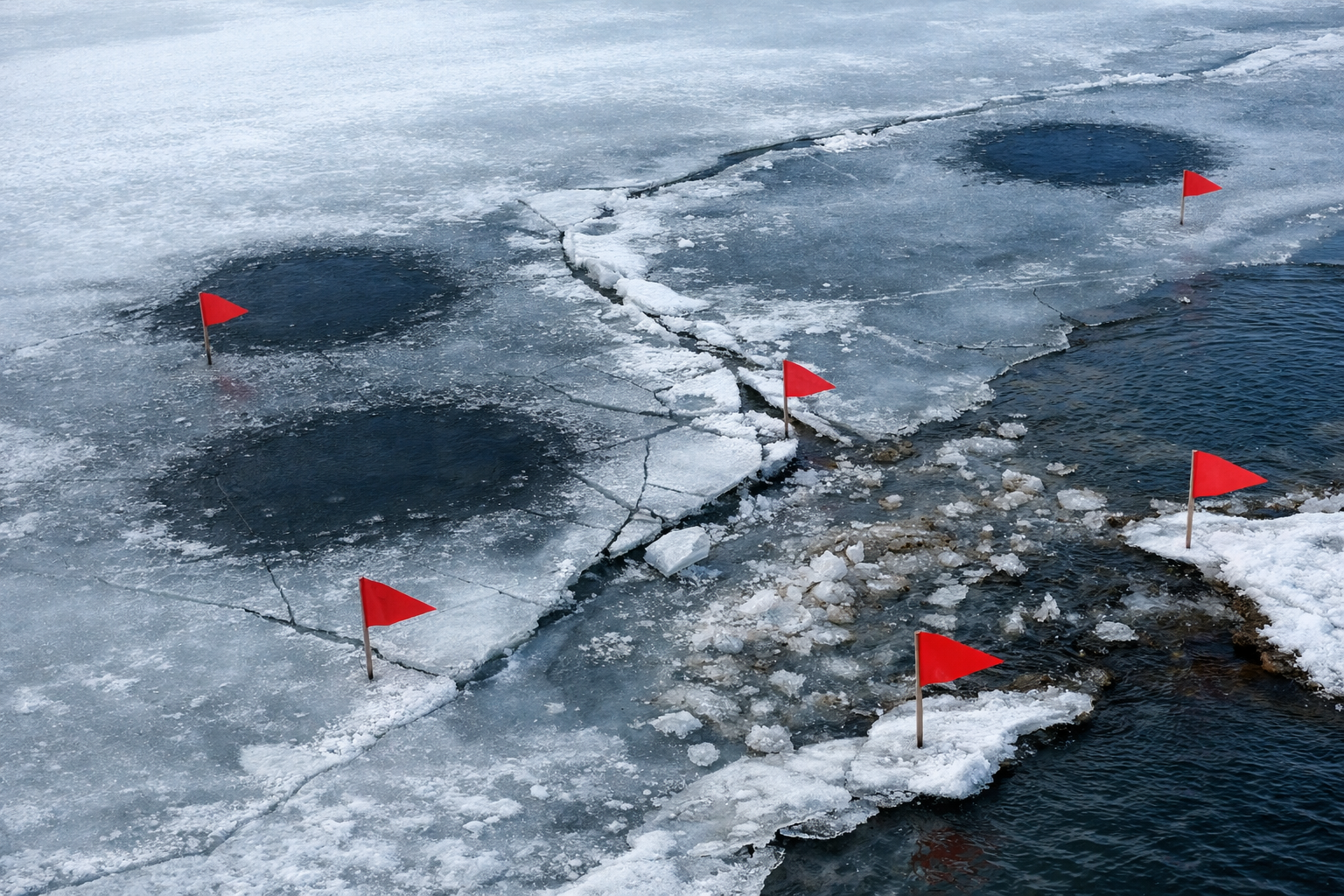
The most dangerous areas on any frozen lake are where water moves, where the ice structure changes, or where external factors have weakened the surface. Know these zones and avoid them or approach with extreme caution on foot only.
Inlet and outlet areas. Anywhere water flows into or out of a lake creates current that erodes ice from below. These areas freeze last and thaw first. Stay at least 100 yards from visible inlets and outlets during early season.
Underwater springs. Springs push warmer water up from below, creating localized thin spots that are invisible from the surface. Local knowledge is the best defense here. Ask experienced anglers who fish the lake regularly where springs are located.
Pressure ridges. When ice sheets expand due to temperature changes, they push against each other and against the shoreline. This creates ridges of buckled, cracked ice. Pressure ridges indicate structural stress in the ice sheet. Do not drive across pressure ridges. Walk across them with extreme caution after testing thickness on both sides.
Bridge and dock areas. Structures that extend into the water absorb and radiate heat differently than the surrounding environment. Ice near docks, bridge pilings, and retaining walls is often thinner than ice in open water.
Narrows and channels. Where a lake pinches into a narrow channel, water flow increases. Faster-moving water means thinner ice. Treat narrows the same as inlet areas.
Snow-covered sections. Heavy snow insulates ice and prevents further thickening. Worse, the weight of snow pushes water up through the ice, creating hidden slush layers. After the January 2026 storm, many lakes across the Midwest developed significant slush layers under snow cover that persisted into February.
What Safety Gear Do You Need for Early-Season Ice Travel?
Carry this gear every time you step onto early-season ice, whether walking or driving.
Personal safety essentials:
- Ice picks (ice claws) on a lanyard around your neck. These allow you to grip the ice edge and pull yourself out after a breakthrough.
- Float suit or inflatable PFD. A float suit provides both flotation and insulation. Wear it as your outer layer.
- Throw rope, 50 feet minimum, stored in an accessible pocket or clipped to your belt.
- Whistle attached to your PFD or jacket zipper.
- Fully charged phone in a waterproof case.
- Headlamp with fresh batteries (early-season days are short).
Ice assessment tools:
- Spud bar for testing ice ahead of you on foot.
- Hand auger or battery-powered auger for drilling test holes.
- Tape measure or marked stick for measuring ice thickness in test holes.
Vehicle-specific additions (if driving):
- Window punch tool on the dashboard.
- Tow strap rated for your vehicle weight.
- Extra set of ice picks inside the cab within arm's reach.
Communication and planning:
- Tell someone your plan: which lake, which access point, expected return time.
- Carry a handheld VHF radio or personal locator beacon if fishing remote lakes without cell coverage.
This gear list parallels the Rigging Mastery approach that FishOnYak applies to kayak fishing. Every piece of equipment has a purpose, a location, and a reason for being accessible. Tournament-ready anglers prepare for the worst and fish for the best. Kayak. Drill. Catch. Repeat. Check the FishOnYak blog for more on building systems that keep you safe and productive.
How Do Variable Conditions Change Your Decision to Walk vs. Drive?
Variable conditions tip the decision toward walking every time. When ice thickness, quality, or structure changes across a lake, the risk of driving increases faster than the risk of walking.
Here is a decision framework:
| Condition | Walk | Drive |
|---|---|---|
| Ice thickness 4 to 7 inches clear | Yes | No |
| Ice thickness 8 to 11 inches clear | Yes (preferred) | Snowmobile/ATV only with caution |
| Ice thickness 12+ inches clear, verified route | Yes | Yes, with protocols |
| Mixed clear and white ice | Yes, with caution | No |
| Heavy snow cover, unverified slush | Yes, with spud bar | No |
| Recent warming trend (above 32 F) | Yes, with caution | No |
| Near inlets, outlets, or springs | Yes, extreme caution | No |
| Pressure ridges present on route | Yes, test both sides | No |
The core principle: Walking gives you options. Driving commits you to a path and a weight load that the ice must support continuously. In variable conditions, the ice will not support that load uniformly. One weak spot under a tire is all it takes.
The 2026 season, with its storm-disrupted freeze patterns and La Nina-to-El Nino transition, demands extra caution. Conditions that looked solid in mid-January shifted after the late January storm. Conditions that look solid in late February will shift again as March temperatures fluctuate.
For more on building your knowledge base and staying current with conditions, explore the FishOnYak resource hub.
FAQ: Safe Ice Travel in Variable Conditions
Q: What is the minimum ice thickness for walking? A: Four inches of clear, solid ice supports a single person on foot (up to approximately 200 pounds). White or opaque ice requires double the thickness for the same load.
Q: What is the minimum ice thickness for driving a truck? A: Twelve to fifteen inches of clear ice for a full-size pickup or SUV. Lighter vehicles (cars, small SUVs) need a minimum of 8 to 12 inches of clear ice.
Q: How do I tell the difference between clear ice and white ice? A: Clear ice appears blue or black and forms from direct freezing of lake water in sustained cold. White ice appears opaque or milky and forms from refrozen snow, slush, or rain. Clear ice is roughly twice as strong as white ice of the same thickness.
Q: Should I wear a seatbelt when driving on ice? A: No. Unbuckle your seatbelt when driving on ice. Keep windows down and doors unlocked. A seatbelt traps you inside a sinking vehicle.
Q: How often should I check ice thickness while traveling? A: Drill test holes every 50 yards when walking an unverified route. When driving an established route, check at least every 100 to 150 yards and at any point where conditions visually change.
Q: Does snow on ice make it stronger or weaker? A: Weaker. Snow insulates the ice and slows further thickening. Heavy snow pushes water up through cracks, creating slush layers that refreeze into weak white ice.
Q: What should I do if I fall through the ice? A: Stay calm. Turn toward the direction you came from (that ice held your weight). Kick your legs to get horizontal. Use ice picks to grip the ice edge and pull yourself up onto the surface. Roll away from the hole. Do not stand up until you are well away from the breakthrough area.
Q: Are ATVs and UTVs safe on early-season ice? A: ATVs (5 to 7 inches of clear ice minimum) are safer than UTVs. UTVs weigh approximately 3,000 pounds, equivalent to a car, and require 8 to 12 inches of clear ice. Six fatalities in Wisconsin last season involved ATVs, UTVs, and snowmobiles breaking through.
Q: Who monitors ice conditions on local lakes? A: State DNR agencies generally do not monitor ice conditions. Contact local bait shops, fishing clubs, and outfitters for the most current reports on specific lakes.
Q: Is early-morning or late-afternoon ice safer? A: Early morning, after a full night of freezing temperatures, provides the strongest ice conditions. Afternoon sun and warming temperatures weaken ice, especially on south-facing shorelines and shallow bays.
Q: What is a spud bar and how do I use it? A: A spud bar is a heavy, chisel-tipped metal bar (4 to 5 feet long) used to strike the ice ahead of you while walking. If the bar punches through on one solid strike, the ice is too thin. Turn around.
Q: How does the January 2026 storm affect current ice conditions? A: The late January 2026 storm deposited heavy snow and sleet across the Midwest and Northeast, creating insulating snow layers that slowed ice growth and produced slush layers on many lakes. These conditions persist into late February 2026 and require extra caution.
Key Takeaways for 2026 Early-Season Ice Travel
- Four inches of clear ice is the minimum for walking. Twelve to fifteen inches of clear ice is the minimum for driving a full-size vehicle.
- White ice has half the strength of clear ice. Double the required thickness when traveling on white or opaque ice.
- The January 2026 storm created widespread slush layers and uneven ice formation. Do not assume conditions are uniform across any lake.
- Walk when conditions are variable, uncertain, or unverified. Driving commits you to a weight load that variable ice will not support uniformly.
- Carry ice picks, a float suit, a throw rope, and a spud bar every time you step onto early-season ice.
- Contact local bait shops, fishing clubs, and outfitters for current ice conditions on your target lake. State agencies do not monitor ice.
- Drill test holes every 50 yards on unverified routes. Record thickness and ice quality at each hole.
- Avoid inlets, outlets, springs, pressure ridges, and snow-covered sections where ice integrity is compromised.
- If you drive, keep windows down, doors unlocked, seatbelt off, and ice picks within arm's reach.
- The safest decision is always to walk. The ice will be there tomorrow. You need to be there too.
The 2026 season demands respect. Variable conditions, storm-disrupted freeze cycles, and a shifting climate pattern mean that safe ice travel in variable conditions requires active assessment, not assumptions. Know when to walk vs. drive on early-season ice, and you fish all season long.
See you on the water.
SEO Meta Title: Safe Ice Travel: When to Walk vs. Drive on Early Ice
SEO Meta Description: Learn safe ice travel in variable conditions for 2026. Know when to walk vs. drive on early-season ice with thickness guidelines, gear lists, and expert tips.