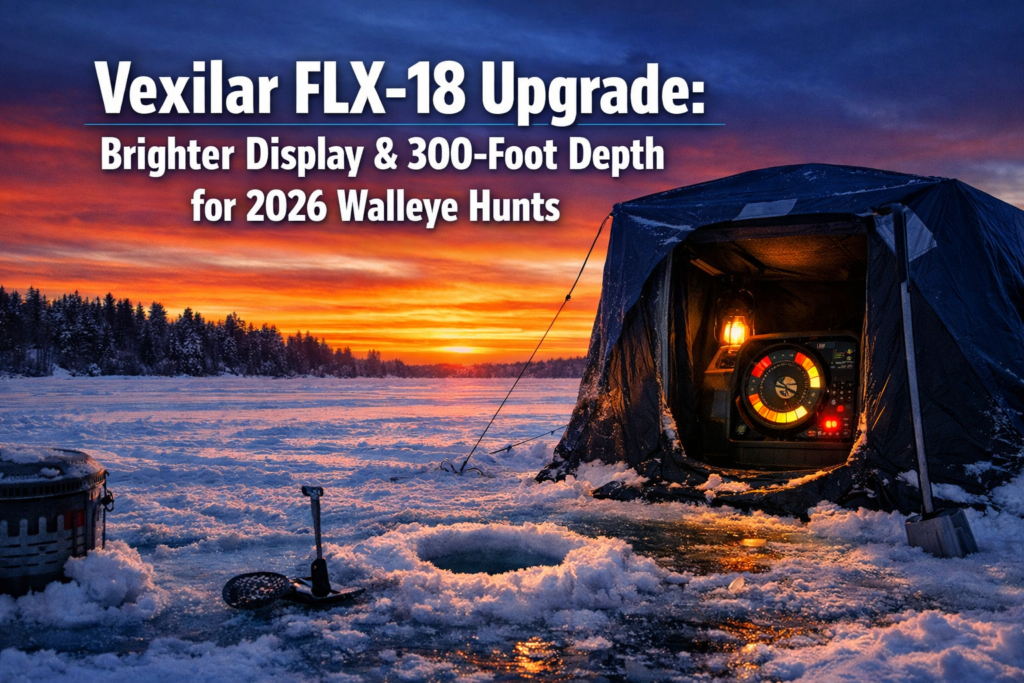
Last updated: February 24, 2026
Key Takeaways
- The Vexilar FLX-18 replaces the legacy FL-18 with a flat 3-color LED display (red, orange, green) that reads clearly in direct sunlight and low-light shanty conditions.
- Depth range expands from 200 feet on the old FL-18 to 300 feet on the FLX-18, opening access to deep basin walleye structure during mid-winter.
- The FLX-18 Pro Pack retails at $499.99 as of February 2026.
- Night mode and three selectable color palettes give you better target separation on 10 to 20 foot transition zones where walleye stage in January and February.
- Twenty interference rejection settings let you fish in crowded ice communities without signal clutter.
- Low-power zoom mode isolates the bottom 10 feet of the water column with 1/4-inch target identification.
- The FLX-18 sits between the budget-friendly older FL-18 (clearance pricing) and the premium FLX-28 (sub-2.5 cm target ID, more color palettes, higher cost).
- Battery efficiency in extreme cold outperforms LCD-based units from Garmin and Humminbird for full-day sessions.
Quick Answer
The Vexilar FLX-18 is the 2025-2026 season replacement for the FL-18, adding a brighter flat LED display, 300-foot depth capability, night mode, and low-power zoom. For mid-winter walleye anglers fishing 10 to 20 foot transitions on Minnesota and Wisconsin lakes, the FLX-18 provides clearer target separation and deeper reach at $499.99. The display upgrade and expanded depth range make the biggest difference when walleye push off shallow flats into mid-depth basins during the coldest weeks of the season.
What Changed in the Vexilar FLX-18 Upgrade: Brighter Display and 300-Foot Depth for 2026 Mid-Winter Walleye Hunts?
The FLX-18 is a ground-up redesign of Vexilar’s most popular flasher, the FL-18. Three changes matter most for walleye anglers fishing the 2026 mid-winter period.
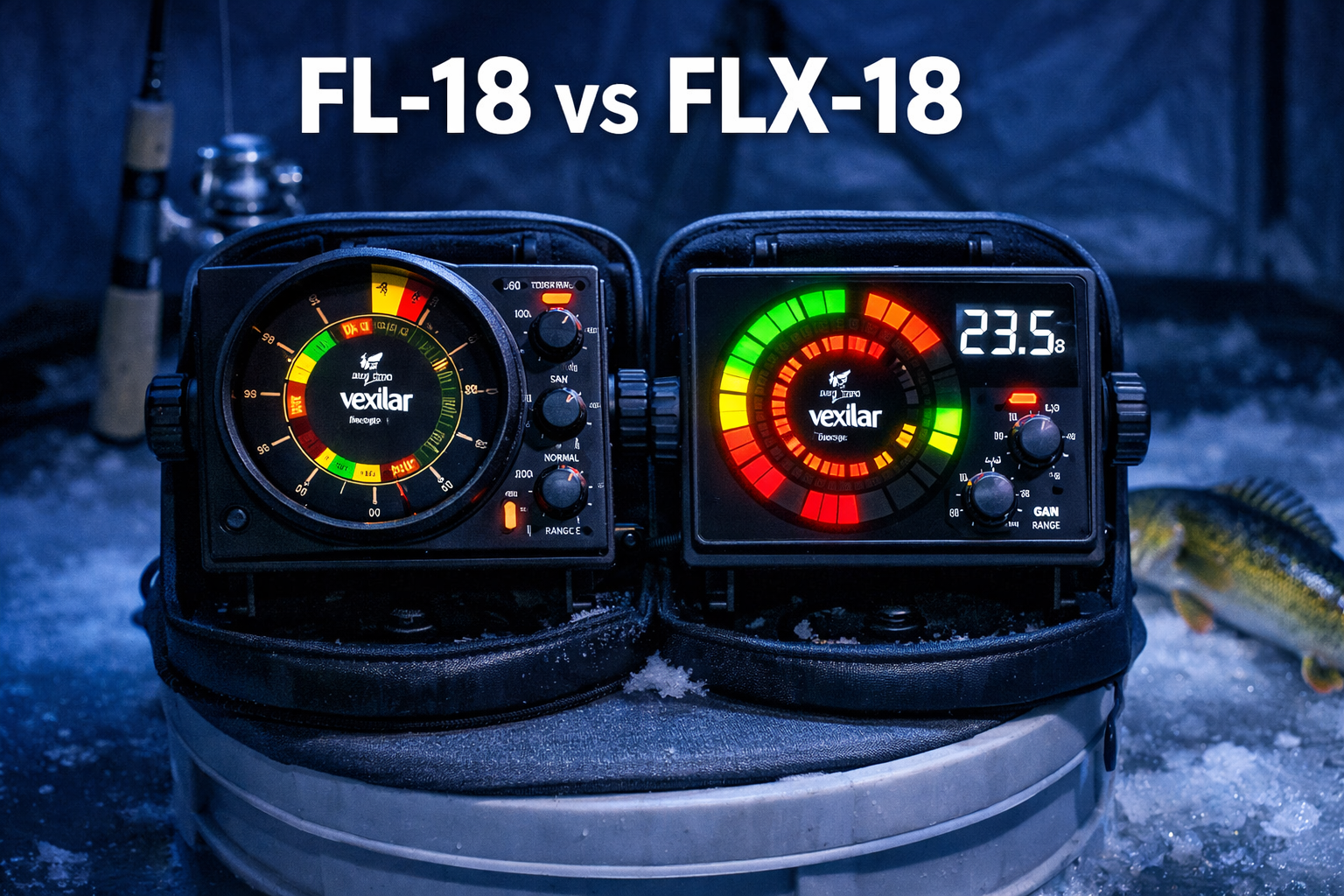
Display. The old FL-18 used a traditional circular LED ring. The FLX-18 switches to a flat 3-color LED panel with red, orange, and green returns. This flat panel reduces glare and improves readability in bright conditions when you’re fishing outside a shelter. In a dark shanty, the three color palettes and dedicated night mode prevent the display from washing out your night vision. You see more detail on each sonar return, which means you distinguish a walleye holding 6 inches off bottom from the bottom signal itself.
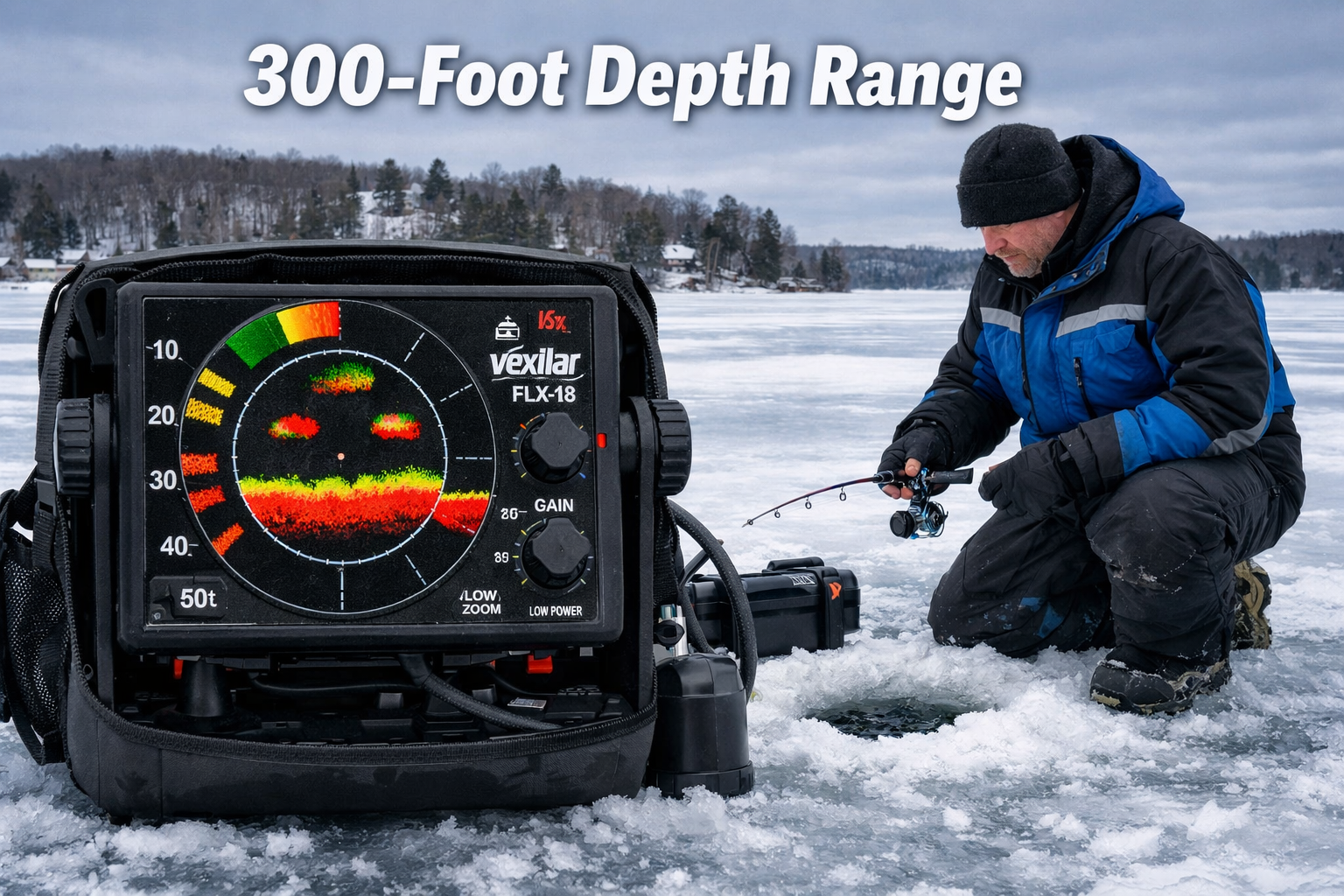
Depth. The FL-18 topped out at 200 feet. The FLX-18 reaches 300 feet. For anglers on deep lakes like Mille Lacs, Lake of the Woods, Green Bay, or the Apostle Islands region, that extra 100 feet of range matters in February when walleye drop into deep mud flats and basin edges.
Zoom and Power Modes. The FLX-18 offers selectable high and low power transmission. Low power reduces signal noise in shallow water (under 30 feet) and activates a zoom window that isolates the bottom section of the water column. This zoom gives you 1/4-inch target identification, enough resolution to watch a walleye rise toward your jig and track your presentation in real time.
For a deeper look at how FishOnYak.com approaches technical gear content, visit our services page.
How Does the FLX-18 Compare to the FL-18 and FLX-28?
Choose the FLX-18 if you want the FL-18’s simplicity with modern display and depth upgrades. Choose the FLX-28 if you need tournament-level target separation below 1/4 inch.
| Feature | FL-18 (Legacy) | FLX-18 | FLX-28 |
|---|---|---|---|
| Max Depth | 200 ft | 300 ft | 300 ft |
| Display Type | Circular LED | Flat 3-color LED | Flat multi-color LED |
| Target ID Resolution | 1/2 inch | 1/4 inch | Sub-2.5 cm |
| Color Palettes | 1 | 3 | 5+ |
| Night Mode | No | Yes | Yes |
| Interference Rejection | 6 settings | 20 settings | 20+ settings |
| Zoom Modes | Basic | Low-power zoom | Advanced zoomID |
| Approximate Price (2026) | $300-350 (clearance) | $499.99 | $600+ |
Decision rule: If you fish lakes under 150 feet and want to save money, the FL-18 at clearance prices still works. If you fish 150 to 300 feet or need better target separation on mid-depth walleye structure, the FLX-18 is the right pick. If you compete in tournaments and need the finest resolution available in a flasher, step up to the FLX-28.
A common mistake is buying the FLX-28 for casual walleye fishing. The extra color palettes and sub-2.5 cm resolution add cost without a meaningful advantage unless you’re separating panfish in tight schools or reading extremely subtle presentation changes in competition settings.
Why Does the Brighter Display Matter for Mid-Winter Walleye Hunts?
The FLX-18’s brighter flat LED display solves a specific problem: reading sonar returns during the low-light, high-contrast conditions of mid-winter fishing.
In January and February across Minnesota and Wisconsin, daylight hours are short. You often fish in a dark portable shelter or during dawn and dusk windows when walleye feed most aggressively on 10 to 20 foot transition zones. The old FL-18’s circular LED display worked fine in a dark house but washed out in ambient light and lacked the color separation to distinguish a walleye from a perch at the same depth.
The FLX-18’s three color palettes let you select the display mode that matches your conditions:
- Standard mode for normal daylight fishing outside a shelter.
- Night mode for dark house fishing, reducing brightness to protect your night vision while keeping returns visible.
- High-contrast mode for reading subtle signals in deep water where returns weaken.
This matters on transition zones because walleye often suspend 1 to 3 feet off bottom on the break between a shallow flat and a deeper basin. A brighter, higher-resolution display lets you see that fish and track your jig’s position relative to the fish. You adjust your jigging cadence based on what the flasher shows you in real time. That feedback loop between your rod tip and the display is the core advantage of a flasher over camera or forward-facing sonar in these conditions.
Check out our blog for more tactical angling breakdowns across seasons.
How to Use the FLX-18’s 300-Foot Depth for 2026 Mid-Winter Walleye Hunts on Deep Transitions
Set your FLX-18 to the appropriate depth range before drilling. Start with the auto-range feature, then narrow your zoom window to the bottom 10 to 15 feet once you confirm depth.
Here is a step-by-step approach for fishing 10 to 20 foot transitions on deep structure lakes:
Study your lake map before you leave. Identify transition zones where the bottom drops from 20 to 30 feet (or 30 to 50 feet on deeper lakes). Walleye stage on these breaks during mid-winter, especially where hard bottom (gravel, rock) meets soft bottom (mud, sand).
Drill a line of holes along the break. Space holes 30 to 50 feet apart, following the contour. Drill at least 8 to 10 holes so you have options.
Deploy the FLX-18 transducer in the first hole. Drop the ice-ducer straight down and confirm depth. Set the unit to the correct range bracket. For 25 to 50 foot depths, use the 0-60 or 0-80 foot range.
Switch to low-power zoom. Once you know the bottom depth, activate the zoom mode to isolate the bottom 10 feet. This is where you see walleye holding on or near structure. The 1/4-inch target ID shows your jig, your bait, and any fish in the zone as separate marks.
Set interference rejection. If other anglers are fishing nearby, scroll through the 20 interference rejection settings until you find a clean display. Start at a low setting and increase only as needed. Over-filtering removes weak returns, which means you lose sight of smaller bait or subtle fish marks.
Read the display for fish behavior. A walleye approaching your jig shows as a colored band rising from bottom or moving horizontally into your cone. When you see a mark rise toward your jig, slow your cadence. When the mark stops, hold still or add a subtle twitch. The FLX-18’s color coding tells you signal strength: red means a strong, close return (big fish or fish directly in the cone center), orange means moderate, and green means weak or at the cone’s edge.
Move systematically. If you see no marks in 10 to 15 minutes, pull the transducer and move to the next hole. Mid-winter walleye roam along transitions. You find them by covering water, not by sitting in one spot.
This process works on classic mid-winter walleye lakes in both Minnesota (Mille Lacs, Upper Red Lake, Leech Lake) and Wisconsin (Lake Winnebago, Chequamegon Bay, Green Bay). The 300-foot depth range gives you full coverage on any of these fisheries, even on the deepest basin edges.
For more on how FishOnYak.com helps anglers build tactical skills, visit our about page.
FLX-18 vs. Forward-Facing Sonar and LCD Flashers for Ice Walleye
The FLX-18 is a traditional flasher, and that format has specific advantages over forward-facing sonar (like Garmin LiveScope) and LCD-based ice units for mid-winter walleye.
Battery life. LED flashers draw less power than LCD screens. In extreme cold (below zero Fahrenheit), battery performance drops. The FLX-18 runs all day on a single 12V battery. LCD units and forward-facing sonar systems drain batteries faster, and you lose screen brightness as voltage drops in cold temperatures.
Real-time feedback. A flasher updates in real time with zero lag. Forward-facing sonar processes data and displays a rendered image, which introduces a slight delay. When a walleye commits to your jig, that fraction-of-a-second advantage on a flasher lets you set the hook at the right moment.
Simplicity. The FLX-18 has a small learning curve. You read colored bands on a circular display. Forward-facing sonar requires interpretation of a 2D or 3D rendered image, menu navigation, and frequent adjustment. For anglers who want to focus on jigging technique rather than screen management, the flasher wins.
Where forward-facing sonar beats the FLX-18: If you want to see fish approaching from outside your sonar cone, or if you want to watch your jig’s action in a rendered view, forward-facing sonar provides information a flasher does not. Some tournament anglers use both: a flasher for real-time vertical feedback and a forward-facing unit for scouting.
Marcum LX series comparison. Marcum’s 3-color flashers compete directly with the FLX-18 in the same price range. Both offer 200 to 300 foot depth ranges and similar display technology. The FLX-18’s advantage is its 20-level interference rejection system, which outperforms Marcum’s options in crowded fishing areas. If you fish popular public lakes during peak weekends, interference rejection keeps your display clean.
Common Mistakes When Setting Up the FLX-18 for Walleye
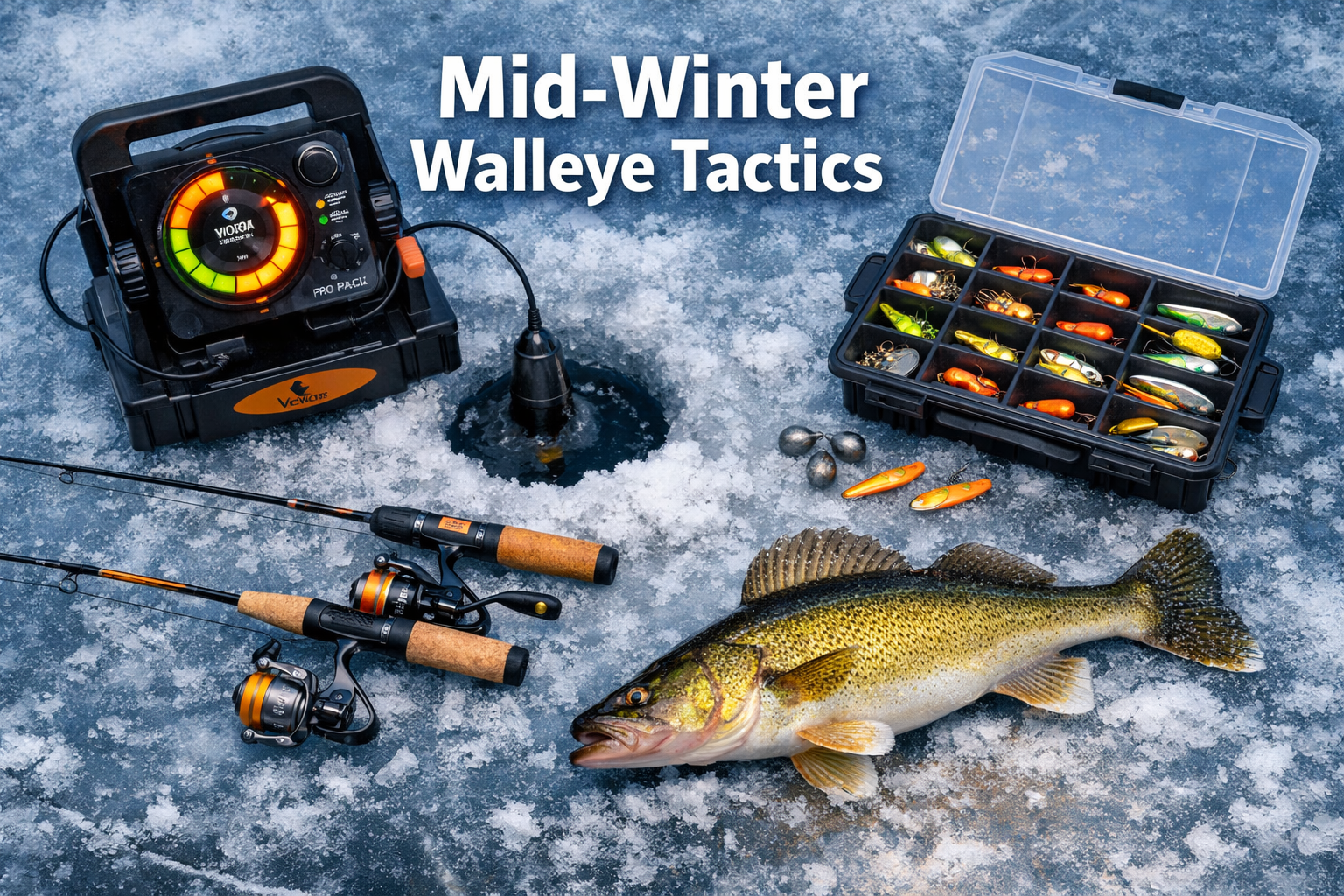
Avoid these errors to get the most from your FLX-18 on mid-winter walleye transitions.
Running too much gain. New users often crank the gain (sensitivity) to maximum, thinking more signal means more fish. High gain in shallow water (under 30 feet) creates clutter and false marks. Start with gain at 50% and increase until you see a clean bottom signal and your jig. Stop there.
Ignoring the low-power mode. The FLX-18’s low-power mode exists for shallow water. In 10 to 25 feet, high power bounces too much energy off the bottom and creates a wide, messy bottom signal. Switch to low power, and the bottom tightens into a thin band. You see fish holding within inches of bottom that high power would hide.
Wrong transducer angle. The ice-ducer must hang straight down in the hole. Any tilt shifts your sonar cone off-center, and you lose accuracy on depth readings and target position. Use the transducer float or a stabilizing bracket to keep the ducer level.
Not using zoom on transitions. When fishing a 10 to 20 foot break, the full water column view wastes display space. Zoom into the bottom zone. You gain resolution and see fish behavior that the full-range view misses.
Skipping interference rejection in a crowd. On busy lakes, other flashers and sonar units create interference lines on your display. These look like fish marks and cause false hooksets. Scroll through the FLX-18’s 20 rejection settings until the interference disappears.
Explore more tactical angling content on the FishOnYak.com blog.
What Walleye Presentations Work Best with the FLX-18 on 10 to 20 Foot Transitions?
Match your jigging style to what the FLX-18 shows you. The flasher tells you how walleye respond to your presentation in real time.
Aggressive jigging for active fish. When the FLX-18 shows fish marks rising quickly toward your jig, the fish are active. Use a 1/4 oz jigging spoon (like a Rapala Jigging Rap or VMC Rattle Spoon) with aggressive 6 to 12 inch lifts. Pause at the top of each lift and watch the display. Active walleye commit on the pause.
Deadsticking for neutral fish. When marks appear on the display but hold at the same depth without rising, the fish are neutral. Set a second rod with a live minnow on a plain hook or small jig head. Position the minnow 12 to 18 inches off bottom. The FLX-18 shows the minnow as a faint green mark and the walleye as a stronger return. Watch for the minnow mark to disappear into the fish mark. That is your bite.
Pounding bottom for negative fish. In tough mid-winter conditions, walleye sometimes sit directly on bottom and refuse to chase. Drop your jig to bottom and tap the substrate repeatedly. The FLX-18 shows your jig hitting bottom as a flickering mark at the base of the bottom signal. Walleye respond to the vibration and sediment disturbance. When a mark separates from the bottom and moves toward your jig, lift slowly and set the hook.
The FLX-18’s 1/4-inch target separation makes these reads possible. On an older unit with 1/2-inch resolution, your jig and a fish holding 6 inches off bottom merge into one signal. The FLX-18 keeps them distinct.
Learn more about how FishOnYak.com supports multi-season anglers on our homepage.
Is the FLX-18 Worth the Upgrade from an FL-18?
Yes, if you fish water deeper than 150 feet or need better target separation on mid-depth walleye structure. The 300-foot depth range, improved display, and 20-level interference rejection address the FL-18’s three biggest limitations.
If you fish shallow lakes under 100 feet and rarely encounter crowded conditions, the FL-18 at clearance pricing (around $300 to $350) still performs well. The core sonar technology is proven, and the FL-18 has decades of reliability behind the design.
For anglers who fish both shallow and deep water across a season, or who travel to different fisheries, the FLX-18’s versatility justifies the $499.99 investment. You carry one unit that handles everything from 8-foot panfish bays to 250-foot lake trout basins.
The upgrade also makes sense if you fish tournaments. The FLX-18’s night mode, color palettes, and zoom modes give you a tactical angling advantage in competitive settings where reading fish behavior faster than the angler in the next hole determines placement.
Check out testimonials from anglers who have upgraded their approach through FishOnYak.com resources.
FLX-18 Pro Pack: What Comes in the Box?
The FLX-18 Pro Pack at $499.99 includes everything you need for a complete ice fishing sonar setup:
- FLX-18 flasher unit with flat 3-color LED display
- Pro View ice-ducer transducer with float and stopper
- 12V rechargeable battery
- Battery charger
- Soft carry case
You do not need to buy a separate transducer or battery. The Pro Pack is ready to fish out of the box. The soft carry case protects the unit during transport and stores the battery and charger together.
Optional add-ons to consider:
- Genz Pack carrying case for hands-free transport across the ice.
- DD-100 Flex transducer if you want a second ducer for open-water use on a kayak or boat.
- Extra 12V battery for multi-day trips or extreme cold conditions where battery capacity drops.
FAQ
How deep does the Vexilar FLX-18 read? The FLX-18 reads to 300 feet, a 100-foot increase over the FL-18’s 200-foot maximum.
What is the target separation on the FLX-18? The FLX-18 provides 1/4-inch target identification in zoom mode, allowing you to distinguish your jig from a fish holding inches off bottom.
Does the FLX-18 have night mode? Yes. The FLX-18 includes a dedicated night mode that dims the display to preserve your night vision during dark house fishing.
How many interference rejection settings does the FLX-18 have? Twenty. This is the highest count in Vexilar’s FLX lineup below the FLX-28 and gives you clean readings in crowded fishing areas.
What is the price of the FLX-18 Pro Pack in 2026? The FLX-18 Pro Pack retails at $499.99 as of February 2026 through Vexilar’s official store.
Does the FLX-18 work for species other than walleye? Yes. The FLX-18 works for panfish (crappie, bluegill), lake trout, pike, and any species you target through the ice. The zoom mode is particularly useful for panfish where precise jig control matters.
How does the FLX-18 perform in extreme cold? LED flashers handle extreme cold better than LCD units because the LED display does not slow down or dim at low temperatures. Battery performance is the limiting factor. Carry a fully charged 12V battery and keep a backup if you fish below minus 10 Fahrenheit.
Is the FLX-18 good for beginners? Yes. The flasher format is straightforward to learn. Most anglers read the display confidently after two or three outings. The three color palettes and auto-range feature reduce setup complexity.
Does the FLX-18 replace the FLX-20? Vexilar positions the FLX-18 as the successor to both the FL-18 and FLX-20 product lines, combining features from both into one unit.
What lakes are best for the FLX-18’s 300-foot range? Any lake with walleye structure deeper than 150 feet benefits from the extended range. In Minnesota, Mille Lacs, Lake of the Woods, and Leech Lake are prime candidates. In Wisconsin, Green Bay and Chequamegon Bay offer deep-water walleye opportunities where the 300-foot range provides full coverage.
Kayak. Drill. Catch. Repeat.
See you on the water.
Visit FishOnYak.com for more rigging mastery content, tournament-ready gear guides, and coaching resources for every season.