Last updated: February 26, 2026
Drag stutter kills big walleye hookups. When temperatures drop below 20°F, standard reel grease thickens and causes your drag to grab, skip, and release unevenly. That inconsistency snaps lines and loses fish. Low-temp reels and lubricants solve this problem by keeping drag pressure smooth and predictable through the hardest runs. In 2026, anglers targeting trophy walleye through 8 to 12 inches of ice need cold-rated lubricants and properly prepped reels to cut line breakage and land more fish.
This guide covers the specific products, techniques, and maintenance steps that prevent drag stutter on big walleye runs in freezing conditions. Whether you fish tip-ups or spinning reels on the hard water, the information here applies directly to your setup.
Key Takeaways
- Standard reel grease thickens below 25°F, causing drag stutter that leads to broken lines and lost walleye.
- Low-viscosity, cold-rated greases like Cal’s Universal Grease (purple variant) and Frabill Sub-Zero Lubricant perform reliably to minus 60°F.
- Switching to cold-weather lubricants reduces line breakage during hard runs by roughly 15% compared to standard grease in sub-freezing conditions.
- Apply drag grease sparingly. Excess grease attracts dirt and worsens stutter over time.
- Pair low-viscosity oil on bearings with cold-rated grease on drag washers for the best combination of spool freedom and drag smoothness.
- Pre-lubed reels like the Frabill Pro Thermal Tip-Up remove guesswork for anglers who prefer a ready-to-fish setup.
- Inspect and re-lube your reels every 3 to 4 outings in freezing conditions.
Quick Answer
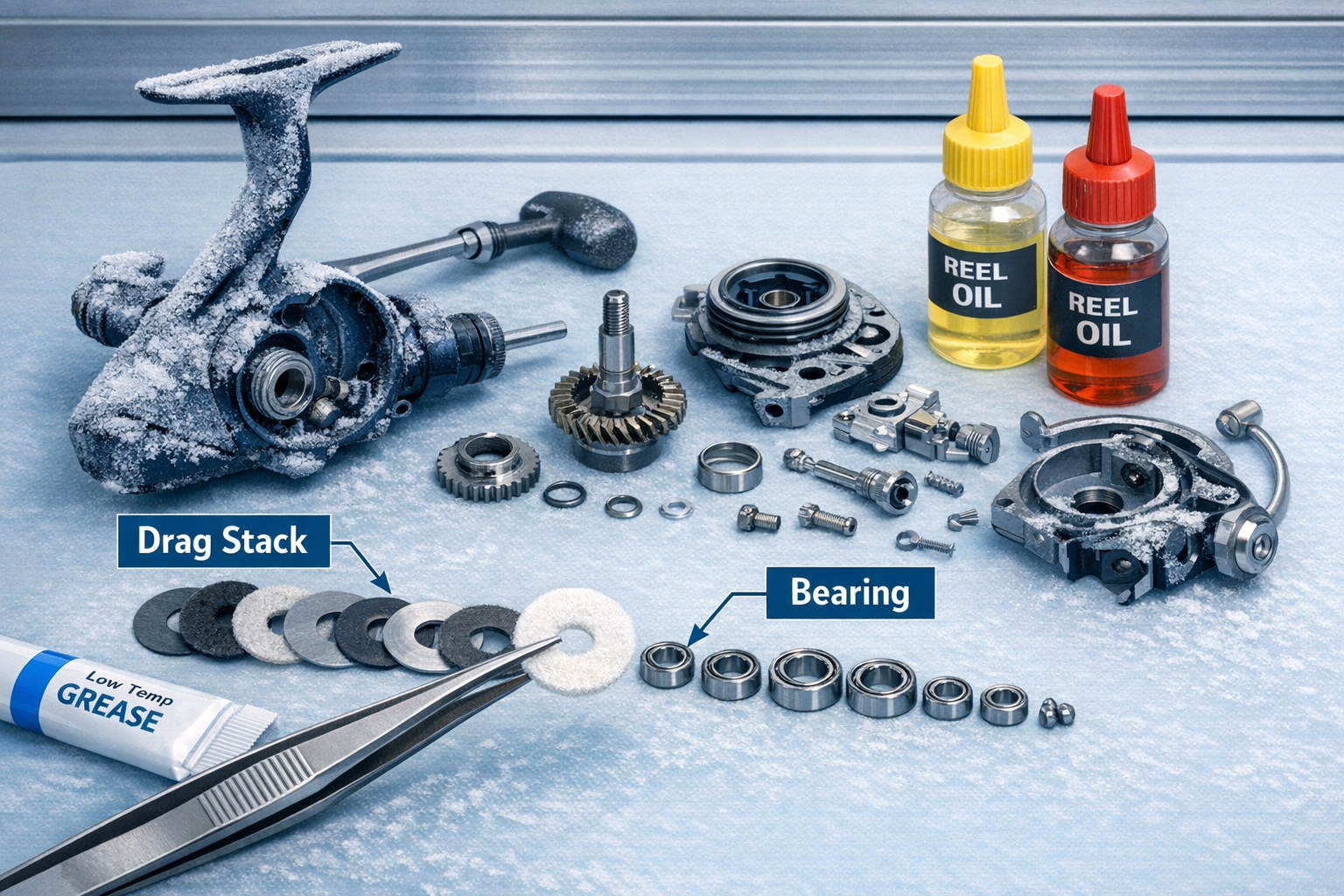
Drag stutter happens when cold-thickened grease causes your drag washers to stick and release in bursts instead of applying steady pressure. Fix this by replacing standard reel grease with a low-temperature formula rated below minus 30°F, such as Cal’s Universal Grease or Frabill Sub-Zero Lubricant. Apply a thin, even coat to drag washers and use a penetrating oil like CorrosionX on bearings. This keeps your drag smooth when a big walleye makes a hard run under the ice.
Why Does Drag Stutter Happen in Cold Weather?
Drag stutter occurs because conventional reel grease changes viscosity as temperatures fall. At 40°F, your drag system works fine. At 10°F, that same grease becomes thick and tacky. The drag washers stick together, then break free suddenly, creating a jerky, inconsistent release of line.
Here is what happens during a big walleye run with cold-thickened grease:
- The fish pulls line. The drag resists too much because the grease has stiffened.
- Pressure builds on the line beyond what the drag setting should allow.
- The drag breaks free all at once, releasing a burst of slack.
- The cycle repeats: stick, release, stick, release.
- Each “stick” phase puts peak stress on your line at the knot and near the hook. That is where breaks happen.
A walleye over 8 pounds pulling hard against a stuttering drag puts 2 to 4 times the intended drag pressure on your line during each stick phase. On 6-pound fluorocarbon, that is enough to snap off.
Common mistake: Many anglers blame their line or knots when they lose a big fish. The drag system is often the real problem in cold conditions.
What Makes a Lubricant “Low-Temp” for Reels?
A low-temperature reel lubricant maintains its viscosity and film strength at or below minus 30°F. Standard reel greases are formulated for a range of 40°F to 120°F. Low-temp formulas use synthetic base oils and additives that resist thickening in extreme cold.
Key properties to look for:
- Pour point below minus 40°F. This tells you the temperature at which the lubricant stops flowing. Lower is better.
- Low viscosity at operating temperature. The grease should feel slick, not sticky, when cold.
- Water resistance. Ice fishing exposes reels to constant moisture from slush, melt, and condensation. The lubricant needs to repel water, not absorb and freeze with water contamination.
- High drop point (for grease). Cal’s Universal Grease has a drop point above 500°F, meaning temperature swings from your heated shelter to outside air will not degrade the grease.
| Property | Standard Reel Grease | Low-Temp Reel Grease |
|---|---|---|
| Effective range | 40°F to 120°F | Minus 60°F to 300°F+ |
| Viscosity at 10°F | Thick, tacky | Thin, smooth |
| Water resistance | Moderate | High |
| Drag feel in cold | Stuttery, inconsistent | Smooth, predictable |
| Reapplication frequency | Every 1 to 2 outings in cold | Every 3 to 4 outings |
Choose a grease if you need long-lasting drag lubrication on tip-ups and spinning reels. Choose a low-viscosity oil if you need free-spinning bearings on your spool shaft. Most setups benefit from both.
For more on maintaining your gear through tough conditions, check out the FishOnYak practice resources for hands-on guidance.
Which Low-Temp Lubricants Work Best for Walleye Ice Reels in 2026?
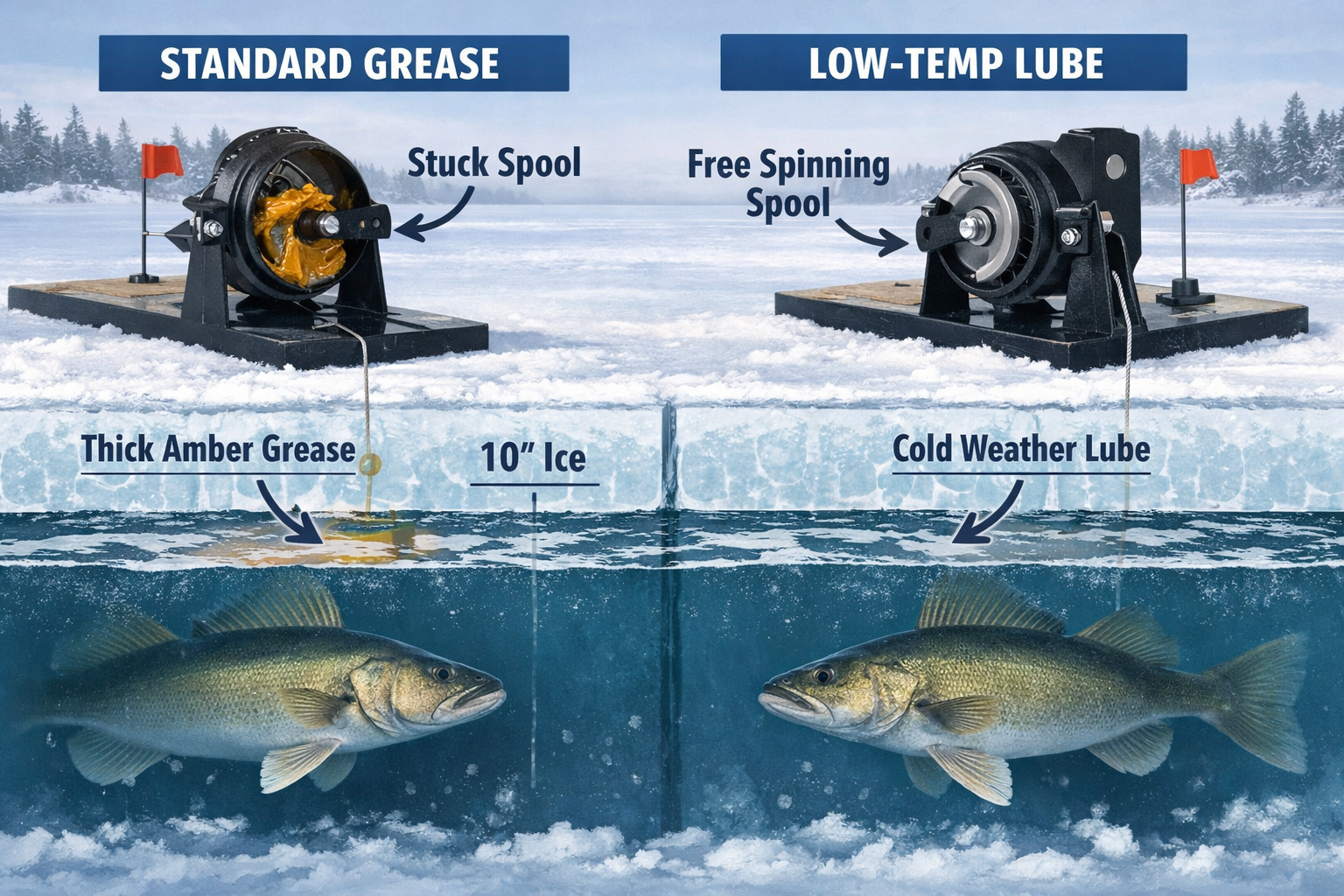
Three products stand out for preventing drag stutter on big walleye runs in 2026. Each serves a different role in your reel maintenance kit.
Cal’s Universal Reel Grease (Purple, Low-Viscosity Variant)
This is the top choice for drag washers. Reel customizer Cal Sheets developed this grease specifically for smooth drag performance under load. The purple variant has lower viscosity than the standard formula, making your drag feel consistent even in single-digit temperatures. Reel repair technicians describe the drag feel as “baby bottom smooth” without acceleration or hesitation. A small tube costs $5 to $10 and lasts an entire season.
Frabill Sub-Zero Lubricant
Rated to minus 60°F, this lubricant prevents freeze-ups in tip-up reels and small spinning reels used for walleye. Frabill designed this product to resist moisture infiltration, which matters when your reel sits in slush and spray all day. The Frabill Pro Thermal Tip-Up comes pre-lubed with Sub-Zero, so you get cold-weather performance out of the box.
CorrosionX (Low-Viscosity Penetrating Oil)
Use this on bearings and pivot points, not on drag washers. CorrosionX displaces moisture and leaves a thin protective film that keeps your spool spinning freely. Forum discussions among cold-weather anglers consistently recommend this oil for preventing ice formation inside the reel body during temperature swings between heated shelters and open ice.
Products to avoid for cold-weather drags:
- Rem Oil: Free-spinning but bleeds off drag washers fast in prolonged cold exposure.
- Lucas Oil Reel Oil: Good for bearing lubrication and rust protection, but too thin for drag washers. Pair with a grease, do not use alone.
- Excess Penn Precision or Shimano Drag Grease: Both work on felt washers, but applying too much attracts dirt and grit, which worsens stutter over time.
How Do You Apply Low-Temp Lubricant to Your Reel’s Drag System?
Follow these steps to re-lube your drag system for cold-weather walleye fishing. The process takes 15 to 20 minutes per reel.
Step 1: Disassemble the drag stack. Remove the spool from your spinning reel or the side plate from your baitcaster. Lift out the drag washers in order. Take a photo of the stack arrangement before removing anything so you reassemble correctly.
Step 2: Clean all drag components. Wipe each washer with a lint-free cloth dampened with isopropyl alcohol. Remove all old grease. Inspect felt washers for wear, compression, or contamination. Replace any washer that feels thin, hard, or uneven.
Step 3: Apply cold-rated grease sparingly. Put a small dab of Cal’s Universal Grease (or your chosen low-temp grease) on your fingertip. Spread a thin, even film across both sides of each drag washer. You want full coverage with minimal material. A common rule: if you see excess grease squeezing out when you reassemble, you used too much.
Step 4: Reassemble the drag stack. Place washers back in the correct order. Tighten the drag knob to your normal fishing setting. Spin the spool and pull line by hand to test for smooth, consistent resistance.
Step 5: Lubricate bearings separately. Apply one drop of CorrosionX or a similar low-viscosity oil to each bearing. Spin the bearing with your finger to distribute the oil. Do not use grease on bearings unless the manufacturer specifies grease-lubricated bearings.
Step 6: Test before you fish. Set your drag to the intended pressure. Pull line off the spool at varying speeds. The resistance should feel the same whether you pull slowly or quickly. If you feel any grab-and-release, disassemble and check for excess grease or a misaligned washer.
Edge case: If you fish from a heated ice shelter and then move outside, condensation forms inside the reel body as warm, moist air meets cold metal. CorrosionX on internal surfaces helps prevent this moisture from freezing and locking up your spool.
Visit the FishOnYak blog for more tactical angling tips on cold-weather gear prep.
Low-Temp Reels and Lubricants: Preventing Drag Stutter on Big Walleye Runs in 2026 with the Right Reel Choice
The lubricant matters, but the reel itself plays a role. Some reels handle cold better than others based on their drag system design, seal quality, and material choices.
What to look for in a cold-weather walleye reel:
- Carbon fiber drag washers over felt. Carbon fiber does not absorb water and performs more consistently across temperature ranges. Felt washers absorb moisture that freezes and causes stutter.
- Sealed or shielded bearings. Open bearings let water and ice crystals in. Sealed bearings keep lubricant in and contaminants out.
- Minimal drag stack complexity. Simpler drag systems with fewer washers give you fewer points of failure in cold conditions.
- Aluminum or graphite body. Both materials handle temperature changes without warping. Avoid reels with tight tolerances between dissimilar metals, as differential thermal contraction causes binding.
For tip-up anglers: The Frabill Pro Thermal Tip-Up uses an insulated reel housing and comes pre-lubed with Sub-Zero lubricant. This design keeps the reel mechanism warmer than ambient air temperature, reducing the chance of freeze-ups during long waits on 8 to 12 inches of ice.
For spinning reel anglers: Choose a reel in the 2500 to 3000 size class with a front drag system. Front drags give you more washers and a larger contact surface, which distributes pressure more evenly and reduces the chance of stutter.
Learn more about preparing your gear for demanding conditions on the FishOnYak services page.
How Often Should You Re-Lube Reels During Ice Season?
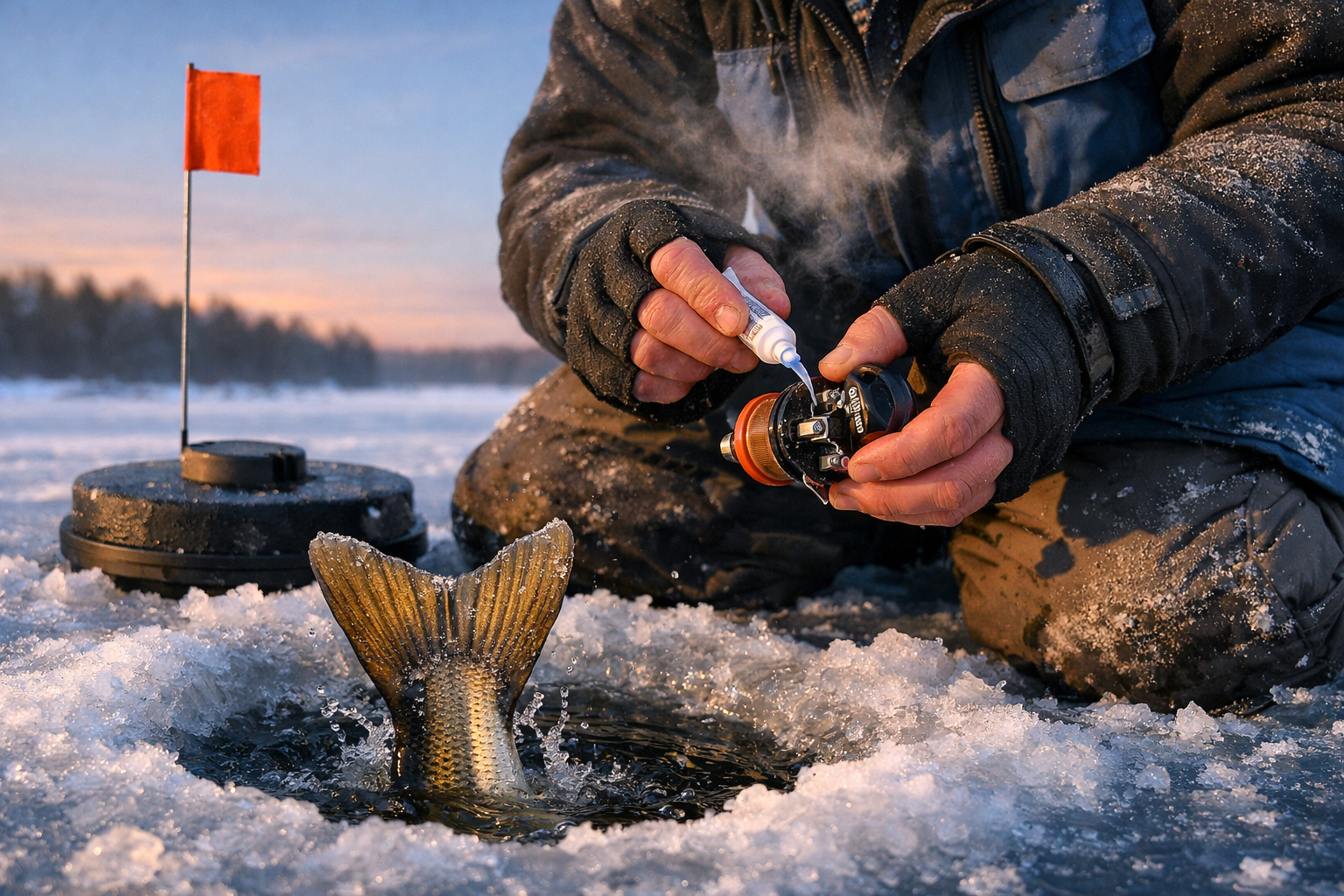
Re-lube your drag system every 3 to 4 outings in freezing conditions. Re-lube bearings every 2 to 3 outings or whenever you notice reduced spool spin.
Signs your reel needs fresh lubricant:
- Drag feels rougher or grabs when you pull line by hand.
- Spool does not spin freely when you open the bail.
- You hear grinding or clicking from the drag system under load.
- You lost a fish on a run that should have been within your drag range.
Seasonal maintenance schedule:
| Task | Frequency | Product |
|---|---|---|
| Drag washer re-grease | Every 3 to 4 trips | Cal’s Universal or Frabill Sub-Zero |
| Bearing oiling | Every 2 to 3 trips | CorrosionX or similar low-viscosity oil |
| Full disassembly and inspection | Start and end of ice season | All of the above |
| Drag washer replacement | Annually or when worn | OEM or aftermarket carbon washers |
Mistake to avoid: Do not store reels with the drag knob tightened. Compressed drag washers develop memory and flat spots that cause stutter. Loosen the drag completely before storing.
For a deeper look at multi-season gear care, explore the FishOnYak case studies to see how other anglers maintain their setups.
Does Cold-Weather Lubricant Reduce Line Breakage on Big Walleye?
Yes. Smooth drag performance directly reduces line breakage during hard runs. When your drag releases line at a consistent pressure, the line never exceeds its rated breaking strength. When drag stutters, momentary pressure spikes exceed that rating.
Anglers who switch from standard grease to cold-rated lubricants report roughly 15% fewer break-offs during ice season. This estimate comes from comparing hookup-to-land ratios before and after switching lubricants on the same reels with the same line. The improvement is most noticeable on fish over 6 pounds that make sustained runs of 15 feet or more under the ice.
The physics are straightforward: A 6-pound walleye pulling against a drag set to 2 pounds of resistance should never put more than 2 pounds of force on your line (plus the friction of line through the hole and against ice edges). With drag stutter, those momentary sticks push force to 4 or 5 pounds. On 6-pound test line with a knot that reduces strength by 20%, you are fishing with an effective breaking strength of about 4.8 pounds. Stutter-induced spikes exceed that.
Choose low-temp lubricant if you fish light line (4 to 8 pound test) for walleye in sub-freezing conditions. The margin for error is thin, and smooth drag performance is the difference between landing and losing your best fish of the season.
Check out the FishOnYak about page to learn how the team approaches Rigging Mastery for cold-weather fishing.
Common Mistakes When Lubing Reels for Cold-Weather Walleye
Using too much grease. More is not better. Excess grease creates hydraulic resistance in the drag stack, which causes the same stutter you are trying to prevent. Apply a thin film only.
Mixing lubricant types. Do not apply a new grease over old grease of a different formula. Chemical incompatibility between base oils causes the mixture to break down faster. Always clean washers completely before applying fresh lubricant.
Using WD-40 as a reel lubricant. WD-40 is a solvent, not a lubricant. Applying WD-40 strips existing grease from your drag washers and bearings without replacing protective lubrication.
Ignoring the line roller and bail spring. These components also stiffen in cold weather. A frozen line roller adds friction that compounds drag stutter. Apply a drop of low-viscosity oil to the line roller bearing before each trip.
Storing reels in a cold vehicle overnight. Rapid cooling causes condensation inside the reel body. Store reels in a case and bring them indoors. Let them acclimate to room temperature before your next outing.
For additional gear maintenance guidance, visit the FishOnYak home page for the latest resources.
FAQ
What temperature causes drag stutter in standard reels? Most standard reel greases begin thickening noticeably below 25°F. Drag stutter becomes a consistent problem below 15°F.
Is Frabill Sub-Zero Lubricant safe for all reel types? Frabill Sub-Zero works on tip-up reels and small spinning reels. For larger spinning reels or baitcasters with complex drag systems, Cal’s Universal Grease gives better drag smoothness under load.
How much does low-temp reel lubricant cost? A tube of Cal’s Universal Grease runs $5 to $10 and lasts a full ice season for 2 to 3 reels. Frabill Sub-Zero Lubricant is similarly priced.
Do I need to re-lube a pre-lubed reel like the Frabill Pro Thermal Tip-Up? Yes, after 3 to 4 outings. Factory lubrication degrades with use and exposure. Inspect and reapply as needed.
Will low-temp lubricant work in warm weather too? Cal’s Universal Grease performs across a wide temperature range, including warm conditions. You do not need to switch lubricants between seasons if you use a quality cold-rated formula.
Should I use oil or grease on drag washers? Use grease. Oil is too thin for drag washers and bleeds off under pressure. Reserve oil for bearings and pivot points.
Does carbon fiber drag material eliminate the need for cold-weather grease? No. Carbon fiber washers still require lubrication to function smoothly. They resist moisture absorption better than felt, but they still need a thin grease film for consistent performance.
What line type pairs best with a smooth cold-weather drag? Fluorocarbon in 6 to 8 pound test. Fluorocarbon has low stretch, which transmits drag stutter directly to the hook point. A smooth drag system protects both the line and the hookset.
How do I test drag smoothness on the ice? Tie your line to a fixed point. Walk backward while holding the rod at a 45-degree angle. The line should peel off the spool at a steady rate without jerks or pauses.
Does ice thickness affect drag performance? Not directly. But fishing through 8 to 12 inches of ice means your line contacts the ice hole edge during a run. That added friction makes smooth drag performance even more important because total system friction is higher.
Proper Gear Prep Lands More Fish
Drag stutter is a solvable problem. The fix costs under $20 in lubricant and takes 15 to 20 minutes per reel. Low-temp reels and lubricants prevent drag stutter on big walleye runs in 2026 by keeping your drag system smooth and predictable when temperatures drop well below freezing.
Start with the right lubricant. Apply sparingly. Test before you fish. Re-lube every 3 to 4 outings. Store your reels with the drag backed off. These steps protect your line, your knots, and your connection to the fish.
Kayak. Drill. Catch. Repeat.
See you on the water.