Last updated: March 3, 2026
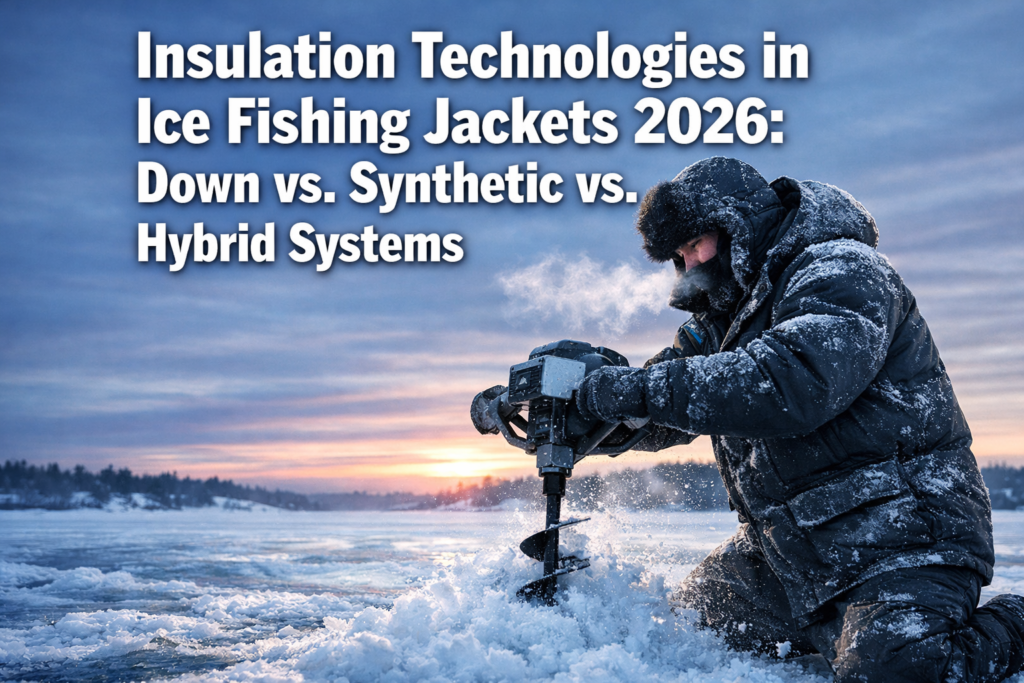
Synthetic insulation now matches down in warmth output while handling wet conditions far better on the ice. That single development defines insulation technologies in ice fishing jackets 2026: down vs. synthetic vs. hybrid systems. If you fish in slush, snow, or freezing rain, your insulation choice determines whether you stay warm for two hours or ten. This guide breaks down each insulation type, compares performance in real ice fishing conditions, and helps you pick the right system for your style and budget.
Key Takeaways
- Synthetic insulation (PrimaLoft, Thermadex, Climashield APEX) retains warmth when wet, making it the top choice for slushy ice conditions.
- Down offers the best warmth-to-weight ratio but loses insulating ability after 25 to 60 minutes of moisture saturation.
- Hybrid systems place down in the torso and synthetic in the arms and shoulders, but remain largely unproven for dedicated ice fishing.
- Expect to pay $100 to $300 for quality synthetic jackets and $250 to $500+ for down or hybrid options.
- PFC-free DWR treatments on 2026 synthetics improve water repellency and environmental safety.
- For temperatures below negative 20 degrees Fahrenheit, choose 150g or heavier synthetic fill with a proper layering system.
- Down jackets pack smaller and weigh less, which matters if you hike to remote spots but not if you drive an ATV to your shanty.
Quick Answer
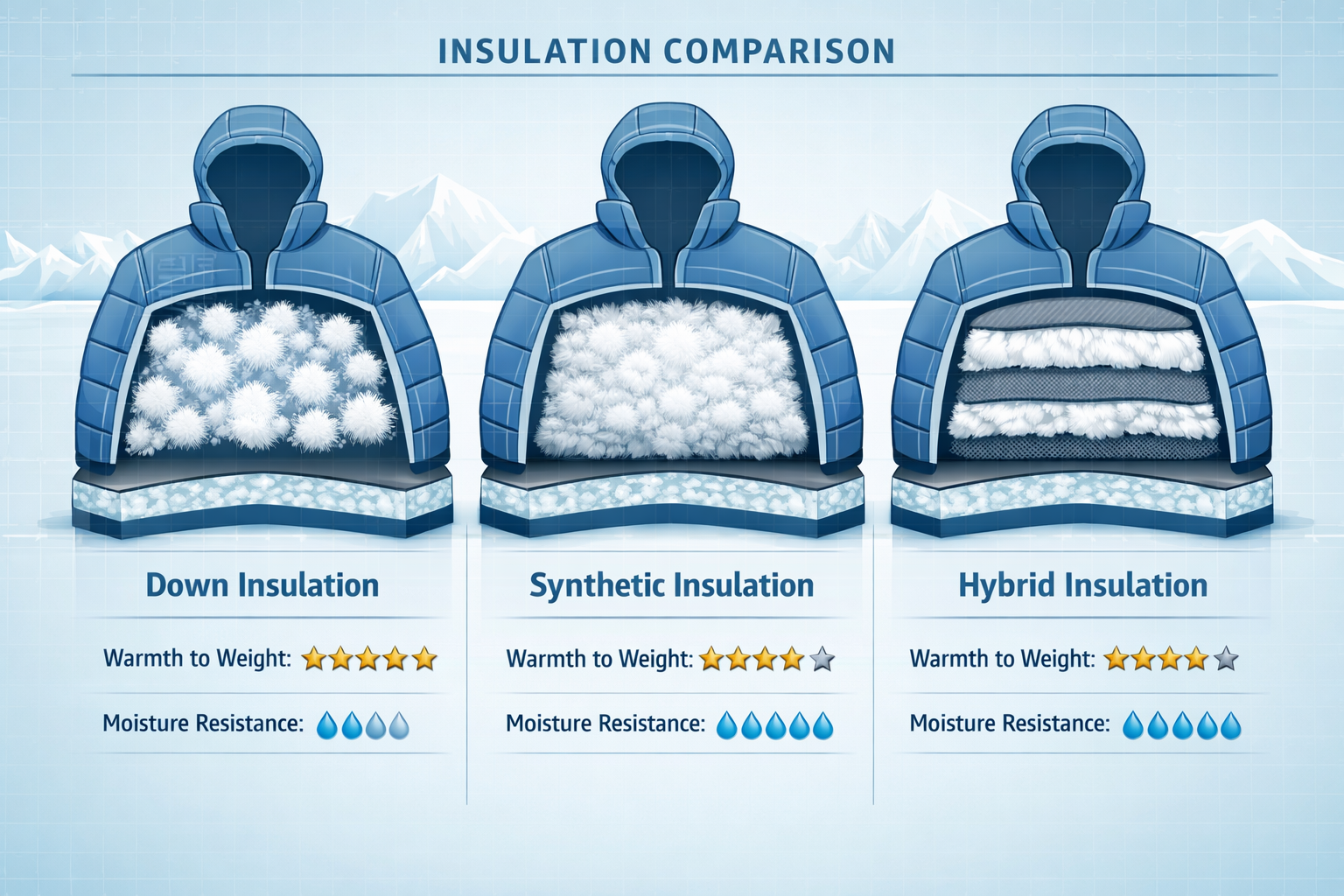
Choose synthetic insulation if you fish in wet, active conditions on the ice. Pick down if you need maximum warmth in dry, stationary setups and you protect the jacket from moisture. Consider a hybrid if you want a versatile jacket for mixed conditions, but know that hybrid systems for ice fishing are still emerging. For most anglers drilling holes and jigging in 2026, synthetic wins on performance and value.
Why Does Insulation Type Matter for Ice Fishing?
Your jacket’s insulation is the barrier between your body heat and air temperatures that drop to negative 40 degrees Fahrenheit. The wrong choice leads to cold, fatigue, and safety risks.
Ice fishing creates a unique challenge. You sit still for long periods, which reduces body heat output. You also handle wet lines, slush, and snow that soak your outer layers. Standard outdoor insulation ratings don’t account for these conditions. A jacket rated for negative 20 degrees in dry alpine air performs differently when you’re kneeling in slush on a frozen lake.
The three insulation categories available in 2026 each handle this challenge differently:
- Down traps air in clusters of fine feathers. Dry air pockets create warmth. Wet feathers clump and lose those air pockets.
- Synthetic uses engineered fibers (polyester, PrimaLoft, Thermadex) that hold structure when wet. Water passes through without collapsing the fiber matrix.
- Hybrid combines both materials in different jacket zones, aiming for the strengths of each.
Understanding these differences helps you make a decision based on how and where you fish, not on marketing claims. Check out the FishOnYak showroom for gear recommendations tailored to multi-season anglers.
How Does Down Insulation Perform on the Ice?
Down delivers the highest warmth-to-weight ratio of any insulation. A jacket with 800-fill goose down weighs less and packs smaller than any synthetic alternative at the same warmth level.
Where down works well for ice fishing:
- Stationary fishing inside a heated shelter where moisture exposure is minimal
- Short sessions (under two hours) in dry, cold conditions
- Hiking to remote ice fishing spots where packability and low weight matter
Where down fails:
- Extended sessions in snow, slush, or freezing rain
- Active jigging or hole-hopping that generates sweat
- Any situation where the jacket contacts wet ice or water
Jottnar experts note that hydrophobic treatments like DownTek extend wet resistance to about 25 hours. That sounds impressive, but ice fishing involves direct, repeated moisture contact that overwhelms even treated down over a full day. Once down gets saturated, it clumps. You lose warmth fast, and the jacket takes hours to dry, sometimes requiring a tumble dryer with tennis balls to restore loft.
Common mistake: Buying a down jacket because of its warmth rating without considering moisture exposure. A 900-fill down jacket rated to negative 30 degrees performs like a windbreaker once the fill gets wet.
Choose down if you fish exclusively in shelters, keep sessions short, and prioritize ultralight gear for the walk in.
What Makes Synthetic Insulation the 2026 Standard for Ice Fishing?
Synthetic insulation dominates the 2026 ice fishing jacket market because it solves the moisture problem that down cannot. Materials like PrimaLoft Silver, Thermadex, and Climashield APEX maintain their fiber structure when wet, so you keep warmth even after kneeling in slush or handling wet gear.
Key synthetic insulation options in 2026 ice fishing jackets:
| Insulation Type | Weight (g/m2) | Wet Performance | Breathability | Found In |
|---|---|---|---|---|
| PrimaLoft Silver | 60g | Strong | 15,000 g/m2/24hr | Simms Challenger [1] |
| Thermadex | 150g | Strong | Moderate | Striker Hardwater [3] |
| Climashield APEX | 100-167g | Strong | Moderate-High | Multiple brands [9] |
| Poly Fiberfill | 100g | Moderate | Moderate | Ice Runner Flotation Jacket [4] |
| PrimaLoft (removable liner) | Varies | Strong | High | Striker Climate Jacket [10] |
The Striker Climate Series stands out in 2026 with its removable PrimaLoft liner system. You add or remove insulation based on conditions, which gives you one jacket for early ice (November) through deep winter (February).
Practical advantages of synthetic for ice anglers:
- Dries 3 to 5 times faster than down after getting wet
- Costs $100 to $300 for quality options versus $250 to $500+ for comparable down
- Hypoallergenic, which matters for anglers with feather sensitivities
- Easier to wash and maintain at home without special detergents
- PFC-free DWR coatings on 2026 models improve surface water repellency without environmental harm
The tradeoff: Synthetic insulation is bulkier and heavier than down at the same warmth level. A 150g synthetic jacket takes up more space in your gear bag than an equivalent down jacket. For ice fishing, this tradeoff rarely matters because you’re not backpacking. You’re driving to the lake.
Treeline Review tested Climashield APEX in wet-cold conditions in Iceland and found it outperformed down for sustained warmth in freezing precipitation. That mirrors exactly what you face on the ice.
For anglers building a tournament-ready gear setup, explore FishOnYak’s services for coaching on cold-weather preparation and tactical angling strategies.
How Do Hybrid Insulation Systems Work in Ice Fishing Jackets?
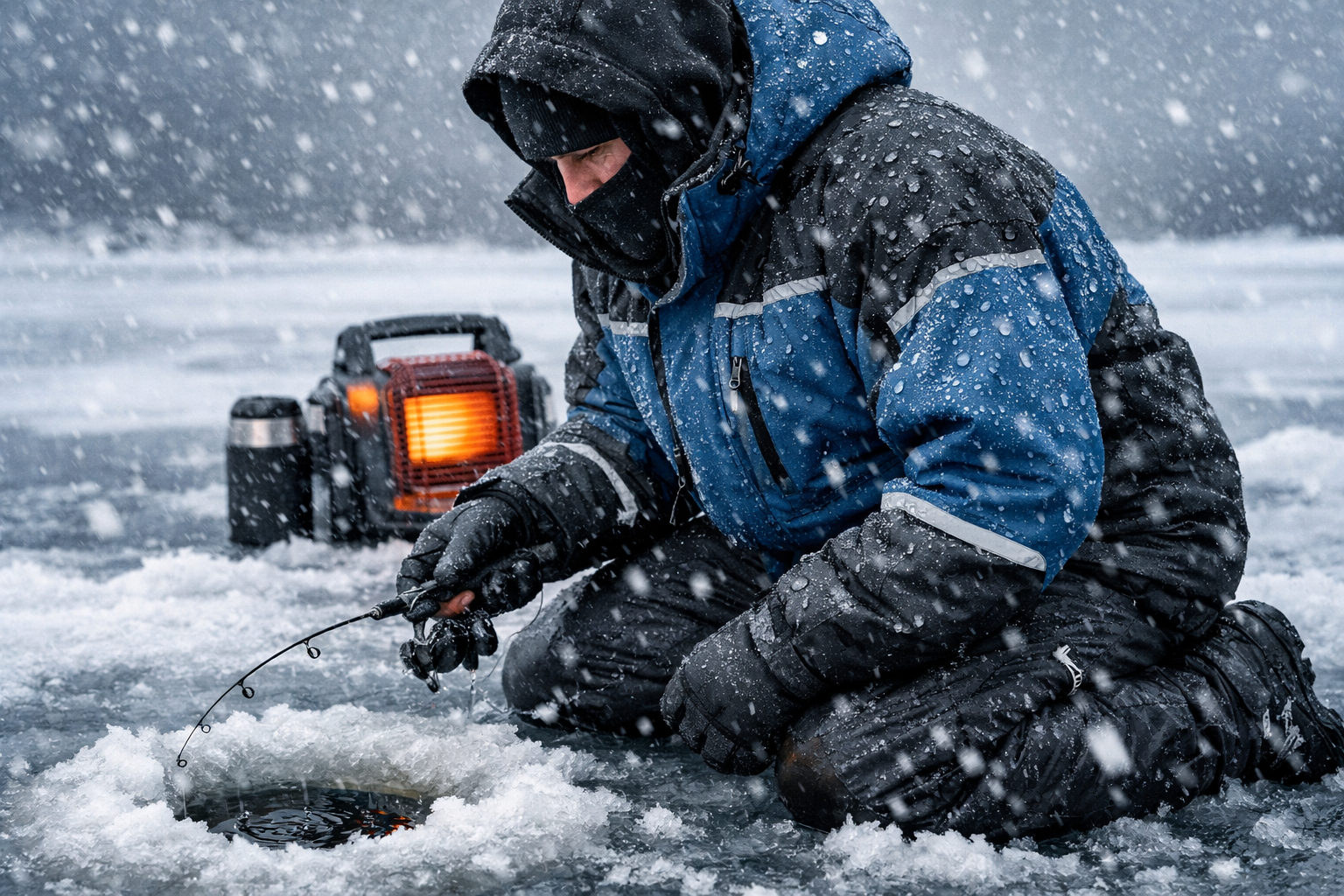
Hybrid systems place down insulation in the torso (where you need maximum warmth and minimal moisture contact) and synthetic insulation in the arms, shoulders, and hood (where sweat and external moisture hit hardest).
The concept is sound. Your core generates and retains the most heat. Your arms move, sweat, and contact wet surfaces. By matching insulation type to body zone, hybrids aim to deliver down-level warmth with synthetic-level moisture management.
Current state of hybrid ice fishing jackets in 2026:
Hybrid systems exist in mountaineering and backcountry skiing jackets from brands like Arc’teryx and Rab. For dedicated ice fishing, hybrid designs remain limited. No major ice fishing brand (Striker, Eskimo, Clam, Ice Runner) has released a purpose-built hybrid ice fishing jacket as of March 2026.
Should you buy a hybrid for ice fishing?
- Choose hybrid if you crossover between backcountry skiing and ice fishing and want one jacket for both
- Skip hybrid if you want a jacket designed specifically for ice fishing conditions, including flotation features
- Watch for hybrid designs entering the ice fishing market in late 2026 and 2027 as the technology matures
Edge case: Some anglers create DIY hybrid systems by wearing a down vest under a synthetic shell jacket. This approach gives you torso warmth from down with full synthetic protection on the arms. The downside is added bulk and potential gaps at the waist where cold air enters.
The FishOnYak blog covers gear layering strategies for multi-season adventurers who transition between saltwater and ice environments.
Insulation Technologies in Ice Fishing Jackets 2026: Down vs. Synthetic vs. Hybrid Systems Compared
Here is a direct comparison across the factors that matter most on the ice:
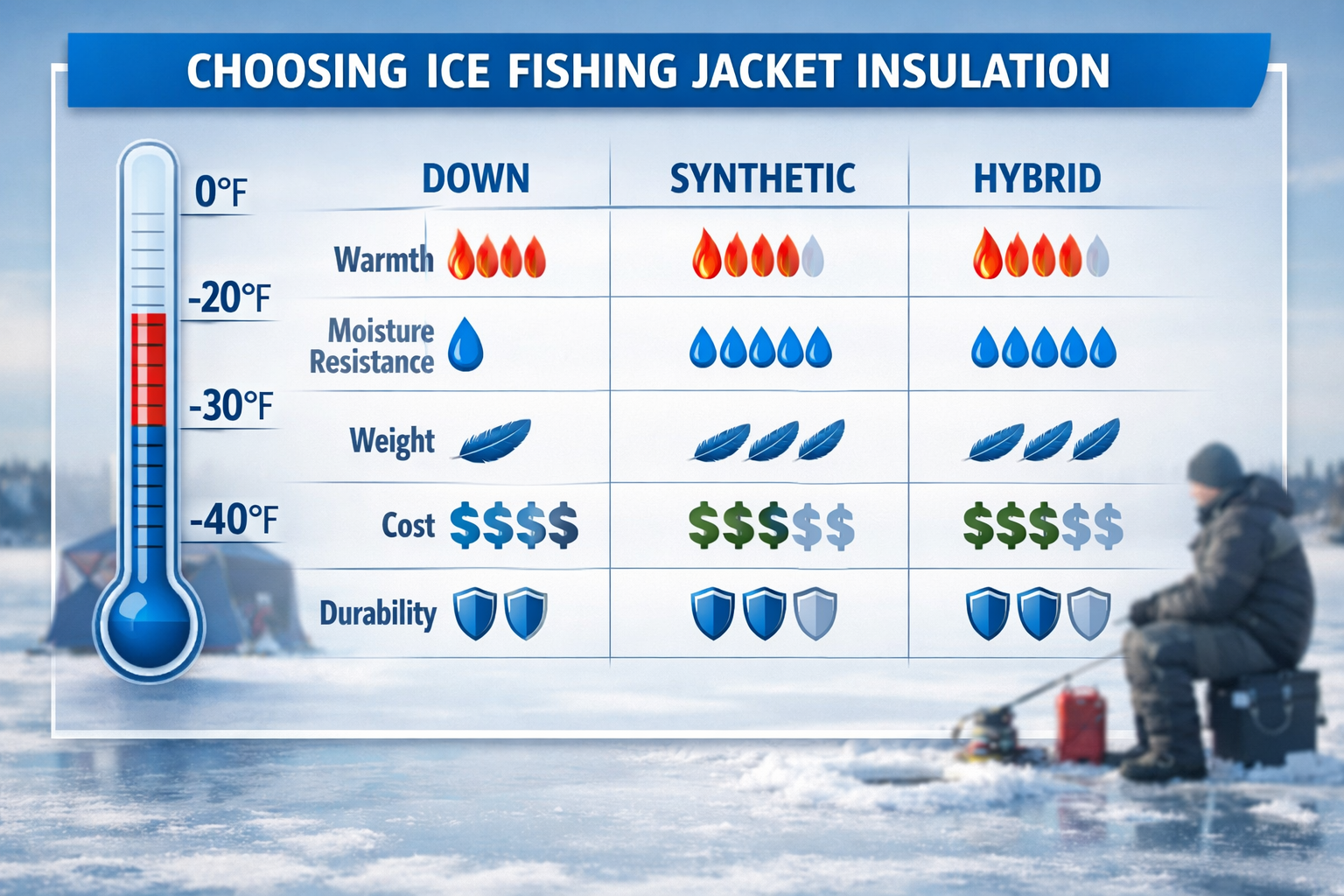
| Factor | Down | Synthetic | Hybrid |
|---|---|---|---|
| Warmth-to-weight ratio | Best | Good | Very Good |
| Wet performance | Poor (clumps) | Strong (retains loft) | Moderate (zone-dependent) |
| Drying time | 6-12 hours | 1-3 hours | 3-6 hours |
| Packability | Best | Moderate | Good |
| Price range | $250-$500+ | $100-$300 | $300-$500+ |
| Durability | 5-10 years (dry care) | 3-7 years | 4-8 years |
| Maintenance | Specialty wash required | Machine washable | Mixed care |
| Ice fishing suitability | Low (unless sheltered) | High | Moderate (unproven) |
| Flotation compatibility | Rare | Common [4][7] | Rare |
Decision rule: If you fish exposed on the ice in any conditions involving moisture, synthetic wins. If you fish inside a heated shelter in dry cold, down works. If you want versatility across multiple outdoor sports, hybrid offers a compromise.
What Temperature Ratings Should You Look For?
Match your insulation weight to your coldest expected fishing temperature and your activity level.
General guidelines for synthetic insulation weight:
- 60g (PrimaLoft Silver): Best for active jigging in temperatures above 10 degrees Fahrenheit. High breathability prevents overheating.
- 100g (Poly Fiberfill, Climashield): Good for moderate cold (negative 10 to 10 degrees Fahrenheit) with moderate activity.
- 150g+ (Thermadex, heavy PrimaLoft): Required for extreme cold (negative 20 to negative 40 degrees Fahrenheit) or stationary fishing.
Common mistake: Buying the heaviest insulation available without considering activity level. A 150g jacket while actively hole-hopping causes sweat buildup, which defeats the purpose of moisture-resistant insulation. Layer up for stationary fishing. Layer down for active fishing.
For down, look for 700-fill power or higher. Anything below 600-fill power does not justify the premium price over synthetic.
What About Flotation-Integrated Insulation?
Several 2026 ice fishing jackets combine synthetic insulation with built-in flotation. This matters for safety. If you break through the ice, a flotation jacket keeps you at the surface while the synthetic insulation continues providing warmth in the water.
The Eskimo Expedition Jacket with Uplyft flotation and the Ice Runner Flotation Jacket (100g poly fiberfill) both offer this combination. Down jackets with flotation are rare because down loses all insulating value when submerged.
Fluid safety protocol: If you fish on early ice or late ice (thinner conditions), a flotation-integrated synthetic jacket is a baseline safety requirement. Learn more about safety-first gear approaches on the FishOnYak about page.
How Should You Layer with Each Insulation Type?
Layering strategy changes based on your jacket’s insulation:
With synthetic insulation (most common):
- Base layer: Moisture-wicking merino wool or synthetic fabric
- Mid layer: Fleece or thin synthetic puffy (add for stationary fishing, remove for active)
- Outer layer: Your insulated synthetic ice fishing jacket with DWR coating
With down insulation:
- Base layer: Moisture-wicking fabric (critical to prevent sweat from reaching down)
- Mid layer: Thin fleece only (avoid overheating)
- Outer layer: Down jacket with waterproof shell over top
- Vapor barrier: Some anglers add a vapor barrier liner between base and mid layer to prevent body moisture from reaching the down
With hybrid insulation:
- Follow the synthetic layering approach. The synthetic zones handle moisture. The down zones benefit from the same sweat management strategy.
Visit the FishOnYak contact page to connect with coaching experts who help anglers build complete cold-weather systems.
What Are the Biggest Mistakes Anglers Make with Insulation in 2026?
- Choosing down for exposed ice fishing. Down fails in wet conditions. Period. Unless you fish exclusively in a heated shelter, synthetic is safer.
- Ignoring breathability ratings. A warm jacket that traps sweat makes you colder over time. Look for breathability ratings of 10,000 g/m2/24hr or higher.
- Skipping the DWR check. DWR (Durable Water Repellent) coatings wear off over time. Reapply DWR spray every 10 to 15 washes or when water stops beading on the surface.
- Overdressing for active fishing. More insulation is not always better. Match insulation weight to your activity level and temperature.
- Washing down jackets in regular detergent. Standard detergent strips natural oils from down clusters and destroys loft. Use down-specific wash products.
Conclusion
The insulation technologies in ice fishing jackets 2026: down vs. synthetic vs. hybrid systems conversation has a clear winner for most ice anglers. Synthetic insulation handles the wet, demanding conditions of ice fishing better than down or hybrid alternatives. Materials like PrimaLoft, Thermadex, and Climashield APEX retain warmth when soaked, dry fast, and cost less than down [1][3][9]. Down still earns a place for ultralight, dry-condition use. Hybrid systems show promise but need purpose-built ice fishing designs before they become a reliable choice.
Your next steps:
- Assess your typical fishing conditions: exposed or sheltered, active or stationary, wet or dry.
- Choose synthetic insulation at 100g or higher for general ice fishing. Go 150g+ for extreme cold.
- Prioritize jackets with flotation integration if you fish early or late ice.
- Build a layering system around your jacket’s insulation type.
- Check out the FishOnYak showroom for recommended gear and the FishOnYak blog for seasonal transition guides.
Kayak. Drill. Catch. Repeat.
See you on the water.
FAQ
Q: Does down insulation work for ice fishing? A: Down works for short sessions in dry, sheltered conditions. For exposed ice fishing with moisture contact, synthetic insulation performs better because it retains warmth when wet.
Q: What is the best synthetic insulation for ice fishing in 2026? A: PrimaLoft Silver and Thermadex lead the 2026 market. PrimaLoft Silver offers high breathability (15,000 g/m2/24hr) for active fishing. Thermadex at 150g provides maximum warmth for stationary fishing in extreme cold.
Q: How much should a good ice fishing jacket cost? A: Quality synthetic ice fishing jackets range from $100 to $300. Down jackets run $250 to $500+. Hybrid options start around $300.
Q: Are hybrid insulation jackets available for ice fishing? A: Purpose-built hybrid ice fishing jackets are limited as of March 2026. Most hybrid designs come from mountaineering brands. Ice fishing brands focus on synthetic insulation with flotation features.
Q: How do I maintain the DWR coating on my ice fishing jacket? A: Reapply a DWR spray every 10 to 15 washes or when water stops beading on the jacket surface. Use PFC-free DWR products for environmental safety.
Q: What insulation weight do I need for negative 30 degrees Fahrenheit? A: Use 150g or heavier synthetic fill combined with proper base and mid layers. A 60g jacket will not provide enough warmth at that temperature without significant layering.
Q: Do flotation jackets use down insulation? A: Flotation ice fishing jackets use synthetic insulation because down loses all insulating value when submerged. The Ice Runner Flotation Jacket uses 100g poly fiberfill.
Q: How long does down take to dry compared to synthetic? A: Down takes 6 to 12 hours to dry fully and often requires a tumble dryer. Synthetic insulation dries in 1 to 3 hours and air-dries effectively.
Q: Is hydrophobic down a good alternative to synthetic for ice fishing? A: Hydrophobic treatments like DownTek extend wet resistance to about 25 hours, but repeated moisture contact on the ice overwhelms even treated down over a full day of fishing.
Q: What breathability rating should I look for in an ice fishing jacket? A: Look for 10,000 g/m2/24hr or higher. The Simms Challenger with PrimaLoft Silver offers 15,000 g/m2/24hr, which prevents sweat buildup during active jigging.
References
[1] The 10 Best Ice Fishing Jacket Reviewed – https://bowinsgarment.com/the-10-best-ice-fishing-jacket-reviewed/ [2] Down Vs Synthetic – https://www.jottnar.com/blogs/guides/down-vs-synthetic [3] The 7 Best Ice Fishing Coats Review – https://www.bwfishingclothing.com/the-7-best-ice-fishing-coats-review/ [4] Winter Float Jacket New For 2025 – https://icerunnerhouses.com/winter-float-jacket-new-for-2025/ [5] Down Vs Synthetic Whats The Difference – https://www.trekitt.co.uk/blog/down-vs-synthetic-whats-the-difference/ [6] Best Insulated Jackets – https://www.thegreatoutdoorsmag.com/gear-guides/best-insulated-jackets/ [7] Best Ice Fishing Suits – https://www.outdoorlife.com/gear/best-ice-fishing-suits/ [8] Down Vs Synthetic Guide – https://www.sierra.com/lp2/down-vs-synthetic-guide/ [9] Best Synthetic Insulated Jackets – https://www.treelinereview.com/gearreviews/best-synthetic-insulated-jackets [10] Climate Series 25 – https://www.strikerbrands.com/collections/climate-series-25