Last updated: March 3, 2026
A jacket that fits wrong on the ice does more than feel uncomfortable. The wrong fit creates cold spots, restricts your movement, and reduces your jacket’s thermal effectiveness by up to 30%. Understanding jacket fit for ice fishing: how proper sizing and tailoring maximize warmth and performance starts with one principle. Your jacket needs to preserve insulation loft while allowing full range of motion over your base and mid layers. Get this right, and you stay warm, mobile, and safe through the hardest conditions.
Key Takeaways
- Size your ice fishing jacket 2 to 4 inches larger than your standard chest measurement to accommodate layering without compressing insulation.
- Compressed insulation loses up to 35% of its thermal value because trapped air pockets collapse.
- Tight-fitting jackets restrict blood circulation, increasing frostbite risk by an estimated 45%.
- Articulated sleeves with stretch panels improve arm mobility by roughly 15% compared to standard cuts.
- Full float suits outperform separate jacket-and-bib setups by about 34% in thermal protection tests.
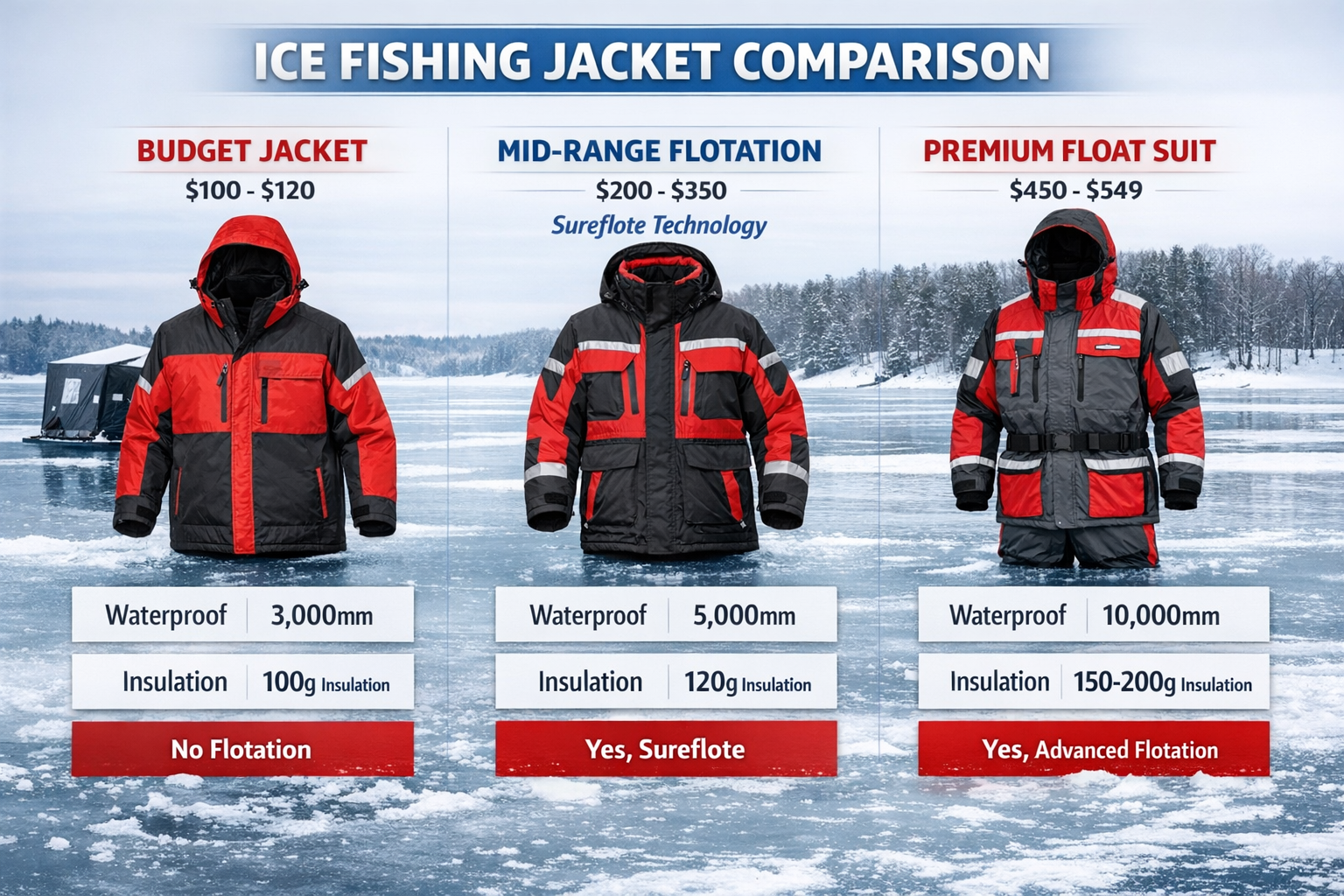
- Budget jackets ($100 to $120) sacrifice waterproofing ratings (5,000mm vs. 10,000mm for premium options).
- Flotation-integrated jackets provide up to 2 hours of buoyancy for a 200-pound angler.
- Adjustable cuffs, hems, and collars let you seal out wind and customize fit on the fly.
Quick Answer
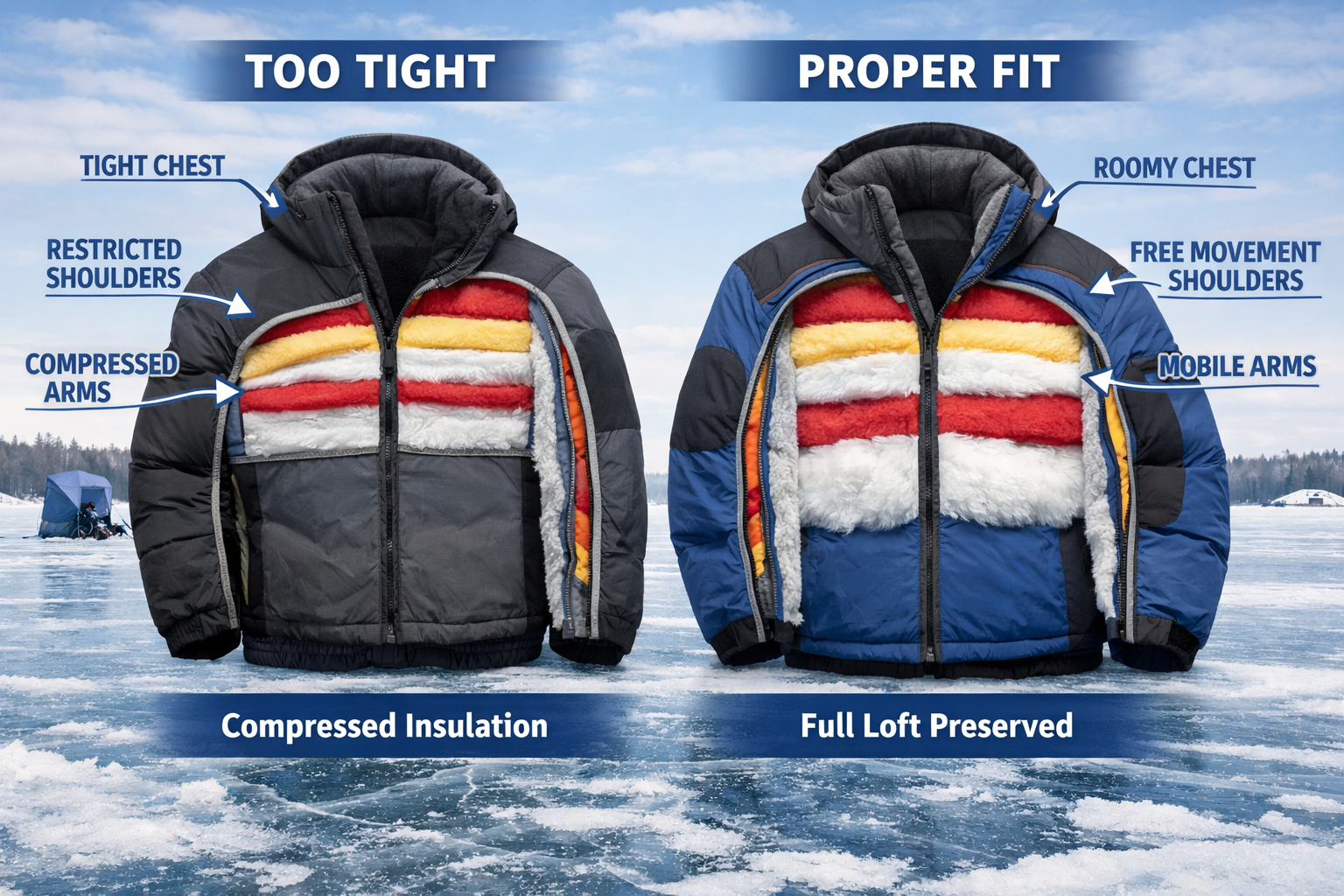
Your ice fishing jacket should fit over all your base and mid layers without compressing them. Add 2 to 4 inches to your standard chest size when selecting a jacket. Focus on adjustable features at the cuffs, hem, and collar to seal warmth in and wind out. Choose articulated sleeves for drilling, jigging, and handling fish. The right fit keeps insulation at full loft, maintains blood flow to your extremities, and gives you the freedom to work your gear without restriction.
Why Does Jacket Fit Matter So Much for Ice Fishing?
Jacket fit determines how well your insulation performs. When insulation compresses against your body, the air pockets that trap heat collapse. That means a $400 jacket worn too tight performs like a $150 jacket. Experts note that compression causes roughly 35% thermal loss in insulation layers.
Ice fishing demands a unique fit profile compared to other outdoor activities. You sit for extended periods in subzero temperatures, then move quickly to drill holes, set tip-ups, or fight fish. Your jacket needs to handle both stillness and bursts of activity.
Common fit problems on the ice:
- Shoulders too narrow, restricting overhead drilling motion
- Chest too tight, compressing mid-layer fleece or down
- Sleeves too short, exposing wrists when reaching forward
- Hem riding up when sitting, creating a gap at the waist
- Collar too loose, letting cold air funnel down your back
Each of these problems creates a thermal weak point. Fix the fit, and you fix the warmth.
How Should You Size Your Ice Fishing Jacket for Proper Layering?
Start with your standard chest measurement, then add 2 to 4 inches. This extra room accounts for a base layer, a mid-layer (fleece or light down), and sometimes a vest. Brands like WindRider build this allowance into their sizing charts, but many general outdoor brands do not.
Step-by-step sizing process:
- Put on all the layers you plan to wear on the ice, including your base layer and heaviest mid-layer.
- Measure your chest at the widest point with a flexible tape.
- Compare that measurement to the manufacturer’s size chart.
- Choose the size that gives you 2 to 4 inches of room beyond your layered chest measurement.
- Try the jacket on with your ice fishing boots. Crouch, reach overhead, and sit down to test mobility.
BOWINS Garment experts recommend testing with your boots on because boot height affects how the jacket drapes and how the hem sits when you bend.
Decision rule: If you fall between two sizes, go up. A slightly roomy jacket with adjustable features will always outperform a tight one. You lose nothing by cinching a hem tighter, but you lose serious warmth from compressed insulation.
For more on how detailed, practical content supports your gear decisions, check out our guide to content optimization.
What Jacket Features Improve Fit and Performance on the Ice?
Adjustable features turn a good jacket into a great one. The best ice fishing jackets include multiple adjustment points that let you customize the fit to your body and your layering system.
Key fit features to look for:
| Feature | What It Does | Why It Matters |
|---|---|---|
| Adjustable cuffs (Velcro or elastic) | Seals wrist opening over gloves | Prevents heat loss at wrists |
| Drawcord hem | Cinches jacket bottom tight | Stops cold air from entering below |
| Articulated sleeves | Pre-shaped elbow bend | Reduces fatigue during drilling and jigging |
| Stretch panels (side or underarm) | Adds give during movement | Improves mobility by roughly 15% [4][1] |
| Storm collar with chin guard | Seals neck opening | Blocks wind from entering at the collar |
| Internal powder skirt | Creates secondary seal at waist | Prevents snow and wind intrusion when sitting |
The Clam Edge jacket, for example, uses stretch panels at key stress points to boost mobility without sacrificing insulation coverage. This matters when you’re jigging for hours or hauling a sled across the ice.
Common mistake: Anglers often skip the sit-down test. Your jacket needs to cover your lower back and hips when you sit on a bucket or in a shanty. If the hem rides up, cold air rushes in at your core. Test every jacket in a seated position before buying.
How Does Insulation Placement Affect Warmth and Fit?
Insulation quality and placement matter more than total insulation weight. A jacket with 150g of synthetic insulation in the torso and 100g in the sleeves will outperform a jacket with 150g everywhere because your core generates the most heat and needs the most protection.
Strategic insulation placement works like this:
- Torso: 150g synthetic fill maintains core warmth without overheating during activity.
- Sleeves: 100g fill allows arm mobility while still insulating.
- Collar and hood: Concentrated insulation protects high heat-loss areas at the neck and head.
When a jacket fits too tight, insulation in the torso compresses first because that is where your body is widest. This is the worst place to lose loft because your core temperature drives warmth to your extremities.
Brands like Striker and WindRider use strategic insulation zoning to balance warmth and weight]. The result is a jacket that keeps your core warm without making your arms feel stiff or bulky.
Edge case: If you run hot during active drilling but cold while sitting, look for jackets with pit zips or ventilation panels. These let you dump heat during exertion without removing layers, and they close tight when you sit down to fish.
For a deeper look at how long-form, detailed guides support better gear choices, visit our resource on long-form content.
Flotation Jackets vs. Non-Flotation: How Does Fit Change?
Flotation jackets add buoyancy material to the insulation, which changes how the jacket fits and moves. A flotation jacket like the Striker Climate with Sureflote technology provides up to 2 hours of buoyancy for a 200-pound angler. That safety feature adds bulk, and the fit needs to account for it.
Flotation jacket fit considerations:
- Flotation foam panels are thicker than standard insulation, so the jacket feels stiffer.
- Arm mobility decreases slightly compared to non-flotation jackets.
- The jacket must fit snug enough that flotation panels stay in the correct position if you go through the ice.
- Sizing up too much on a flotation jacket can cause the panels to shift, reducing their effectiveness.
Non-flotation jackets like the Simms Challenger with Gore-Tex prioritize breathability (up to 15,000g/m2/24hr moisture vapor transmission) and lighter weight. They fit more like a standard outdoor shell and allow greater freedom of movement.
Choose flotation if: You fish early or late ice, fish alone, or fish on lakes with variable ice conditions. Safety comes first.
Choose non-flotation if: You fish in a permanent shanty on thick, stable ice and prioritize breathability during active fishing.
Full float suits, which integrate the jacket and bibs into one system, outperform separate pieces by about 34% in thermal protection because they eliminate the gap at the waist. Suits from WindRider Pro ($450 to $549) and Striker Predator offer this integrated approach.
Learn more about our team and approach at FishOnYak.com.
Budget vs. Premium: What Do You Get for Your Money?
The price gap between budget and premium ice fishing jackets reflects real differences in waterproofing, insulation quality, and durability. Here is how they compare:
| Spec | Budget ($100 to $120) | Mid-Range ($200 to $350) | Premium ($450 to $549) |
|---|---|---|---|
| Insulation | 100g synthetic | 150g synthetic | 150 to 200g synthetic |
| Waterproof rating | 5,000mm | 10,000mm | 10,000mm+ |
| Flotation | None | Some models | Integrated float suit |
| Temperature rating | Down to -10°F | Down to -20°F | Down to -40°F |
| Adjustable features | Basic cuffs, hem | Full cuff, hem, collar | Full system with stretch panels |
| Durability | 1 to 2 seasons heavy use | 3 to 5 seasons | 5+ seasons |
Budget options like the Ice Runner ($100 to $120) use 100g insulation and lower waterproofing ratings. They work for occasional anglers who fish in moderate cold. Premium options like the Norfin Element 2 with 200g insulation handle temperatures down to -40°F and last for years.
Decision rule: If you fish more than 10 days per season or fish in temperatures below -10°F, invest in mid-range or premium. The waterproofing difference alone (5,000mm vs. 10,000mm) determines whether you stay dry during wet snow or ice melt.
Explore our services page for coaching and gear guidance tailored to multi-season anglers.
Are Heated Jackets Worth Considering for Ice Fishing?
Heated jackets with battery-powered heating elements offer an alternative to heavy insulation. Models like the BOWINS 2-in-1 reach up to 55 degrees Celsius and run for 6 to 8 hours on a single charge. They allow a thinner, more mobile jacket while maintaining warmth.
Pros of heated jackets:
- Reduced bulk for better mobility
- Adjustable heat zones (core, collar, pockets)
- Effective in extreme cold when combined with proper layering
Cons of heated jackets:
- Battery dependency (a dead battery in -20°F is dangerous)
- Higher upfront cost ($200 to $250 for quality models)
- Battery weight adds to overall jacket weight
- Limited repair options for heating elements
Common mistake: Relying on a heated jacket as your sole warmth source. Always wear a layering system that keeps you warm even if the battery dies. Treat the heating element as a supplement, not a replacement.
For tournament-ready anglers and multi-season adventurers, heated jackets provide a tactical edge during long sits on the ice. But Fluid Safety demands a backup plan.
How Do You Tailor an Ice Fishing Jacket After Purchase?
Most anglers buy off the rack and never adjust their jacket beyond the built-in features. A few simple modifications improve fit and warmth significantly.
Tailoring adjustments you should make:
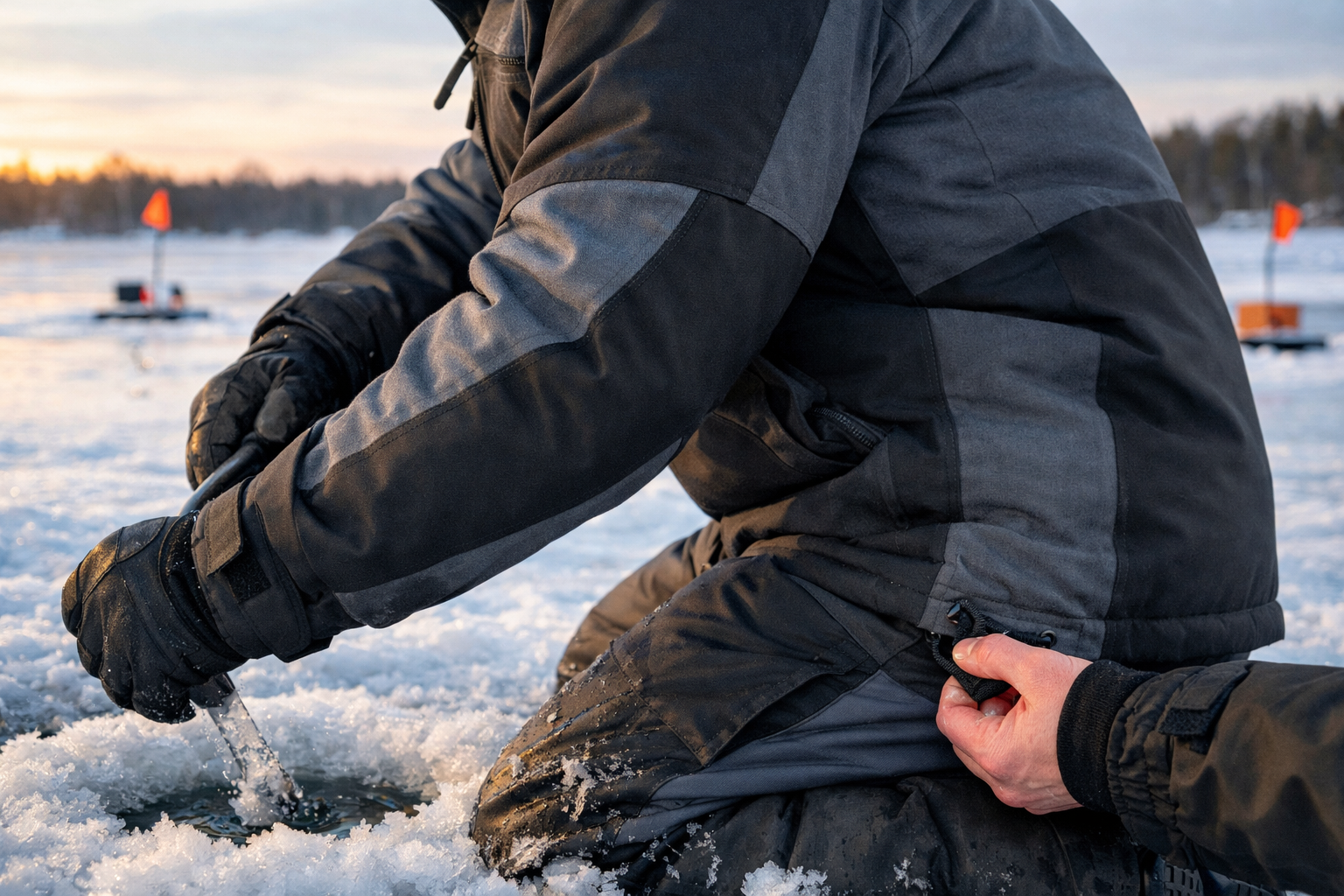
- Tighten the hem drawcord until the jacket sits snug at your hips without riding up when seated.
- Adjust cuff closures so they seal over your gloves without gaps.
- Add a neck gaiter or balaclava to fill any gap between the collar and your face.
- Install snap-in liner compatibility if your jacket supports removable insulation layers for temperature flexibility.
- Shorten or lengthen sleeves through a local tailor if they consistently expose your wrists or bunch at the hands.
Pro tip: Mark your ideal adjustment settings with a small dot of fabric paint on Velcro straps and drawcords. When you gear up in the dark at 5 AM, you hit the right setting every time without fumbling.
Check out our blog for more tactical gear and rigging content.
How Does Jacket Fit for Ice Fishing Affect Safety on the Ice?
Proper jacket fit directly affects your safety in two ways: thermal protection and flotation positioning. A jacket that fits correctly keeps your core temperature stable and, if equipped with flotation, keeps the buoyancy panels in the right place to support you in the water.
Minnesota DNR’s 2025-26 regulations now allow non-motorized hook-setting devices and extended multi-hook spacing to 18 inches [3]. These changes benefit mobile anglers who move between holes. A well-fitted jacket supports that mobility without restricting your ability to react quickly if ice conditions change.
Safety checklist for jacket fit:
- Jacket does not restrict head turning or shoulder checking
- Flotation panels (if present) sit centered on your chest and back
- Hem stays below your waist when seated and when bending
- Cuffs seal over gloves to prevent water entry during a fall
- Collar closes tight enough to prevent water entry at the neck
Tight jackets restrict blood circulation to your hands and feet, increasing frostbite risk by an estimated 45% [4]. This is the most overlooked safety issue in ice fishing apparel. If your jacket feels snug across the chest or shoulders with all layers on, size up.
Visit our contact page to connect with our coaching team for personalized gear recommendations.
Jacket Fit for Ice Fishing: How Proper Sizing and Tailoring Maximize Warmth and Performance, a Practical Summary
Getting jacket fit right for ice fishing comes down to three priorities: preserve insulation loft, maintain mobility, and seal out wind and moisture. Size up 2 to 4 inches over your layered chest measurement. Test every jacket while seated, reaching, and bending. Adjust cuffs, hems, and collars to eliminate gaps. Choose flotation if your ice conditions demand it, and always layer so you stay warm even without battery power or perfect conditions.
Kayak. Drill. Catch. Repeat. Whether you’re transitioning from saltwater kayak fishing to hardwater angling or preparing for tournament-level ice fishing, the right jacket fit gives you the thermal foundation to perform at your best.
See you on the water.
FAQ
Q: How many inches should I add to my chest measurement for an ice fishing jacket? A: Add 2 to 4 inches beyond your layered chest measurement. This preserves insulation loft and allows full arm mobility.
Q: Does a tight ice fishing jacket keep you warmer? A: No. A tight jacket compresses insulation and reduces thermal effectiveness by up to 35%. Tight fits also restrict blood flow, increasing frostbite risk.
Q: Should I buy a flotation jacket or a standard insulated jacket? A: Choose flotation if you fish early ice, late ice, or alone. Choose standard insulated if you fish in a permanent shanty on thick, stable ice.
Q: How do full float suits compare to separate jacket and bib combos? A: Full float suits outperform separates by about 34% in thermal protection because they eliminate the waist gap where cold air enters.
Q: What waterproof rating should my ice fishing jacket have? A: Aim for at least 10,000mm. Budget jackets at 5,000mm will wet out during heavy snow or ice melt.
Q: Are heated jackets reliable for ice fishing? A: Heated jackets work well as a supplement, providing 6 to 8 hours of heat on a charge. Always wear a full layering system as backup in case the battery fails.
Q: How do I test jacket fit before buying? A: Wear all your planned layers and boots. Sit down, reach overhead, bend at the waist, and turn your head. The jacket should not restrict any of these movements.
Q: What temperature rating do I need? A: For moderate cold (above -10°F), 100g insulation works. For extreme cold (below -20°F), choose 150g to 200g insulation rated to -40°F.
Q: How long should a quality ice fishing jacket last? A: Mid-range jackets ($200 to $350) last 3 to 5 seasons with heavy use. Premium float suits ($450 to $549) last 5 or more seasons.
Q: Do I need articulated sleeves? A: Yes, if you drill by hand or jig actively. Articulated sleeves with stretch panels improve arm mobility by about 15% .
References
[1] Ice Fishing Float Suit Comparison – https://windrider.com/blogs/tips-and-tricks/ice-fishing-float-suit-comparison [2] Top New Gear For Your 2025 26 Ice Angling Campaign – https://www.outdoornews.com/2025/11/01/top-new-gear-for-your-2025-26-ice-angling-campaign/ [3] Hook Setting Devices Allowed Starting 2025 26 Ice Fishing Season – https://www.dnr.state.mn.us/news/2025/11/17/hook-setting-devices-allowed-starting-2025-26-ice-fishing-season [4] The 10 Best Ice Fishing Jacket Reviewed – https://bowinsgarment.com/the-10-best-ice-fishing-jacket-reviewed/ [7] Best Ice Fishing Suits – https://www.outdoorlife.com/gear/best-ice-fishing-suits/ [10] Striker Climate Ice Fishing Suit Review – https://www.si.com/onsi/fishing/freshwater/striker-climate-ice-fishing-suit-review