Last updated: March 6, 2026
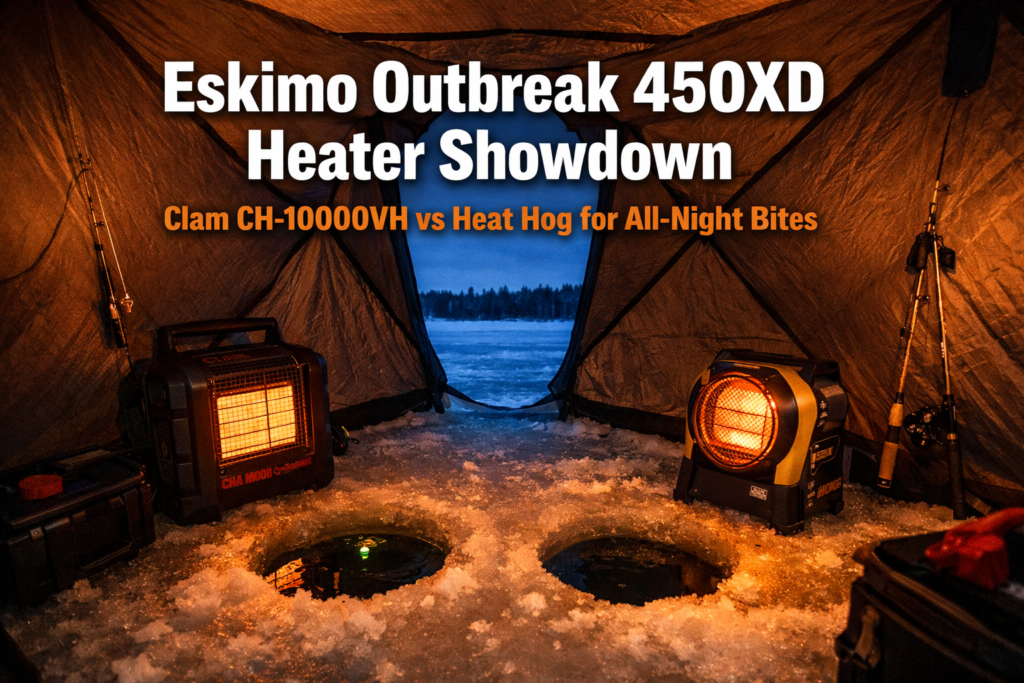
The Clam CH-10000VH wins the Eskimo Outbreak 450XD heater showdown against the Heat Hog for all-night pike sessions in March. The CH-10000VH delivers consistent, adjustable heat across a wider BTU range, runs safer in an enclosed shelter, and burns propane more efficiently over 8+ hour sessions. The Heat Hog costs less upfront but lacks the safety features and directional control you need when fishing through the night in a hub shelter this size.
This guide breaks down BTU output, fuel consumption, safety features, and dual-heater configurations so you choose the right setup for your 450XD. Whether you’re targeting pike on tip-ups or jigging walleye until dawn, the wrong heater choice turns a productive night into a cold, dangerous one.
Key Takeaways
- The Clam CH-10000VH produces 3,000 to 10,000 BTUs with a dial adjustment, giving you precise temperature control inside the 450XD’s 90 square feet of floor space.
- The Heat Hog (Mr. Heater Tank Top) produces roughly 10,000 to 15,000 BTUs but lacks a low setting, making temperature regulation difficult in a sealed shelter.
- A single CH-10000VH keeps the 450XD at 45 to 55 degrees F in temperatures down to minus 10 F with moderate wind.
- The Heat Hog’s radiant design creates hot spots and raises floor-melting risk if you skip a heat shield.
- Running two heaters (dual setup) requires a carbon monoxide detector, proper ventilation, and ceramic tile or metal floor protection.
- Fuel efficiency favors the CH-10000VH at approximately 5 to 7 hours per 1 lb propane cylinder on medium, compared to 3 to 4 hours for the Heat Hog on its lowest setting.
- Both heaters have tip-over shutoff switches, but the CH-10000VH adds an oxygen depletion sensor (ODS) rated for indoor use.
Quick Answer
For all-night pike fishing in the Eskimo Outbreak 450XD, the Clam CH-10000VH is the better primary heater. The adjustable BTU range (3,000 to 10,000) matches the shelter’s volume without overheating. The Heat Hog works as a cheaper warm-up option or secondary heater in a dual setup, but running one alone in a sealed 450XD overnight creates safety and comfort problems. Pair either heater with a battery-powered CO detector and a floor shield.
Why Does Heater Choice Matter for the Eskimo Outbreak 450XD?
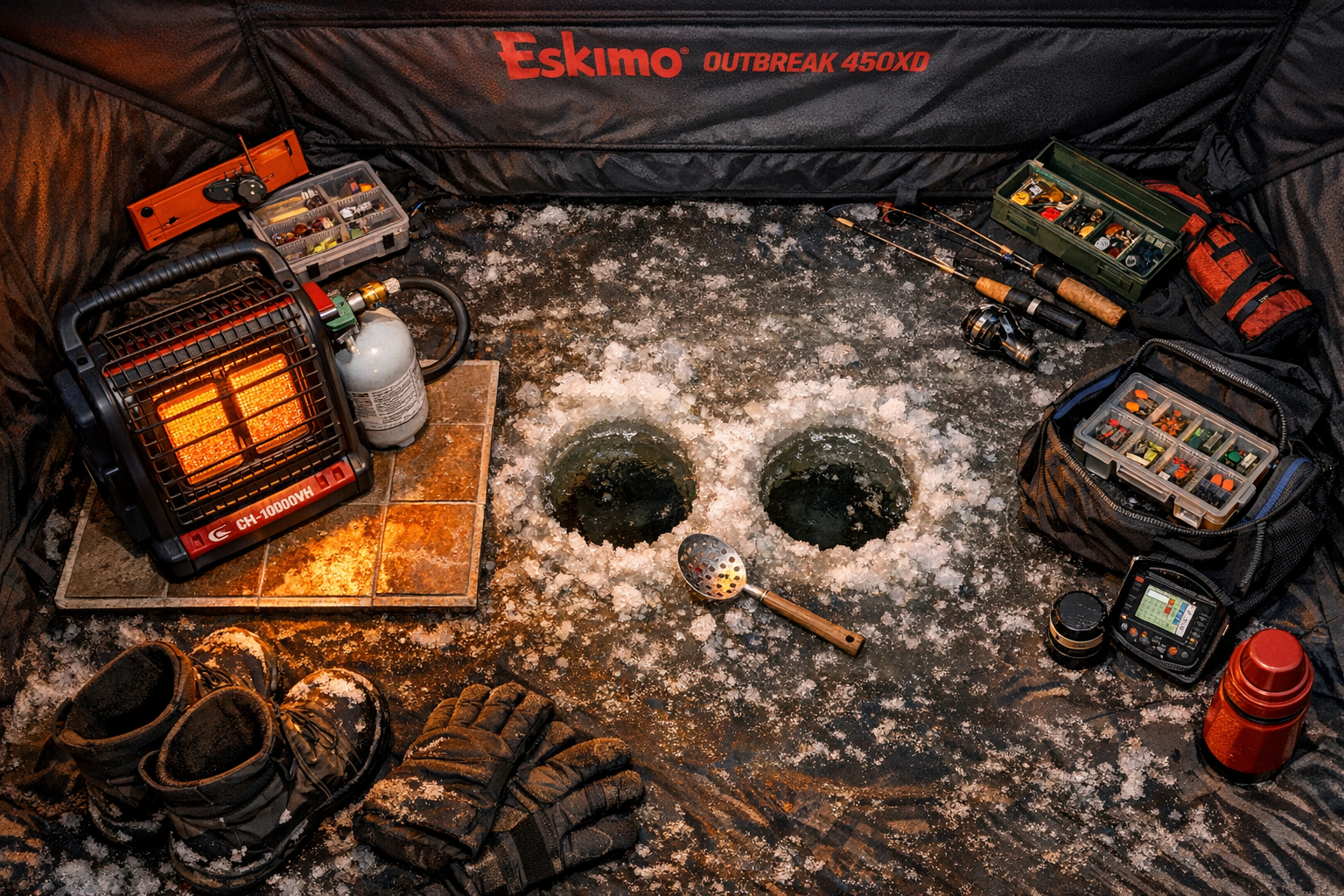
The 450XD is a large hub shelter. The fishable area measures roughly 90 square feet with a peak height of 80 inches. That volume demands a heater that produces enough BTUs to fight wind chill through the fabric walls, but not so many that you’re sweating and creating excessive condensation.
Condensation matters. Moisture drips onto electronics, soaks your gear, and freezes on the shelter walls when you crack a vent. During March pike sessions, outside temps swing from the low 20s at sunset to single digits by 3 a.m. Your heater needs to maintain a stable interior temperature through that range without constant adjustment.
The 450XD’s floor is a tarp-style material. Direct radiant heat from a tank-top heater placed too close will warp, melt, or burn through the floor in under an hour. The CH-10000VH’s cabinet design directs heat forward and upward, reducing floor contact. The Heat Hog radiates in all directions from its exposed element.
Choose the CH-10000VH if: You fish overnight sessions (6+ hours), want set-and-forget temperature control, and prioritize safety in an enclosed space.
Choose the Heat Hog if: You need a budget warm-up heater for shorter sessions (2 to 3 hours), or you plan to run two heaters and want a secondary radiant source.
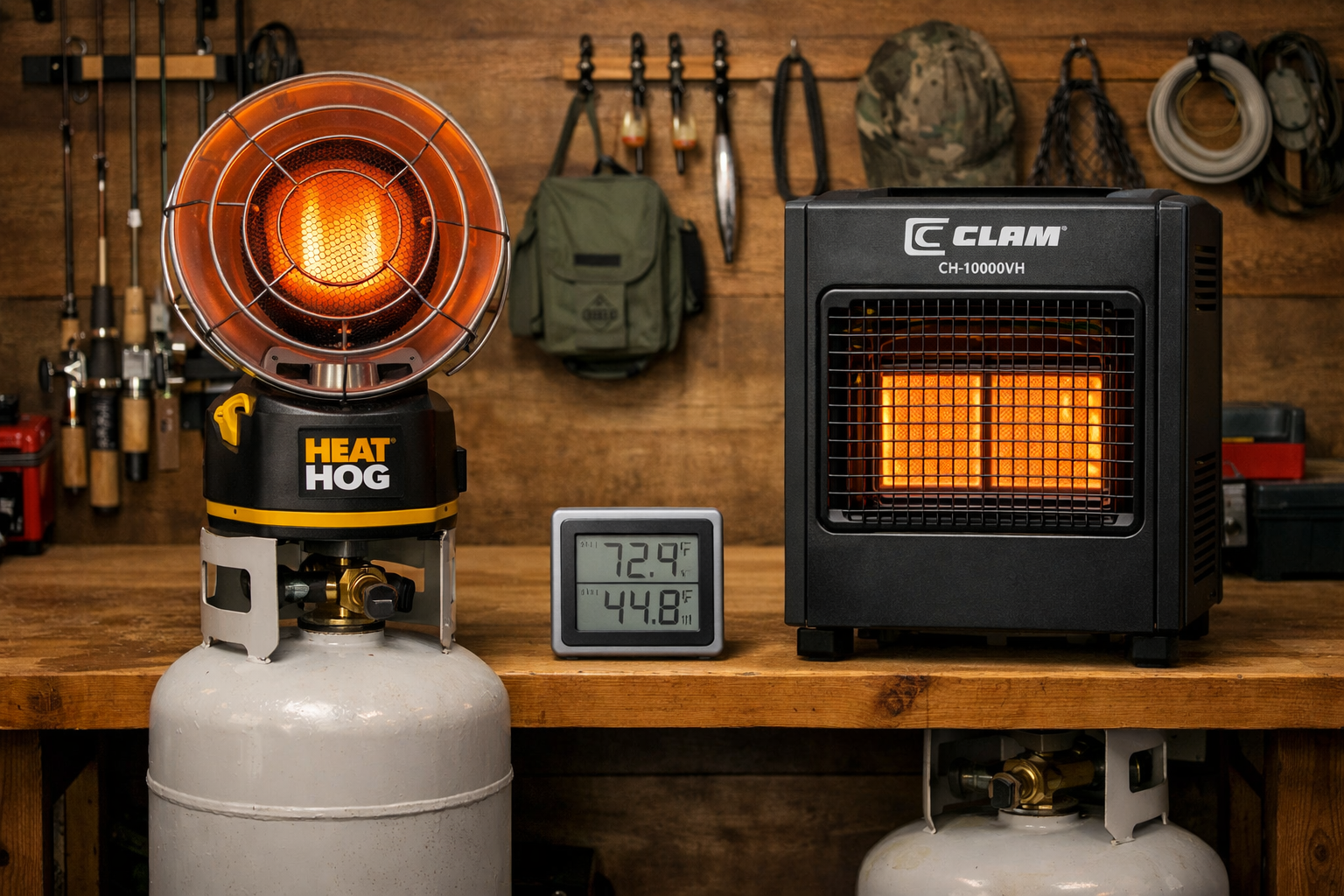
Eskimo Outbreak 450XD Heater Showdown: Clam CH-10000VH vs Heat Hog, Head to Head
Here is a direct comparison of the two heaters based on specs relevant to overnight ice fishing in the 450XD.
| Feature | Clam CH-10000VH | Heat Hog (15,000 BTU Tank Top) |
|---|---|---|
| BTU Range | 3,000 to 10,000 | 10,000 to 15,000 |
| Fuel Type | 1 lb or 20 lb propane | 1 lb or 20 lb propane |
| Burn Time (1 lb cylinder) | 5 to 7 hours (medium) | 3 to 4 hours (low) |
| Heat Direction | Front-facing convection | 360-degree radiant |
| Oxygen Depletion Sensor | Yes | Varies by model |
| Tip-Over Shutoff | Yes | Yes |
| Weight | Approximately 10 lbs | Approximately 3 lbs |
| Indoor Rating | Yes (with ventilation) | Check model, some are outdoor only |
| Price Range (2026 estimate) | $120 to $150 | $40 to $70 |
| Floor Risk | Low (cabinet design) | High (radiant element faces down) |
The CH-10000VH costs roughly twice as much. That price buys you the ODS, a wider BTU adjustment range, and a cabinet that shields the heating element. For overnight sessions where you’ll burn through 2 to 3 one-pound cylinders or run a hose to a 20 lb tank, the fuel savings and safety features pay for the difference within a season.
How Many BTUs Do You Need for All-Night Bites in the 450XD?
For a shelter with 90 square feet of floor space and 80-inch ceilings, you need approximately 5,000 to 8,000 BTUs to maintain a 40 to 55 degree F interior when outside temps sit between 0 and 20 F. Wind increases the demand. A 15 mph wind on an exposed lake adds roughly 20 to 30 percent to your heating needs because the hub fabric offers limited insulation.
The CH-10000VH on medium (roughly 6,000 to 7,000 BTUs) handles this range well. You adjust up during wind gusts and down during calm periods.
The Heat Hog’s lowest setting starts at 10,000 BTUs. In the 450XD, that output pushes interior temps above 65 F quickly, forcing you to open vents or the door. Opening vents defeats the purpose of running a heater and wastes fuel. You end up in a cycle of too hot, then too cold.
Common mistake: Buying the highest BTU heater you find. More heat is not better in a fabric shelter. Excess heat creates condensation, melts ice around your holes (widening them dangerously), and burns through fuel faster.
Fuel Efficiency for Overnight Pike Sessions
March pike fishing means long nights. Sunset to sunrise in northern states runs 12 to 13 hours in early March. You need a heater that stretches fuel.
Clam CH-10000VH fuel math:
- On medium setting (approximately 6,000 BTUs): one 1 lb cylinder lasts 5 to 7 hours.
- For a 12-hour session: plan on 2 to 3 one-pound cylinders, or connect a 20 lb bulk tank with a hose adapter.
- A 20 lb tank at medium burns for roughly 50 to 60 hours, giving you multiple sessions per fill.
Heat Hog fuel math:
- On low (approximately 10,000 BTUs): one 1 lb cylinder lasts 3 to 4 hours.
- For a 12-hour session: plan on 3 to 4 one-pound cylinders.
- A 20 lb tank at low burns for roughly 30 to 40 hours.
Over a season of 10 overnight trips, the CH-10000VH saves you roughly 10 to 15 one-pound cylinders. At $4 to $6 per cylinder in 2026, that adds up to $40 to $90 in fuel savings. The heater pays for the price difference.
Pro tip: Always carry one extra cylinder beyond your estimate. March weather shifts fast, and running out of heat at 4 a.m. with a flag popping on your tip-up is a problem you solve by planning ahead. For more on preparing your gear for demanding conditions, check out our services and coaching options.
Safety Features Inside the 450XD: What Keeps You Alive Overnight
Running a propane heater inside a fabric shelter overnight requires specific safety measures. Carbon monoxide (CO) poisoning kills ice anglers every season. This is not optional gear. Treat safety like rigging mastery: get the details right or stay home.
The CH-10000VH safety profile:
- Oxygen Depletion Sensor (ODS) shuts the heater off when oxygen drops below safe levels.
- Tip-over switch kills the flame if the unit gets knocked over.
- Cabinet design keeps the flame enclosed and away from gear, clothing, and shelter fabric.
- Rated for indoor/enclosed space use by the manufacturer.
The Heat Hog safety profile:
- Tip-over switch on most models.
- No ODS on many tank-top models (check your specific unit).
- Exposed radiant element sits inches from the propane tank.
- Many models carry “outdoor use only” labels, though anglers commonly use them in shelters.
Regardless of heater choice, follow these rules:
- Mount a battery-powered CO detector at head height inside the shelter. Replace batteries before each season.
- Crack at least one vent, even in extreme cold. A 2-inch opening provides enough airflow without killing your heat.
- Never sleep with a heater running unless another person stays awake to monitor conditions.
- Place the heater on a ceramic floor tile (12×12 inch minimum) or a metal heat shield to protect the shelter floor.
- Keep the heater at least 24 inches from shelter walls and any fabric or gear.
For a deeper look at safety-focused preparation, visit our about page to learn how the FishOnYak team approaches fluid safety in every environment.
Dual-Heater Setups: Running Both Without Melting Your Floor
Some anglers run both the CH-10000VH and a Heat Hog in the 450XD for extreme cold (minus 20 F and below) or when fishing with 3 to 4 people who constantly open the door. A dual setup works if you manage placement and floor protection.
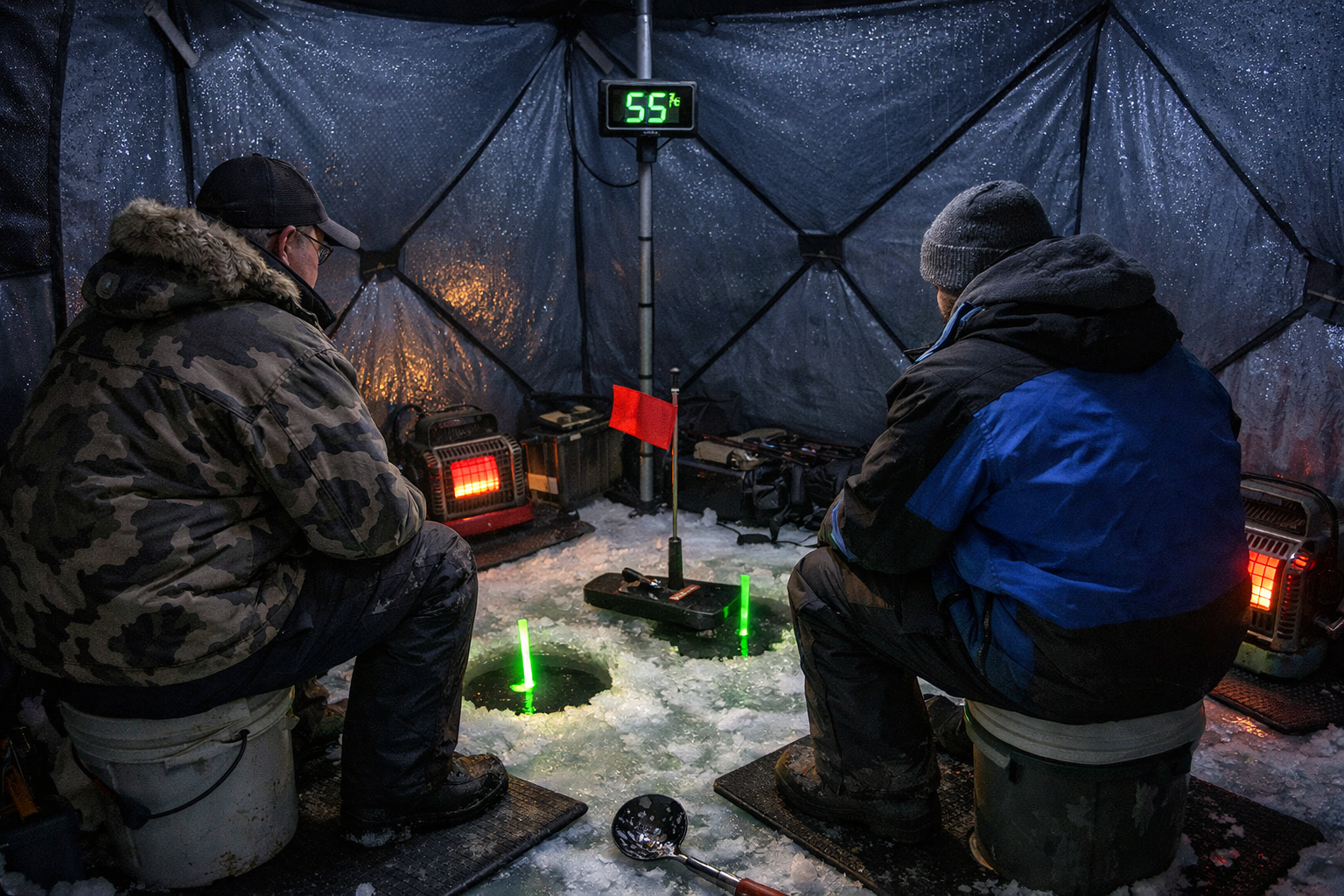
Dual-heater placement in the 450XD:
Position the CH-10000VH as your primary heater near the back wall, facing the center of the shelter. Place the ceramic tile underneath and behind the unit. Run the CH-10000VH on medium for baseline heat.
Position the Heat Hog near the door side on a separate heat shield. Use the Heat Hog as a burst heater. Fire the Heat Hog for 20 to 30 minutes after someone enters or exits, then shut the Heat Hog off. This approach prevents the door-open cold blast from dropping interior temps.
Floor protection for dual setups:
- Use two separate ceramic tiles or a single sheet of thin aluminum flashing (available at hardware stores) cut to 18×18 inches per heater.
- Never place a heater directly on the 450XD’s tarp floor. The tarp material begins to deform at temperatures well below what a propane heater’s base reaches.
- Check the floor under each heater every 2 hours. If the tarp feels soft or tacky, the heat shield is too small or the heater is too close to the floor.
Ventilation for dual setups:
Two heaters consume oxygen faster. Open two vents instead of one. Position vents on opposite sides of the shelter for cross-flow. Your CO detector becomes even more critical with two combustion sources running.
This tactical approach to shelter heating mirrors the same precision you’d apply to rigging a kayak for tournament conditions. Every detail matters. Learn more about our approach to tournament-ready preparation.
Tips for March Pike Sessions with Your Heater Setup
March pike fishing through the ice demands patience. Pike feed aggressively in late winter as they stage for spawning, but bites often cluster between 10 p.m. and 2 a.m. Your heater setup determines whether you’re alert and comfortable during that window or shivering and packing up early.
Set your shelter and heater by 4 p.m. This gives the interior time to warm before sunset. A pre-warmed shelter holds heat better because the fabric absorbs some warmth and reduces condensation buildup.
Run your heater on the lowest effective setting. For the CH-10000VH in the 450XD, medium (roughly 6,000 BTUs) keeps temps comfortable without excessive fuel burn. Resist the urge to crank the heater to high. A 50 degree F interior feels warm when you’re dressed in base layers.
Position tip-ups away from the heater. Radiant heat from either heater softens the ice around nearby holes faster. Keep your holes at least 36 inches from any heat source. Soft ice around a hole creates a safety risk and makes hook-sets sloppy.
Bring a backup heat source. A small hand-warmer or a second 1 lb cylinder with a basic burner head gives you emergency heat if your primary heater fails. March nights on the ice leave no room for error.
For more tactical fishing content and seasonal strategies, browse the FishOnYak blog.
Common Mistakes When Heating the 450XD Overnight
Running the heater on high all night. This wastes fuel, overheats the shelter, and creates dangerous condensation that drips onto gear and electronics.
Skipping the CO detector. A $30 detector saves lives. No heater’s safety features replace a dedicated CO monitor at head height.
Placing the heater on bare tarp. Even the CH-10000VH’s cabinet design transfers enough heat to damage the 450XD floor over a 10-hour session. Always use a heat shield.
Sealing all vents for maximum warmth. Combustion requires oxygen. Sealed shelters with running heaters create CO buildup. Crack a vent. Always.
Using a heater rated for outdoor use only inside the shelter. Check the specific model number of your Heat Hog. Some tank-top heaters lack the ODS required for enclosed spaces. The label on the box tells you.
Frequently Asked Questions
How long does the Clam CH-10000VH run on a 1 lb propane cylinder? On medium setting, approximately 5 to 7 hours. On high (10,000 BTUs), approximately 3 to 4 hours.
Is the Heat Hog safe inside the Eskimo Outbreak 450XD? Some Heat Hog models lack an oxygen depletion sensor and carry outdoor-only ratings. Check your specific model. If the unit lacks an ODS, do not run the unit in a sealed shelter overnight.
How many BTUs heat the Eskimo Outbreak 450XD? Between 5,000 and 8,000 BTUs maintain a comfortable 45 to 55 degree F interior in temps down to minus 10 F with moderate wind.
Do you need a floor shield for the Clam CH-10000VH? Yes. The cabinet reduces direct downward heat, but the base still gets warm enough to damage the 450XD’s tarp floor over extended sessions.
What size propane tank works best for overnight sessions? A 20 lb bulk tank with a hose adapter gives you 50+ hours of heat on medium. This eliminates the hassle of swapping 1 lb cylinders at 2 a.m.
Where should you place the heater inside the 450XD? Position the heater near a wall, facing the center. Keep the heater at least 24 inches from shelter fabric and away from ice holes.
Does condensation damage the 450XD shelter? Excessive condensation freezes on the interior walls and adds weight to the fabric. Over time, repeated freeze-thaw cycles weaken seams. Proper ventilation reduces condensation.
What CO detector works best for ice shelters? Any battery-powered, UL-listed CO detector with a digital readout. Mount the detector at head height (seated position) inside the shelter. Replace batteries at the start of each season.
Should you run the heater while sleeping in the shelter? Only if another person stays awake to monitor conditions. Running a propane heater unattended while sleeping in an enclosed fabric shelter creates a CO poisoning risk that no safety feature fully eliminates.
How do you connect a 20 lb tank to the CH-10000VH? Use a propane hose adapter with a filter (sold separately by Clam and other brands). Route the hose along the shelter wall, away from foot traffic and ice holes.
Picking Your Heater and Fishing Through the Night
The Eskimo Outbreak 450XD heater showdown between the Clam CH-10000VH and Heat Hog for all-night bites comes down to how you fish. Overnight pike sessions demand the CH-10000VH’s adjustable output, fuel efficiency, and enclosed safety features. The Heat Hog earns a role as a budget secondary heater or a short-session warm-up tool.
Pair your heater with a CO detector, a floor shield, and proper ventilation. Plan your fuel supply for the full session plus a reserve. Set up early, keep the heat moderate, and stay alert for those 2 a.m. flags.
Kayak. Drill. Catch. Repeat.
See you on the water.
For more gear breakdowns, coaching, and tournament preparation resources, visit FishOnYak.com or contact our team directly.
References
- Eskimo product specifications for the Outbreak 450XD hub shelter, Eskimo Ice Fishing, 2024
- Clam Outdoors CH-10000VH product page and owner’s manual, Clam Corporation, 2023
- Mr. Heater / Heat Hog tank-top heater specifications, Enerco Group, 2024
- Consumer Product Safety Commission guidance on portable propane heaters and carbon monoxide safety, CPSC, 2023