Last updated: March 13, 2026
Quick Answer
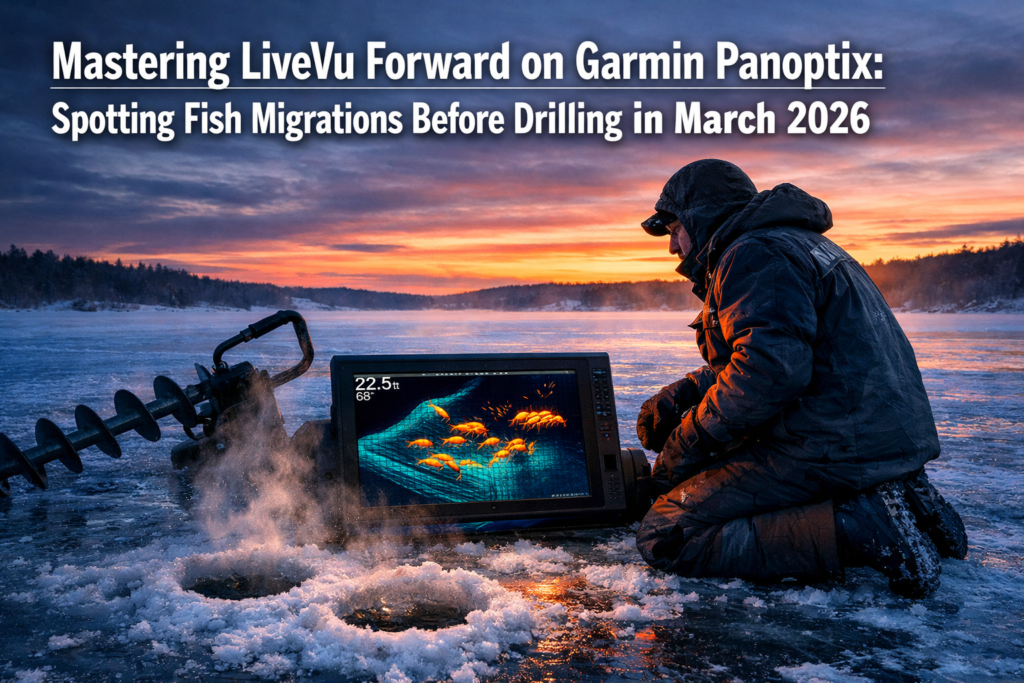
Mastering LiveVu Forward on Garmin Panoptix: Spotting Fish Migrations Before Drilling in March 2026 means using the PS22 or PS51-TH transducer to scan 80 to 100 feet ahead of your position on shallow reed flats, identify migrating fish pods before auger noise scatters them, then drill precisely where the school is heading rather than where it was. Set your forward range wide to locate the pod, rotate to a narrow beam to confirm pod direction, then drop your hole 15 to 20 feet in front of the migration path.
Key Takeaways
- Run LiveVu Forward at 80 to 100 feet range first to locate migrating schools in shallow reed flats before committing to a drill site.
- Auger noise pushes fish 40 to 70 feet laterally. Spot the pod’s travel direction before you drill, and place your hole ahead of that path.
- Garmin’s January 2026 software update added ice fishing zoom and flasher display improvements that sharpen LiveVu Forward returns on suspended fish.
- The LiveScope XR System released in early 2026 extends forward scanning range to 500 feet in freshwater, giving you more time to read migration direction before positioning.
- Narrow beam rotation on the PS22 gives you precise pod location after wide-scan detection. Use it to confirm depth and lateral position before drilling.
- Fish that flee an auger follow predictable routes back to structure. Mark those routes on your chartplotter and intercept them.
- Panoptix scans wider suspended schools faster than LiveScope, making it strong for tracking loose, scattered perch or bluegill pods in reed flat environments.
- Pair LiveVu Forward with a spot-lock trolling motor on open water or a sled-mounted transducer on ice to follow migrations dynamically.
- Compare Panoptix against Humminbird MEGA Live 2 and Lowrance ActiveTarget 2 before buying. Each system has distinct strengths for specific ice scenarios.
- Dress for extended time on ice during March transition periods. Layering and mobility matter when you’re moving between scan positions frequently.
What Is LiveVu Forward on Garmin Panoptix, and Why Does It Matter for Ice Fishing?
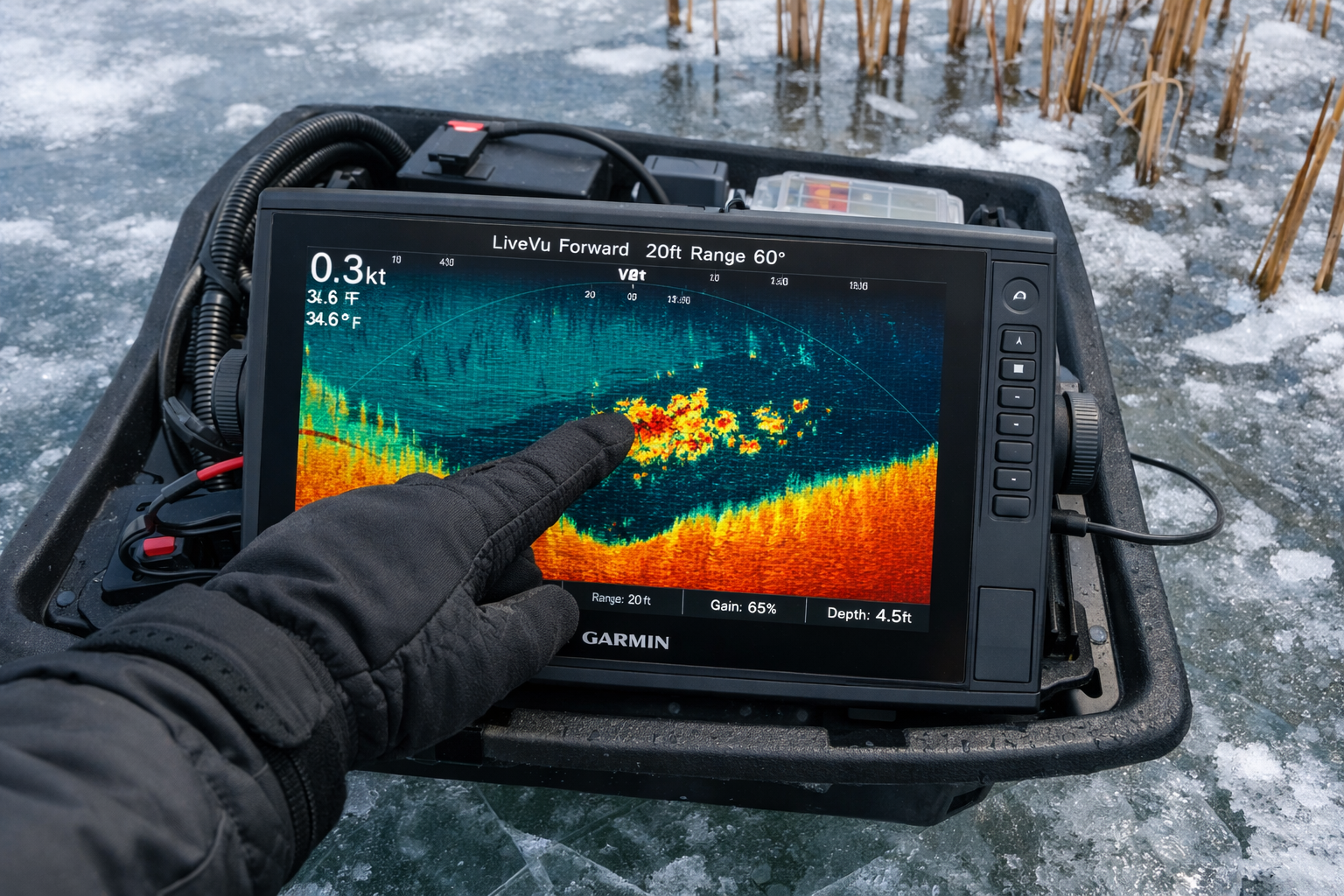
LiveVu Forward is a real-time forward-scanning sonar mode available on the Garmin Panoptix PS22 and PS51-TH transducers. It shows you what is happening in front of your position in live video-like sonar returns, updated continuously so you see fish moving in real time.
For ice fishing, this changes how you choose drill locations. Traditional sonar shows you what is directly below your hole. LiveVu Forward shows you what is approaching, what is leaving, and where a school is headed. That distinction is the difference between drilling into an empty spot and drilling into an active feeding zone.
Pro angler Tom Redington has demonstrated viewing fish up to 100 feet ahead and watching lure reactions in real time using Panoptix LiveVu Forward, which gives anglers the ability to anticipate migrations before committing to a drill site [8]. In March 2026, with late-season fish moving aggressively through reed flats as ice begins its transition phase, that forward view is critical.
Key specs for the PS22 transducer:
- Forward range: up to 100 feet in LiveVu Forward mode
- Works with compatible Garmin GPSMAP and echoMAP chartplotters
- Adjustable tilt for scanning at different depth angles
- Requires no black box on select newer chartplotter models
The PS51-TH thru-hull version adds AHRS stabilization, which keeps returns stable in rough water or when ice sleds shift, and scans up to 300 feet ahead at 8 to 10 times water depth.
How Do Fish Migrations Behave in Shallow Reed Flats During March?
In March, fish in shallow reed flats are transitioning. Ice is thinning, light penetration increases, and baitfish begin moving toward emerging vegetation edges. Panfish, perch, and walleye follow those baitfish in loose, mobile pods rather than tight stationary schools.
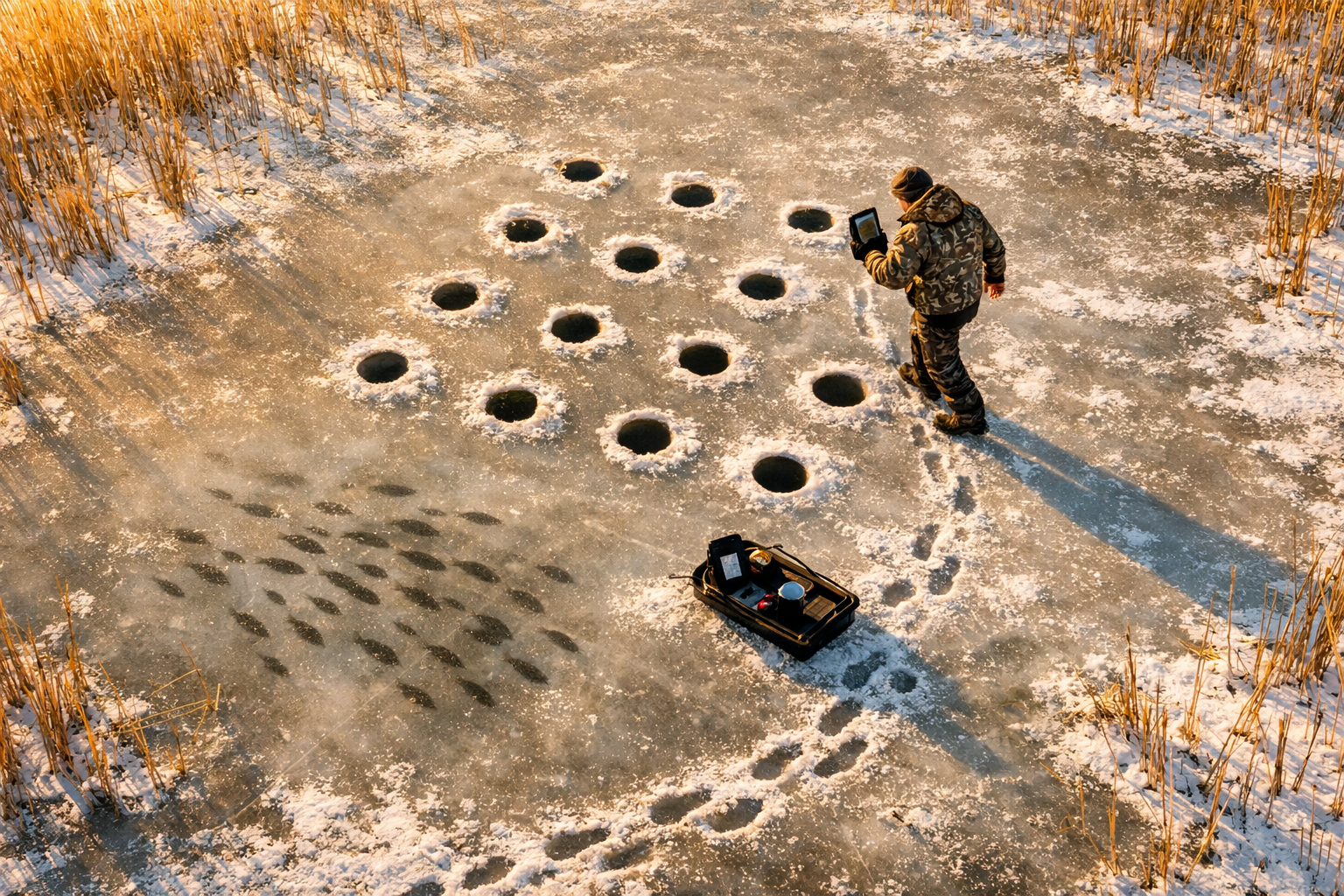
These pods move constantly. A school of 70-plus fish in a reed flat at 6 to 8 feet of water will shift 30 to 50 feet in under two minutes when feeding. Auger noise accelerates that movement. Drilling a hole pushes fish 40 to 70 feet laterally within seconds of the first bite of the blade into ice.
This is why mastering LiveVu Forward on Garmin Panoptix for spotting fish migrations before drilling in March 2026 requires a scan-first approach. You watch the pod’s direction of travel, mark the heading on your chartplotter, and drill 15 to 20 feet ahead of where the school is moving.
Migration patterns to watch for in reed flats:
- Schools moving parallel to the reed edge, feeding along the vegetation line
- Pods pushing from deeper adjacent basins into the flat as morning light builds
- Fish stacking briefly at depth transitions, then scattering and reforming
- Baitfish clouds preceding larger predator pods by 10 to 20 feet
Larry Smith Outdoors recommends using LiveVu Forward to track panfish pod direction and movement, then using a spot-lock trolling motor on open water to follow migrations dynamically rather than staying static.
How Do You Set Up LiveVu Forward for Maximum Scanning Range Before Drilling?
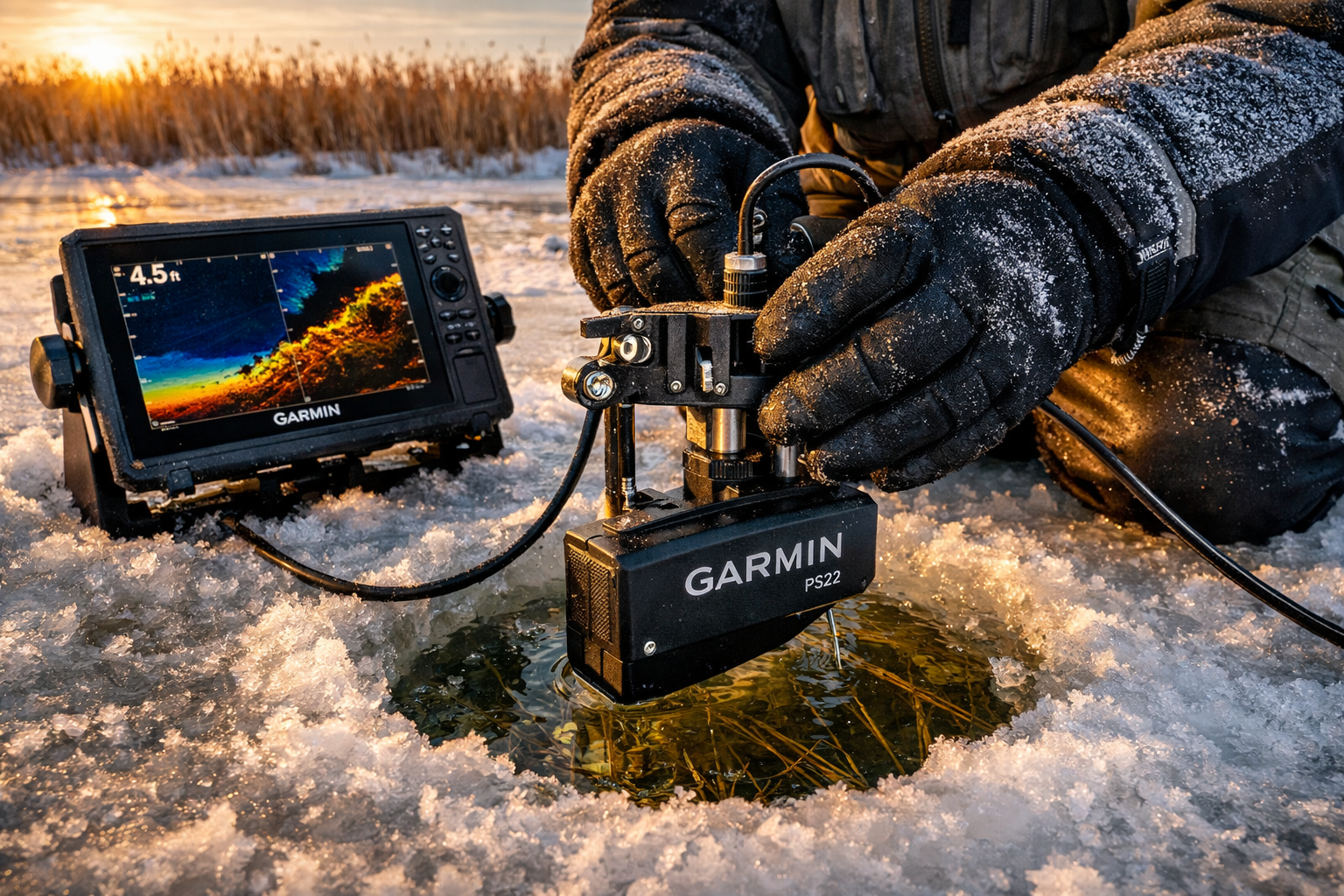
Set up LiveVu Forward correctly before you scan a single inch of ice. A poor transducer angle or wrong range setting gives you cluttered returns that look like bottom noise rather than fish.
Step-by-step setup for ice fishing with LiveVu Forward:
- Lower the PS22 transducer through your observation hole at a 45-degree forward tilt angle. This angle balances forward distance with bottom clearance in shallow water under 10 feet.
- Set your initial range to 80 to 100 feet. This wide view lets you locate pods before they detect you.
- Adjust gain until fish returns appear as distinct marks rather than blobs. In shallow reed flats, bottom clutter is your main interference.
- Once you locate a pod, rotate the transducer to a narrower beam angle. This tightens your view and gives you precise lateral position of the school.
- Drop range to 40 to 60 feet for precise tracking once you have confirmed the pod’s location and direction.
- Mark the pod’s heading on your chartplotter. Drill your hole 15 to 20 feet ahead of that heading.
Fishfinder Coach recommends this two-phase range approach: wide range for detection, shorter range for precision tracking before committing to a drill location.
Garmin’s January 2026 software update via the ActiveCaptain app added ice fishing zoom settings and improved flasher display modes that sharpen LiveVu Forward clarity for tracking migrating fish schools under ice. Update your chartplotter firmware before your March session.
Common mistake: Drilling the observation hole too close to your target zone. Keep your scan hole at least 20 feet from where you plan to drill. Auger noise from your scan hole setup will push fish if you’re too close.
How Does Auger Noise Scatter Fish, and How Do You Use LiveVu Forward to Compensate?
Auger noise is your biggest enemy in shallow reed flats. Fish in under 10 feet of water feel vibration and sound pressure from an auger within seconds of startup. A school of 70-plus fish will scatter radially from the drill point, often splitting into two or three smaller pods that regroup 40 to 70 feet away.
LiveVu Forward lets you watch this happen in real time and use it to your advantage.
The scatter-and-intercept method:
- Scan the flat and locate the primary school before drilling anything.
- Note the two most likely escape routes based on the school’s current travel direction and nearby structure.
- Drill your fishing hole at the intersection of those escape routes, not at the school’s current position.
- When your auger noise scatters the school, fish will move toward your pre-drilled hole rather than away from it.
This approach requires patience. Watch the school for two to three minutes before drilling. Identify whether the pod is moving left to right along the reed edge or pushing toward deeper water. That observation determines where you place your hole.
For related reading on tactical positioning during ice fishing, check out shallow bluegill hotspots and jigging cadence for February bites and jumbo perch tactics in 15 to 20 foot flats, both of which cover fish behavior patterns that apply directly to March reed flat scenarios.
How Does the 2026 Garmin LiveScope XR Compare to Panoptix LiveVu Forward for Migration Spotting?
Garmin released the LiveScope XR System in early 2026, extending forward scanning range to 500 feet in freshwater and 350 feet in saltwater. That range advantage is significant for open-water migration tracking, but for shallow reed flat ice fishing, it changes the comparison.
Garmin LiveScope XR vs. Panoptix LiveVu Forward for March ice fishing:
| Feature | LiveScope XR (LVS62) | Panoptix PS22 (LiveVu Forward) |
|---|---|---|
| Max forward range (freshwater) | 500 feet | 100 feet |
| Best use case | Long-range migration detection, open water | Close-range pod tracking, ice fishing |
| Individual fish detail | Higher resolution, less clumping | Wider school view, faster scan |
| Black box required | Yes (GLS 10) | No on select chartplotters |
| Ice fishing optimization | Updated Jan 2026 [6] | Established ice fishing tool |
| Price point | Higher (XR system) | More accessible |
Side-by-side tests show LiveScope superior to Panoptix for detail on individual fish in migrations, with less clumping of returns. Panoptix scans wider suspended schools faster, which is an advantage when tracking loose panfish pods across a broad flat.
Woods and Waters Magazine noted in January 2026 that Garmin leads in real-time sonar and predicted auto fish-tracking features coming to the LiveScope lineage, though Panoptix remains unchanged as of March 2026.
Choose LiveVu Forward if: You fish shallow ice environments under 15 feet, want a more accessible price point, and need fast wide-school detection over individual fish resolution.
Choose LiveScope XR if: You fish open water or need to track migrations at distances beyond 100 feet before approaching a drill position.
At the 2026 Miami Boat Show in February, Garmin showcased advanced sonar integration including triple-beam technology for improved forward views and real-time migration detection.
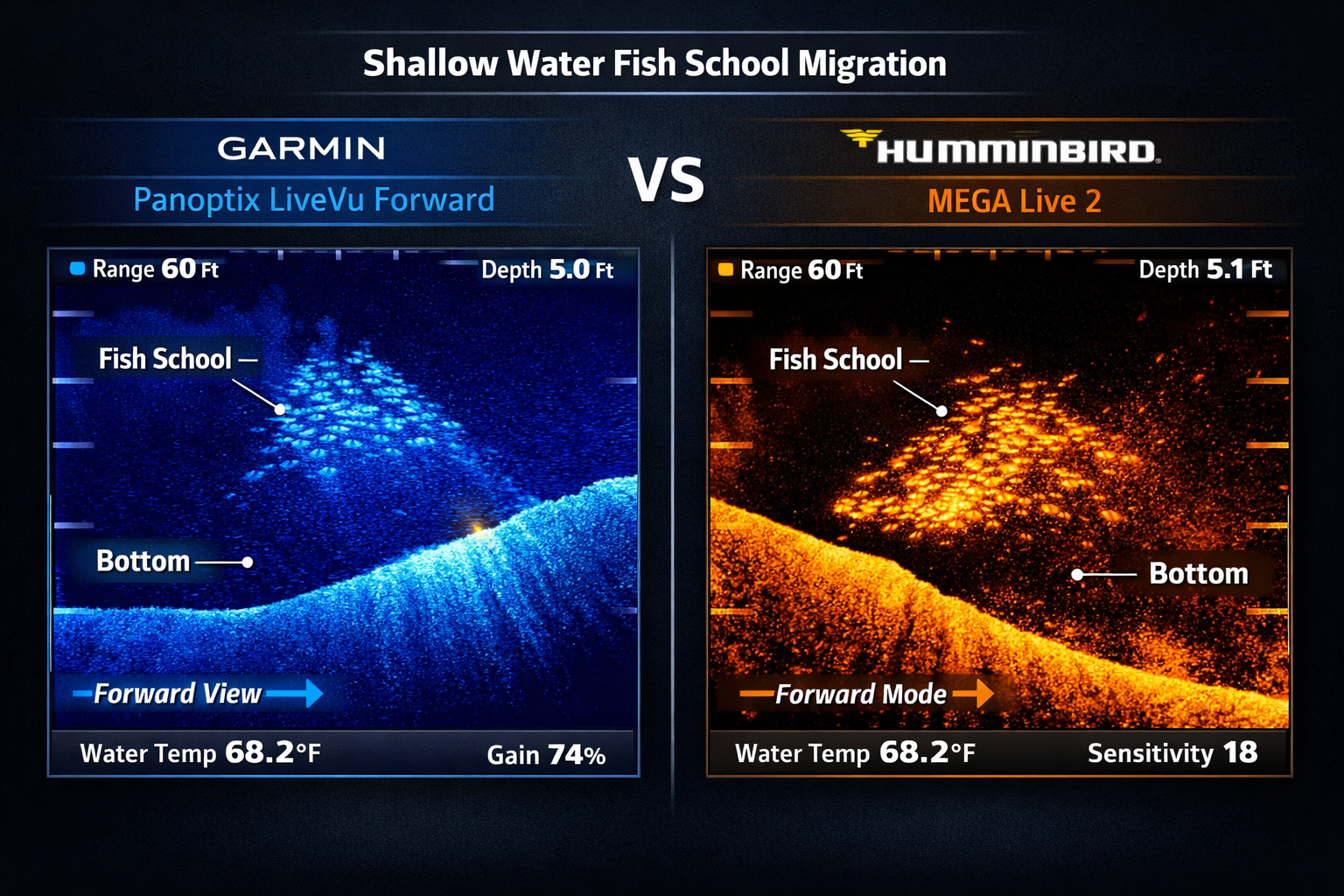
How Does Panoptix LiveVu Forward Compare to Humminbird MEGA Live 2 and Lowrance ActiveTarget 2?
Mastering LiveVu Forward on Garmin Panoptix: Spotting Fish Migrations Before Drilling in March 2026 also means knowing when a competing system might serve you better. Each platform has specific strengths.
Humminbird MEGA Live 2 offers forward, down, and landscape modes without a black box, and its TargetLock feature automatically locks onto migrating fish schools at a price point around $1,499. That auto-lock advantage reduces the manual adjustment required when tracking fast-moving pods in reed flats. Panoptix requires manual transducer rotation to follow a school laterally.
Lowrance ActiveTarget 2 provides the highest resolution live sonar returns per HDS Pro reviews, which makes it stronger in cluttered ice scenarios where bottom debris and vegetation create interference. Panoptix returns in heavy reed environments tend toward blobby returns on bottom-hugging fish.
Summary comparison for March ice fishing in reed flats:
- Panoptix LiveVu Forward: Best for fast wide-school detection, established ice fishing platform, strong in mid-water suspended pods
- MEGA Live 2: Best for hands-free migration tracking with TargetLock, no black box required
- ActiveTarget 2: Best for high-resolution individual fish returns in cluttered shallow environments
What Are the Most Common Mistakes Anglers Make with LiveVu Forward on Ice?
Most anglers who struggle with LiveVu Forward on ice make the same four mistakes. Correcting them immediately improves your drill placement accuracy.
Mistake 1: Scanning at too short a range from the start. Starting at 40 feet means you’re already too close to the school when you find it. Start at 80 to 100 feet. Give yourself time to read the pod’s direction before it detects you.
Mistake 2: Drilling the observation hole in the middle of the flat. Your observation hole creates noise and shadow. Position it at the edge of the flat, scanning toward the center. Fish in the center of the flat are less likely to detect your setup.
Mistake 3: Ignoring the narrow beam rotation step. Wide scan finds the school. Narrow beam confirms exact lateral position and depth. Skipping the narrow beam step leads to holes drilled 5 to 10 feet off the pod’s actual position, which matters in shallow water where fish are already spooky.
Mistake 4: Moving too quickly after the school scatters. When auger noise pushes fish, wait 90 seconds before jigging. Scattered pods regroup faster than most anglers expect. Jigging immediately after drilling pulls attention away from the regrouping school and into empty water.
For mobile anglers covering multiple scan positions across a flat, having the right gear matters as much as technique. A lightweight ice fishing jacket for mobile anglers keeps you moving between scan holes without bulk slowing you down. Pair that with solid ice fishing gloves that balance warmth and dexterity so you can operate your chartplotter accurately in March cold.
What Gear Setup Supports LiveVu Forward for March Reed Flat Ice Fishing?
Getting the most from LiveVu Forward on Garmin Panoptix requires the right supporting gear. The transducer is only as effective as the platform it sits on.
Core gear checklist for LiveVu Forward ice fishing:
- Garmin PS22 transducer with compatible GPSMAP or echoMAP chartplotter (updated to January 2026 firmware)
- Portable transducer arm or sled mount that holds the PS22 at a consistent 45-degree angle
- Power bank with minimum 20,000 mAh capacity for full-day chartplotter operation
- Spot-lock trolling motor for open water or wheeled sled for ice mobility
- Auger positioned at least 20 feet from your observation hole
- Tip-up rigs pre-set at likely intercept points while you scan (see our guide on tip-up setups for walleye ice fishing)
Layering for March transition ice:
March ice is unpredictable. You move more than in mid-winter because you’re following migrations across a flat. Check our comparison of ice fishing bibs versus full float suits to choose the right lower-body protection for active scanning days. For base layers under your outer shell, our guide on ice fishing hoodies and base layers covers optimal pairings for days when you’re constantly moving between observation holes.
Kayak. Drill. Catch. Repeat.
Conclusion
Mastering LiveVu Forward on Garmin Panoptix: Spotting Fish Migrations Before Drilling in March 2026 comes down to three disciplined steps. Scan wide to locate the pod. Rotate narrow to confirm direction and depth. Drill ahead of the migration path, not into it.
March reed flat fishing rewards anglers who observe before they act. The fish are moving. Your job is to read where they are going and be there first.
Actionable next steps:
- Update your Garmin chartplotter firmware to the January 2026 release before your next ice session.
- Practice the two-phase range approach (80 to 100 feet wide, then 40 to 60 feet narrow) on your next outing before drilling a single hole.
- Mark scatter routes on your chartplotter during your first session. Use those routes to predict intercept points on your second session at the same flat.
- Review your transducer mount. A loose or inconsistent angle is the most common cause of poor LiveVu Forward returns on ice.
- Dress for mobility. March scanning sessions require movement. Gear that restricts you costs you fish.
For a deeper look at underwater camera tools that complement your sonar setup, see our wireless underwater camera setup guide for ice fishing.
See you on the water.
Mastering LiveVu Forward on Garmin Panoptix: FAQ
Q: What is the maximum forward range of Garmin Panoptix LiveVu Forward? A: The PS22 transducer reaches up to 100 feet in LiveVu Forward mode. The PS51-TH thru-hull version scans up to 300 feet ahead at 8 to 10 times water depth with AHRS stabilization.
Q: Does the January 2026 Garmin update improve LiveVu Forward for ice fishing? A: Yes. Garmin’s January 2026 software update added ice fishing zoom settings and improved flasher display modes that sharpen sonar clarity for tracking migrating fish schools under ice.
Q: How far ahead of a migrating school should you drill your hole? A: Drill 15 to 20 feet ahead of the school’s confirmed travel direction. This places your presentation in the path of the migration rather than behind it.
Q: Does auger noise always scatter fish in shallow reed flats? A: Yes, in water under 10 feet, fish detect auger vibration and sound pressure within seconds. Expect lateral scatter of 40 to 70 feet. Plan your hole placement around that scatter behavior rather than trying to avoid it.
Q: Is Panoptix LiveVu Forward better than LiveScope XR for ice fishing? A: For shallow ice fishing under 15 feet with wide school detection, Panoptix LiveVu Forward is a strong choice. LiveScope XR offers longer range (up to 500 feet in freshwater) and better individual fish resolution, but at a higher price point.
Q: What transducer angle works best for LiveVu Forward in shallow reed flats? A: Start at a 45-degree forward tilt. This balances forward distance with bottom clearance in water under 10 feet. Adjust based on your specific depth and the angle of the flat’s bottom contour.
Q: Can you use LiveVu Forward without a black box on newer Garmin units? A: Yes. Select newer Garmin GPSMAP and echoMAP chartplotters support the PS22 without a separate black box. Check compatibility with your specific unit model before purchasing.
Q: How does Humminbird MEGA Live 2 compare to Panoptix for tracking migrating schools? A: MEGA Live 2’s TargetLock feature automatically locks onto migrating fish schools, reducing manual adjustment. Panoptix requires manual transducer rotation to follow lateral school movement. For hands-free migration tracking, MEGA Live 2 has a practical advantage.
Q: What is the best range setting to start a LiveVu Forward scan session? A: Start at 80 to 100 feet to locate pods without alerting them. Once you confirm a school’s position and direction, drop to 40 to 60 feet for precise tracking before drilling.
Q: How long should you observe a school before drilling? A: Observe for at least two to three minutes. This gives you enough data to confirm the pod’s travel direction, speed, and likely path. Drilling after less than 60 seconds of observation leads to misplaced holes.
References
[1] New Inventory 2026 Garmin Accessories Livescope Xr System With Gls 10 And Lvs62 Transducer Portland West 13817369 – https://www.stevensmarine.com/New-Inventory-2026-Garmin-Accessories-LiveScope-XR-System-With-GLS-10-and-LVS62-Transducer-Portland-West-13817369
[2] New Electronics For 2026 – https://woodsandwatersmagazine.com/new-electronics-for-2026/
[3] Watch – https://www.youtube.com/watch?v=YpeLEFClZjo
[4] January2026 – https://www8.garmin.com/marine/PDF/MarineSoftwareUpdate/2026/January2026.pdf
[5] Watch – https://www.youtube.com/watch?v=LVNdAVRe7C8
[6] Garmin Panoptix Transducers – https://www.thegpsstore.com/Marine-Electronics/Transducers/Garmin-Transducers/Garmin-Panoptix-Transducers
[7] Watch – https://www.youtube.com/watch?v=NHiv29HvxJE