Last updated: March 19, 2026
Quick Answer
To achieve maximizing battery life in sub-zero temps for your 8-inch electric auger, keep lithium-ion packs inside your jacket or a heated thermal bag to maintain core warmth before drilling. In 2026, rotating two warm batteries and utilizing variable-speed triggers instead of full-throttle bursts effectively prevents the sudden voltage drops that trigger cold-weather shutdowns. Modern 40V and 80V systems can retain up to 90% capacity even at -20°F, provided you never leave the battery exposed on the ice between holes. These essential power management habits ensure your electric auger delivers peak torque and maximum hole counts during the harshest March freezes.
Key Takeaways
- Keep batteries warm before drilling. Store them inside your jacket or heated shelter until the moment you drill.
- Modern lithium-ion batteries in 40V electric augers function reliably to -40°F with proper thermal management.
- The StrikeMaster Maven 40V 8-inch drills up to 125 holes per charge at 3.6 inches per second, weighing only 14.5 lbs.
- The ION Alpha Plus 8-inch (Gen 3, 40V) cuts up to 2,000 inches per charge in field tests at -15°F with minimal degradation when batteries are pre-warmed.
- Variable speed control is your primary tool for conserving power in thick ice.
- Always carry a minimum of two fully charged batteries for sessions exceeding 30 holes in sub-zero conditions.
- Charge batteries at room temperature, never in a frozen truck or shelter without heat.
- Electric augers now account for 60%+ of new auger sales, with 40V models leading the market.
- For ice thicker than 24 inches, plan for a second battery after roughly 40-50 holes.
- Insulated battery bags extend usable runtime by reducing thermal loss between holes.
Why Does Cold Kill Auger Batteries So Fast?
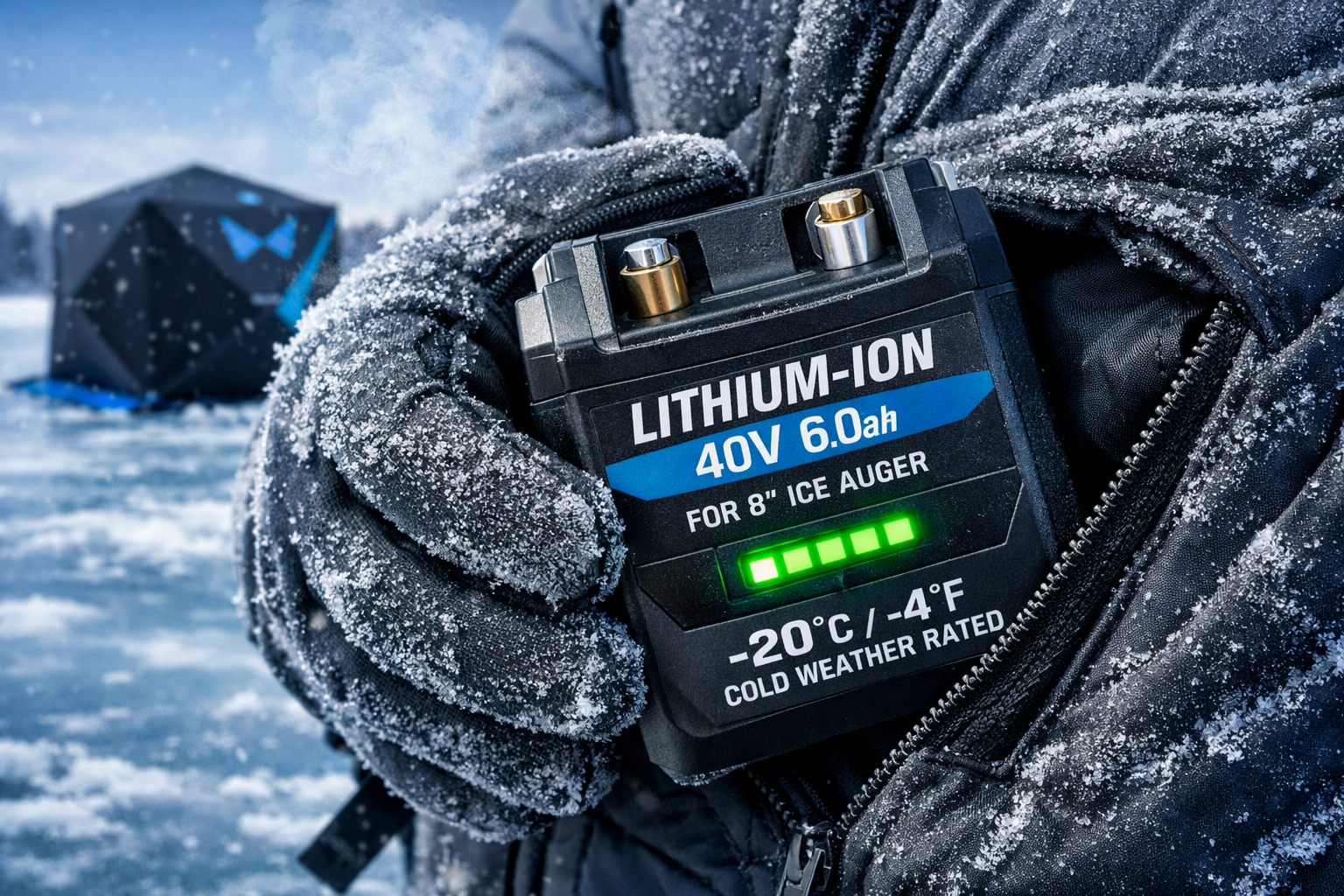
Cold temperatures slow the electrochemical reactions inside lithium-ion cells. The result is a measurable drop in voltage output and available capacity, even if the battery was fully charged before you left the house.
At 32°F (0°C), most lithium packs lose roughly 10-15% of their rated capacity. At -20°F (-29°C), that loss climbs to 20-30% for unmanaged batteries. Batteries that are pre-warmed and stored in insulated bags retain 85-90% of rated capacity even at -20°F.
This matters for 8-inch electric augers because the motor draws peak current during the first two seconds of each hole. Cold batteries struggle to deliver that surge consistently, which slows drilling speed and strains the motor.
Common mistake: Leaving your battery pack in the truck overnight. A battery at -10°F before you even start drilling loses a significant portion of its usable charge before the first hole.
What Are the Best 8-Inch Electric Augers for Sub-Zero Power Management in 2026?
The best 8-inch electric augers for cold-weather power management pair high-voltage brushless motors with cold-rated lithium packs. Three models lead the field in 2026.
StrikeMaster Maven 40V 8-inch
- Drills 125 holes (2,000 inches) per charge
- Drilling speed: 3.6 inches per second
- Weight: 14.5 lbs
- Launched November 2025, engineered for cold-weather efficiency through smooth blades that reduce battery strain
ION Alpha Plus 8-inch (Gen 3, 40V)
- Up to 2,000 inches per charge
- Field-tested at -15°F: 150+ holes in 18-inch ice with minimal capacity loss when batteries are pre-warmed
- Reverse function clears ice jams without manual effort
Eskimo E40 8-inch (40V, 4Ah)
- Excels in standard conditions but requires jacket-warming below 0°F to sustain rated holes per charge
- Variable speed trigger praised for power conservation
For a deeper look at top performers in heavy ice, check out the best electric ice auger for 30-inch ice guide.
Choose the Maven or ION Alpha Plus if you drill 50+ holes per session or fish ice thicker than 18 inches regularly. Choose the Eskimo E40 if you fish moderate ice depths and prioritize a lower price point.
How Do You Actually Keep Batteries Warm on the Ice?
Warm batteries drill more holes. The strategy is straightforward: control battery temperature from the moment you leave home until the moment you drill.
Pre-trip routine:
- Charge batteries fully at room temperature the night before.
- Store charged packs in an insulated bag or cooler (used as a warm-retention vessel, not a cooler) during transport.
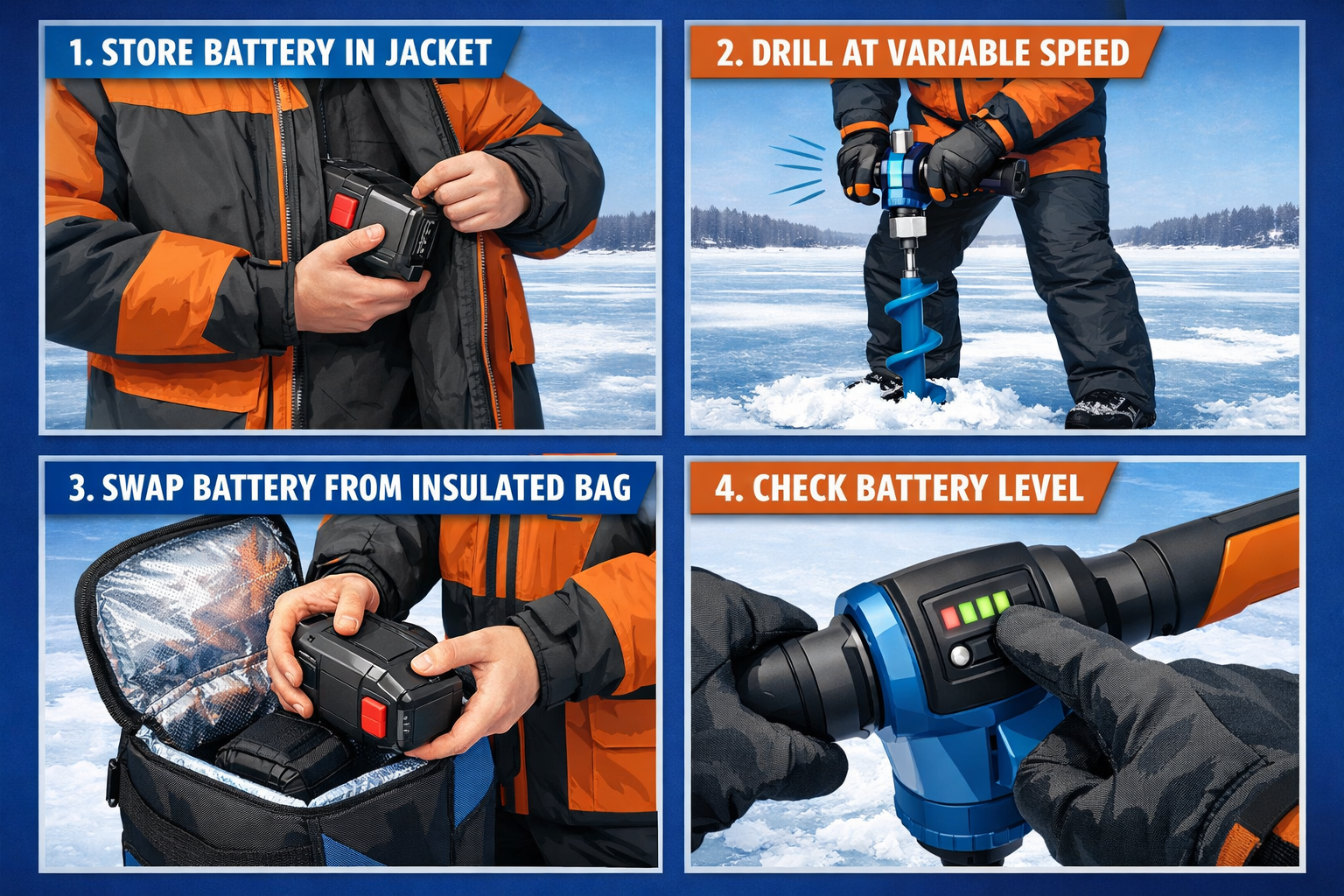
- Place batteries inside your jacket against your body for at least 15 minutes before the first hole.
On the ice:
- Keep spare batteries inside your shelter or jacket at all times.
- Swap batteries before the indicator drops below 20%. Cold batteries lose remaining charge faster than warm ones.
- Use an insulated neoprene battery sleeve or pouch between holes. These cost $15-30 and extend per-session runtime noticeably.
Inside a heated shelter:
- Set batteries on a shelf or hang them in a mesh bag away from the floor. Cold air pools at floor level.
- A shelter running a portable heater at 40-50°F interior temperature keeps batteries in their optimal operating range.
For power management across all your ice electronics, see the portable power solutions guide for all-day ice trips.
Professional ice guides on Lake of the Woods report that electric augers match gas performance at -30°F when batteries are stored in heated shelters between use.
Maximizing Battery Life in Sub-Zero Temps: Drilling Technique That Saves Power
Your drilling technique directly affects how many holes you get per charge. Maximizing battery life in sub-zero temps is as much about how you drill as it is about the battery itself.
Use variable speed correctly:
- Start each hole at 50-60% throttle for the first 2-3 inches to let the blades bite without a full-current surge.
- Increase to full speed once the bit is seated and cutting cleanly.
- Reduce speed again as you break through the bottom of the ice to prevent the auger from grabbing.
Keep blades sharp: Dull blades force the motor to draw more current per inch of ice. Sharp blades on a 40V auger cut at rated speed with less battery load. Inspect blades before every trip and replace them at the first sign of tearing rather than cutting.
Lift and clear ice chips: Pull the auger up slightly every 6-8 inches to clear chips from the hole. Packed chips increase resistance and current draw.
Avoid unnecessary reversals: Use reverse only when the bit is genuinely stuck. Repeated reversals draw significant current without advancing the hole.
The electric vs. gas ice auger comparison for beginners breaks down why technique matters more with electric models than with gas.
How Many Batteries Do You Need for a Full Day on the Ice?
The answer depends on ice thickness, hole count, and temperature. Use this table as a planning baseline.
| Ice Thickness | Holes Per Session | Temp | Batteries Needed (40V) |
|---|---|---|---|
| 8-12 inches | Up to 50 holes | 0°F to -10°F | 1 (with warm storage) |
| 12-18 inches | Up to 50 holes | -10°F to -20°F | 2 |
| 18-24 inches | 50+ holes | -20°F or colder | 2-3 |
| 24-30 inches | 50+ holes | Any temp | 3+ |
Critics of electric augers argue they fall short in ice thicker than 24 inches, where a single battery may only sustain 30-40 holes before significant voltage drop. Gas augers like the Eskimo Quantum 8-inch (33cc Viper engine, 28 lbs) provide unlimited runtime with fuel. However, 40V electric models now close that gap to within 15-20% for most anglers, and they start instantly at -30°F without the mixing, priming, and pull-cord frustration of gas.
Decision rule: If you drill more than 60 holes per day in ice thicker than 20 inches, carry three batteries or consider a gas backup. For most mobile anglers drilling 20-40 holes per session, two 40V batteries cover a full day.
What Is the Right Way to Charge and Store Auger Batteries in Winter?
Charge at room temperature. Always. Charging a lithium pack below 32°F (0°C) causes lithium plating inside the cells, which permanently reduces capacity and creates a safety risk.
Charging protocol:
- Bring batteries indoors after every trip.
- Let them warm to room temperature (at least 60°F) before plugging in. This takes 30-60 minutes after a cold session.
- Charge to 100% if you plan to use them within 48 hours.
- Store at 50-80% charge if you won’t use them for more than a week.
Storage:
- Store batteries in a climate-controlled space, not in a garage or truck during winter.
- Ideal storage temperature: 50-77°F.
- Check charge level monthly during off-season storage and top up to 50% if they drop below 30%.
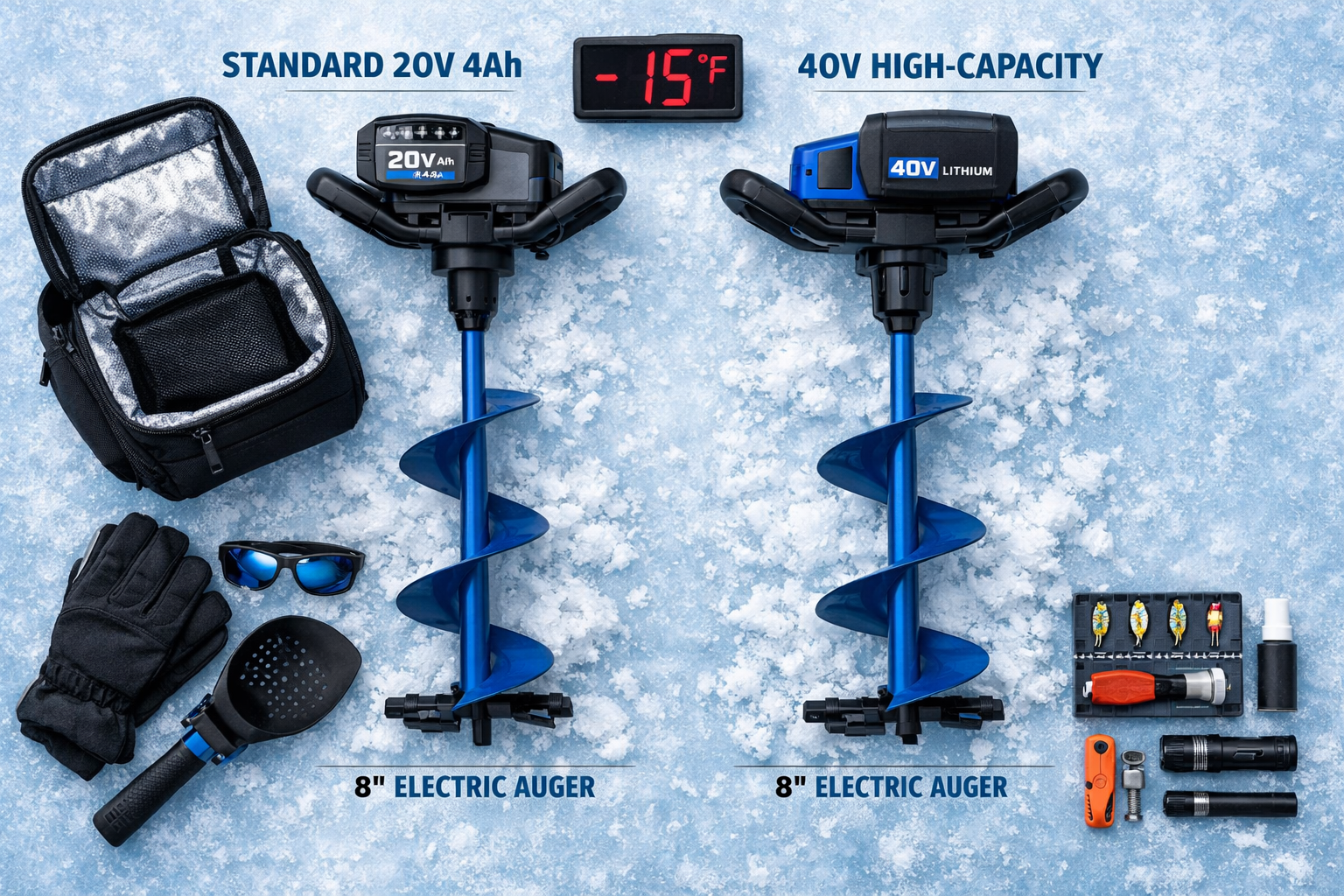
The VEVOR 20V 8-inch (4,000mAh) retains 85-90% capacity at -20°F according to manufacturer specifications, provided batteries are charged and stored at room temperature before use.
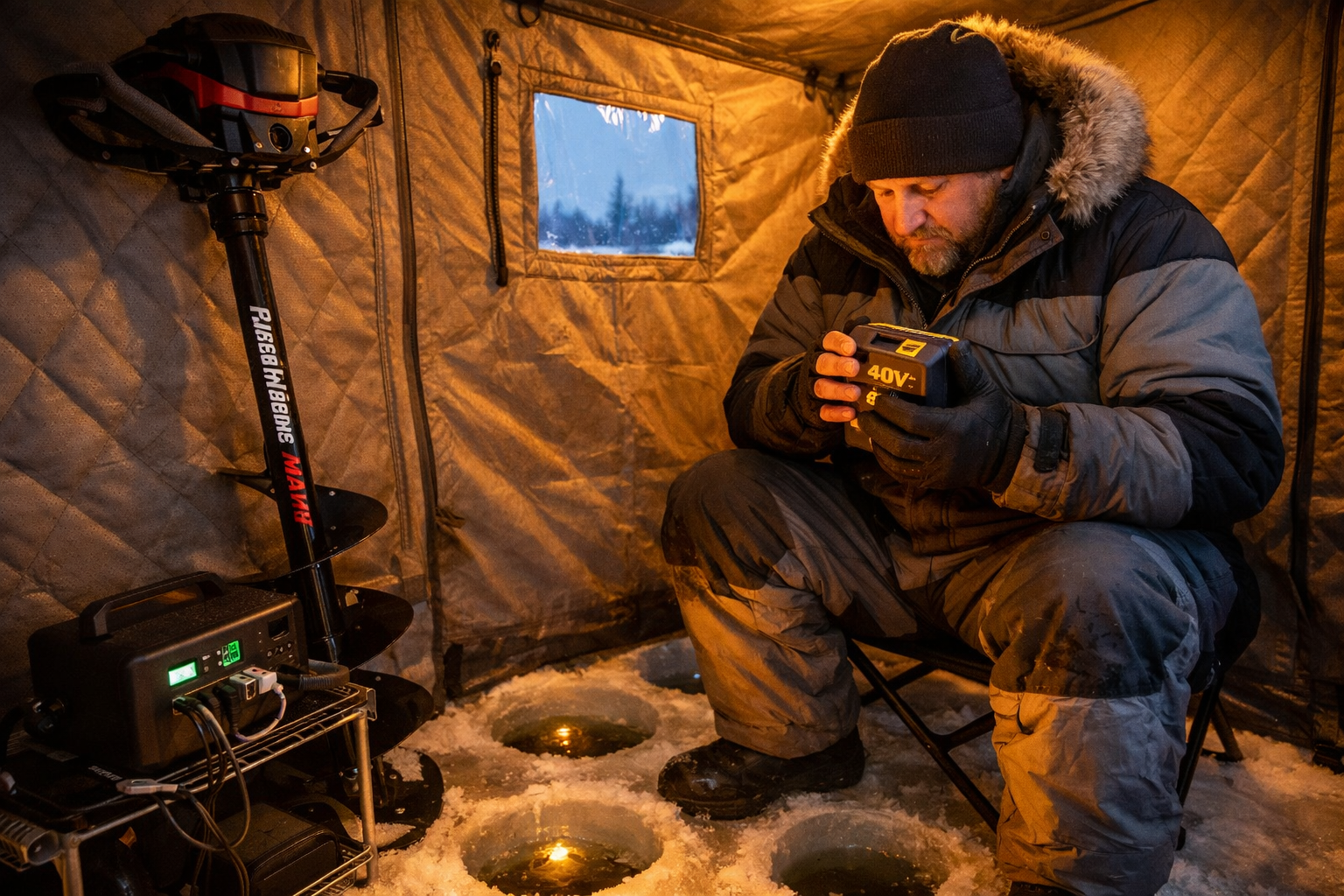
Maximizing Battery Life in Sub-Zero Temps: Spare Battery Systems and Field Setups
Building a spare battery system is the most reliable way to guarantee all-day drilling. Maximizing battery life in sub-zero temps at the field level means treating your batteries like a rotation, not an afterthought.
Spare battery rotation system:
- Start with Battery A warm and ready in the auger.
- Keep Battery B inside your jacket or shelter, warm and fully charged.
- When Battery A hits 20% indicator, swap immediately. Place Battery A inside your jacket to rewarm.
- If Battery A recovers to 30%+ after warming (10-15 minutes), it has usable reserve capacity for additional holes.
- Repeat the rotation throughout the session.
Gear for the rotation:
- Insulated battery bag or neoprene sleeve (one per battery)
- Small portable power bank rated for 40V output if you need emergency top-up in the field
- Waterproof marker to label batteries by charge level at the start of the day
This system works whether you’re fishing solo or running a full crew. For tournament-ready setups where downtime costs fish, this rotation is non-negotiable.
The StrikeMaster 40V Maven paired with the Otter Vortex Pro Monster Cabin shows exactly how a heated shelter and battery rotation work together for sustained all-day performance.
How Does Electric Compare to Gas and Hand Augers in Sub-Zero Conditions?
Each auger type handles cold differently. Here is a direct comparison for sub-zero conditions.
Electric (40V lithium):
- Instant start at any temperature
- 85-90% capacity retained at -20°F with warm storage
- Weight: 14-20 lbs depending on model
- Requires battery management and spare packs
- Zero exhaust inside shelters
Gas (e.g., Eskimo Quantum 8-inch, 33cc):
- Unlimited runtime with fuel
- Weighs approximately 28 lbs (40% heavier than electric)
- Requires fuel mixing, priming, and pull-start, which becomes difficult below -10°F
- Cannot be used inside enclosed shelters safely
Hand auger (e.g., StrikeMaster Mora):
- Zero battery or fuel concerns
- Weighs 3-5 lbs
- Drills one hole in 45-90 seconds vs. 12-18 seconds for electric
- Impractical for ice thicker than 18 inches or sessions requiring more than 10 holes
Electric augers captured 60%+ of new auger sales over the past three years, with the market valued at approximately $0.7 billion in 2026 and projected to reach $0.9 billion by 2035 (CAGR 3.7%). The shift reflects the practical advantages of instant start, low maintenance, and improving cold-weather performance.
Troubleshooting: Why Is My Electric Auger Losing Power Mid-Session?
Four causes account for most mid-session power loss in sub-zero conditions.
1. Battery too cold at the start The battery never reached operating temperature. Solution: Warm batteries for 15+ minutes inside your jacket before the first hole.
2. Dull blades increasing motor load The motor draws excess current fighting through ice rather than cutting it. Solution: Replace blades before the trip.
3. Battery below 20% in cold air Cold accelerates voltage drop below 20%. The remaining charge reads higher than actual usable capacity. Solution: Swap at 20%, not 0%.
4. Charger left in a cold vehicle Batteries were charged below 32°F, causing cell damage. Solution: Always charge indoors.
For related cold-weather gear performance issues, the low-temp reels and lubricants guide covers how cold affects your full tackle system.
FAQ: Electric Auger Battery Life in Sub-Zero Temps
Q: How cold is too cold for a lithium auger battery? Modern lithium-ion batteries in 40V electric augers function reliably to -40°F with proper thermal management. The key is pre-warming, not the temperature itself.
Q: How many holes does a 40V 8-inch auger drill in -20°F weather? With pre-warmed batteries, expect 80-100 holes in 12-inch ice. Without warm storage, that number drops by 20-30%.
Q: Should I run my auger at full speed in cold weather? No. Start each hole at 50-60% throttle, increase once the bit is seated, and reduce speed at breakthrough. This conserves battery charge and protects the motor.
Q: Can I charge my auger battery in my ice shelter? Only if the shelter is heated above 32°F (0°C). Charging below freezing damages lithium cells permanently.
Q: Is a 20V auger enough for sub-zero ice fishing? A 20V model like the VEVOR 8-inch works for moderate sessions (under 20 holes) in 8-12 inch ice. For thicker ice or longer sessions, a 40V system is the better choice.
Q: How long does it take to rewarm a cold auger battery? Inside a jacket against your body, a cold battery recovers usable capacity in 10-15 minutes. In a heated shelter at 50°F, allow 20-30 minutes.
Q: Do I need a special charger for cold-weather use? No special charger is needed, but charge only at room temperature. Standard chargers that detect cell temperature and pause charging below 32°F provide an added safety layer.
Q: What is the best way to carry spare batteries on the ice? Use an insulated neoprene battery bag inside your outer layer or in a small insulated pack. Keep batteries against your body when not in the auger.
Q: How does ice thickness affect battery consumption? Thicker ice requires more current per hole. In 24-inch ice, expect 30-40% fewer holes per charge compared to 12-inch ice.
Q: Is it worth buying a second battery for a one-day trip? Yes, if you plan to drill more than 30 holes at temperatures below 0°F. A second battery costs $60-120 and eliminates the risk of a dead auger mid-session.
Conclusion
Cold weather does not have to end your drilling day early. The principles behind maximizing battery life in sub-zero temps are straightforward: warm your batteries before use, rotate spares systematically, drill with variable speed, and charge only at room temperature.
A 40V 8-inch electric auger with two pre-warmed batteries handles the vast majority of ice fishing sessions, including full days in -20°F conditions. The StrikeMaster Maven 40V and ION Alpha Plus Gen 3 lead the field in 2026 for cold-weather efficiency.
Your action steps:
- Buy a second battery before your next cold-weather trip.
- Pick up an insulated battery bag or neoprene sleeve.
- Practice the warm-up and rotation system before you need it on the ice.
- Inspect and replace blades at the start of every season.
Kayak. Drill. Catch. Repeat.
See you on the water.
References
[1] Vevor 20v Electric Ice Auger 8 Inch Diameter 2 In 1 Cordless Ice Fishing Augers And Earth Auger With Ices Earth Drill Bit Cold Resistant Post Hole Digger Turbo High Speed Cutting System – https://www.vevor.com/auger-drill-bit-c_12389/vevor-20v-electric-ice-auger-8-inch-diameter-2-in-1-cordless-ice-fishing-augers-and-earth-auger-with-ices-earth-drill-bit-cold-resistant-post-hole-digger-turbo-high-speed-cutting-system-p_010325017696
[2] Auger Fishing – https://beyondbraid.com/blogs/news/auger-fishing
[3] Top New Gear For Your 2025-26 Ice Angling Campaign – https://www.outdoornews.com/2025/11/01/top-new-gear-for-your-2025-26-ice-angling-campaign/
[4] High Capacity Ice Fishing Battery – https://www.datainsightsmarket.com/reports/high-capacity-ice-fishing-battery-119812
[5] Best Ice Augers – https://northamerican-outdoorsman.com/best-ice-augers/
[6] Electric Ice Auger Market – https://www.reportsandinsights.com/report/electric-ice-auger-market