Last updated: February 23, 2026
Key Takeaways
- First ice walleye concentrate on shallow weed edges between 8 and 15 feet, feeding aggressively during low-light windows before conditions stabilize.
- Tip-ups with live shiners or sucker minnows produce best results on stained northern lakes where visibility is limited.
- Fluorocarbon leaders (12 to 18 inches) and barrel swivels reduce line twist and improve hookup rates on wary walleye.
- Set tip-ups by 4 PM to cover the critical pre-dusk feeding window when walleye move shallow.
- Circle hooks on tip-ups reduce deep hooking from 50.4% to rates comparable with jigging, supporting catch-and-release compliance.
- Minnesota’s 2026 regulations added 15 lakes to walleye slot limits (18 to 26 inches) and expanded catch-and-release on 8 lakes. Check your specific lake before drilling.
- Wisconsin reduced daily walleye limits to 3 fish on select northern zone lakes for 2026.
- Spread tip-ups along the first breakline rather than clustering them in one spot to cover more of the walleye travel corridor.
- Rattling leaders and small LED lights improve both strike rates and flag detection during dark hours.
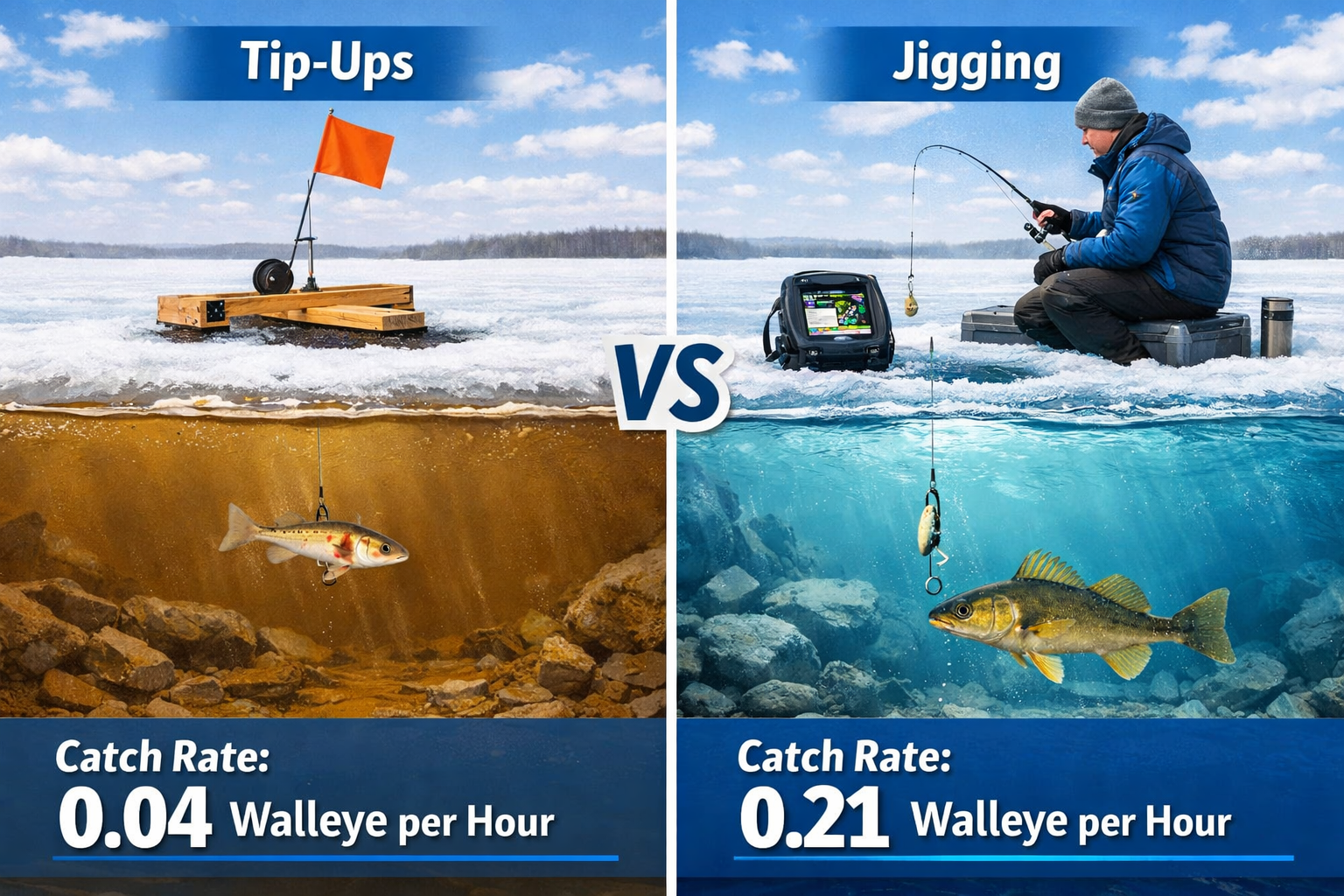
- Jigging outperforms tip-ups in raw catch rates (0.21 vs. 0.04 walleye per hour), but combining both methods covers active and neutral fish simultaneously.
Quick Answer
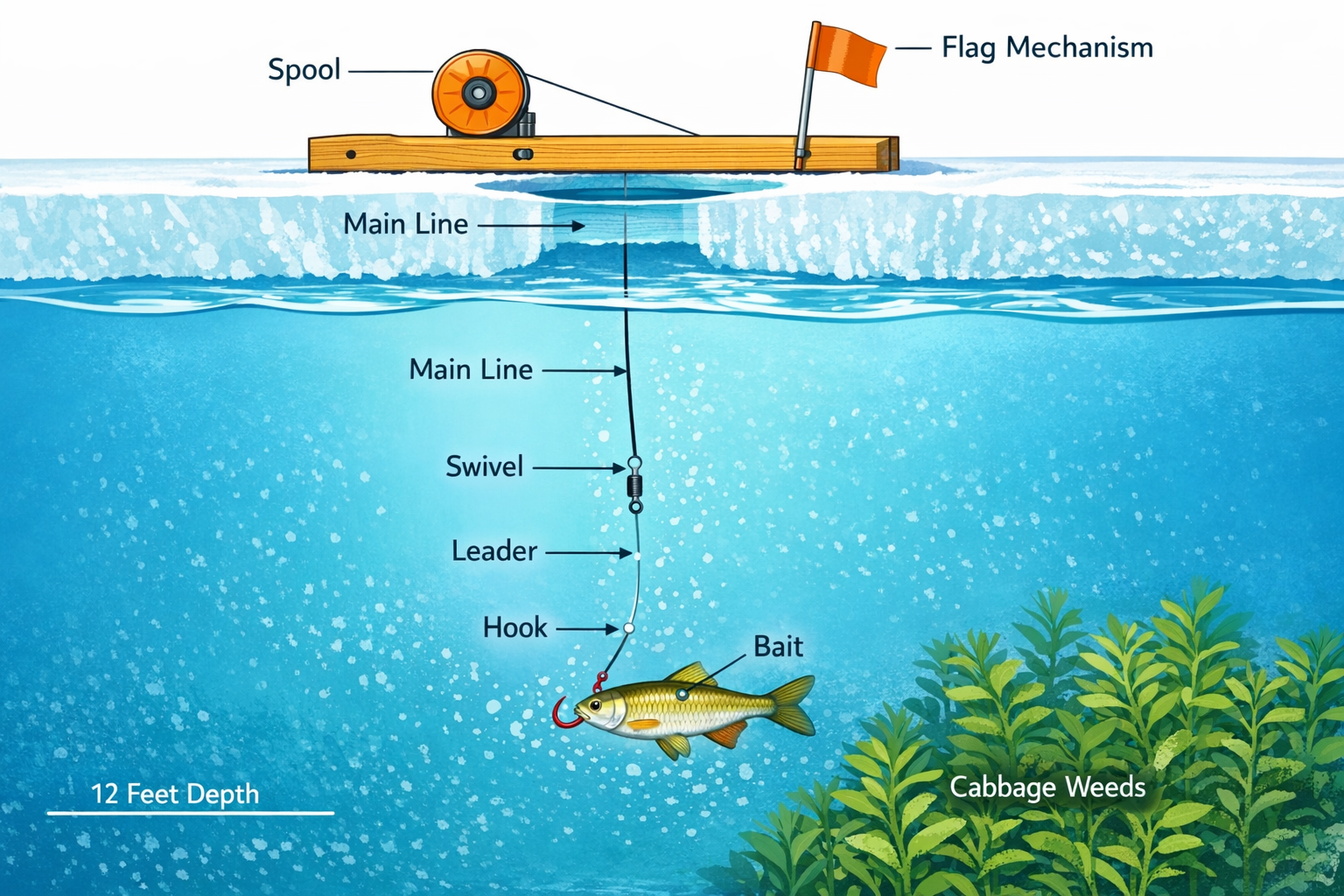
Mastering tip-up setups for first ice walleye in 2026 comes down to three factors: location on shallow weed edges, proper rigging with fluorocarbon leaders and medium shiners, and timing your spread to cover the low-light feeding window. Northern lakes across Minnesota, Wisconsin, and Michigan have updated walleye regulations for the 2026 season, so confirm slot limits and daily bag counts for your target water before heading out. Rig your tip-ups with 12 to 18 inch fluorocarbon leaders, set them along the first breakline by 4 PM, and let live bait do the work while you jig a second hole nearby.
Why Do Tip-Ups Work So Well for First Ice Walleye on Northern Lakes?
Tip-ups allow you to present live bait across multiple locations at once, covering water that a single jigging rod never could. During the first ice period on northern lakes, walleye push into shallow zones (8 to 15 feet) near remaining green cabbage and coontail weed beds. These fish feed aggressively because the water has recently cooled to a stable temperature, forage is concentrated, and competition is high.
On stained water lakes common across northern Minnesota and Wisconsin, live minnows on tip-ups outproduce jigging spoons because walleye rely more on scent and vibration than sight in low-visibility conditions. The Wisconsin DNR has noted this pattern on many of their managed waters.
A tip-up sits motionless on the ice, creating zero disturbance. The minnow does all the attracting. When a walleye picks up the bait, the flag trips, and you walk over to set the hook by hand. This passive approach lets you fish 2 to 3 tip-ups (depending on your state’s line limit) while actively jigging a fourth hole.
Common mistake: Setting all your tip-ups in one cluster. Walleye travel along structure edges, so spread your setups 30 to 50 yards apart along the breakline to intercept fish moving through the zone.
For more on building a tactical approach to your fishing content and strategy, check out our services overview.
What Gear Do You Need for a First Ice Tip-Up Spread?
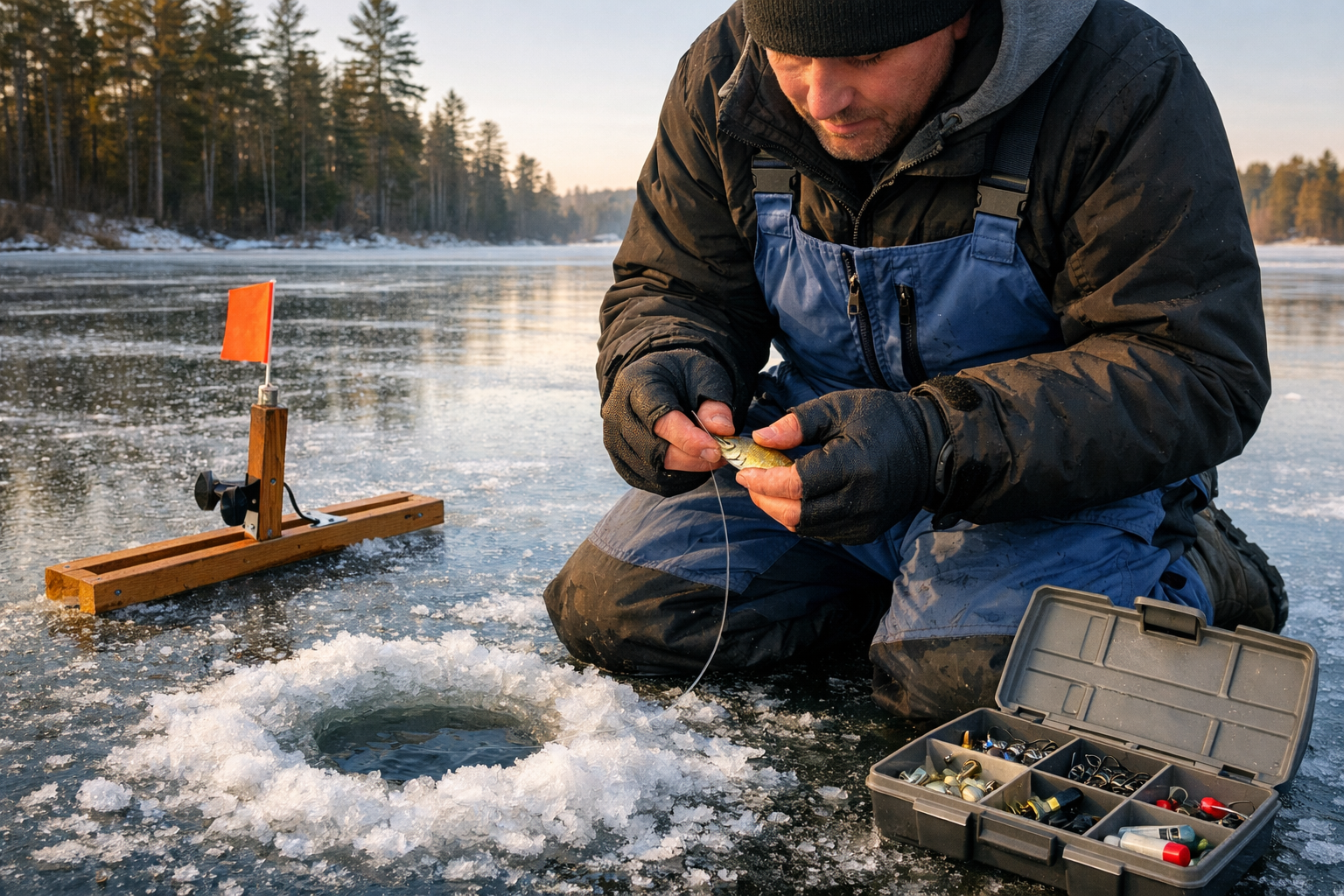
The right gear makes the difference between a productive outing and a frustrating one. Here is a complete breakdown of what to bring for a 2026 early season tip-up spread targeting walleye on northern lakes.
Tip-Up Selection
| Tip-Up Type | Best Use Case | Pros | Cons |
|---|---|---|---|
| Wooden rail (Beaver Dam style) | All-around first ice walleye | Durable, sits flat, wind-resistant | Heavier to carry |
| Plastic round (HT Polar) | Portability, multiple setups | Lightweight, affordable | Freeze-in risk in cold snaps |
| Thermal (insulated cover) | Extended sits, overnight | Prevents hole freeze-up | Bulkier, more expensive |
| Wind tip-up | Ultra-shallow presentations | Adds jigging action to live bait | Limited to calm conditions |
For first ice walleye on northern lakes, the wooden rail design remains the standard. The spool sits below the ice surface, keeping your line in the water column and reducing freeze-up issues during the early season when temperatures fluctuate.
Terminal Tackle Checklist
- Main line: 20 to 30 pound braided Dacron (low memory, high visibility for hand-over-hand retrieval)
- Barrel swivel: Size 10 or 12 to connect main line to leader
- Leader: 8 to 12 pound fluorocarbon, 12 to 18 inches long
- Hook: Size 4 or 6 octopus hook for shiners, size 2 for sucker minnows
- Split shot: One or two BB-sized shot 6 inches above the hook to keep bait at depth
- Snap swivel (optional): At the leader connection for quick bait changes
Live Bait
Angling Buzz experts recommend 3.5 to 4 inch golden shiners for first ice walleye on northern lakes. These are the right profile size for walleye in the 15 to 25 inch range that dominate shallow weed edges during early ice.
Choose golden shiners if: You’re fishing stained water or targeting weed edges in 8 to 15 feet.
Choose medium sucker minnows (4 to 5 inches) if: You’re targeting deeper breaklines (15 to 20 feet) or want to filter out smaller fish and attract trophy-class walleye.
Keep bait alive in an insulated bucket with an aerator. Dead or sluggish minnows produce fewer flags.
How Do You Rig a Tip-Up for Walleye Step by Step?
Proper rigging separates consistent anglers from those who watch flags trip and miss fish. Follow this sequence for a clean, effective walleye tip-up rig.
Step-by-Step Rigging Process
- Spool the tip-up with 50 to 75 yards of 25-pound braided Dacron. Fill the spool to within a quarter inch of the edge for smooth payout.
- Tie a barrel swivel to the end of the Dacron using a Palomar knot. This prevents line twist when the minnow swims in circles.
- Cut a fluorocarbon leader 14 to 16 inches long from 10-pound test. Tie one end to the barrel swivel with an improved clinch knot.
- Attach your hook to the other end of the leader. A size 4 octopus hook works for 3.5-inch shiners. Use a snell knot for the strongest connection.
- Pinch one BB split shot onto the leader, 6 inches above the hook. This anchors the bait at your target depth without restricting movement.
- Hook the minnow through the back, just behind the dorsal fin. Avoid the spine. The minnow should swim freely in a horizontal position.
- Lower the rig to your target depth. For weed edge walleye, set the bait 1 to 2 feet above the weed tops. If weeds top out at 10 feet in 13 feet of water, set your bait at 8 to 9 feet.
- Set the flag tension so a swimming minnow does not trip the flag, but a walleye strike does. Adjust the trip mechanism until the minnow swims without triggering false flags.
Rattling Leader Upgrade
Gary Roach, known as “Mr. Walleye,” recommends adding a small rattling bead or rattling leader sleeve between the swivel and the hook. The subtle clicking sound draws walleye from farther away in stained water. Tom Boley has also documented success with rattling fluorocarbon leaders on lethargic first-ice walleye when jigging slows down.
LED Light Attachment
For low-light and after-dark fishing, attach a small LED light to the flag or the tip-up frame. This serves two purposes: you spot tripped flags from a distance, and the faint glow near the hole attracts baitfish, which in turn draws walleye. This is one of Roach’s two key tip-up additions for northern lake walleye.
If you want to build your knowledge base on tactical approaches to any pursuit, browse our blog for more guides.
Where Should You Place Tip-Ups on Northern Lakes During First Ice?
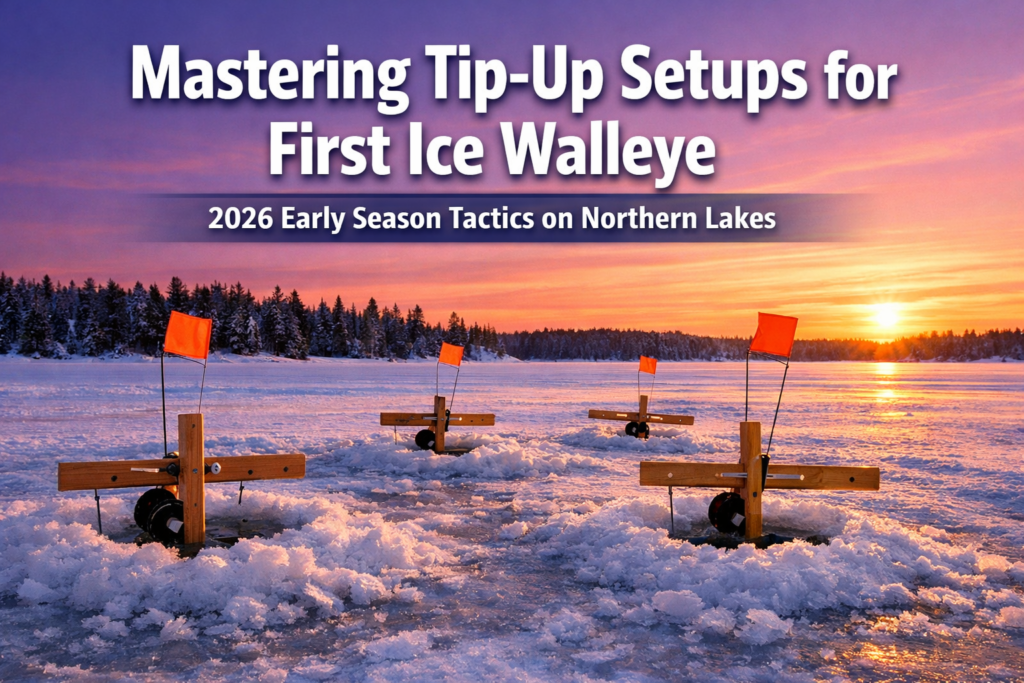
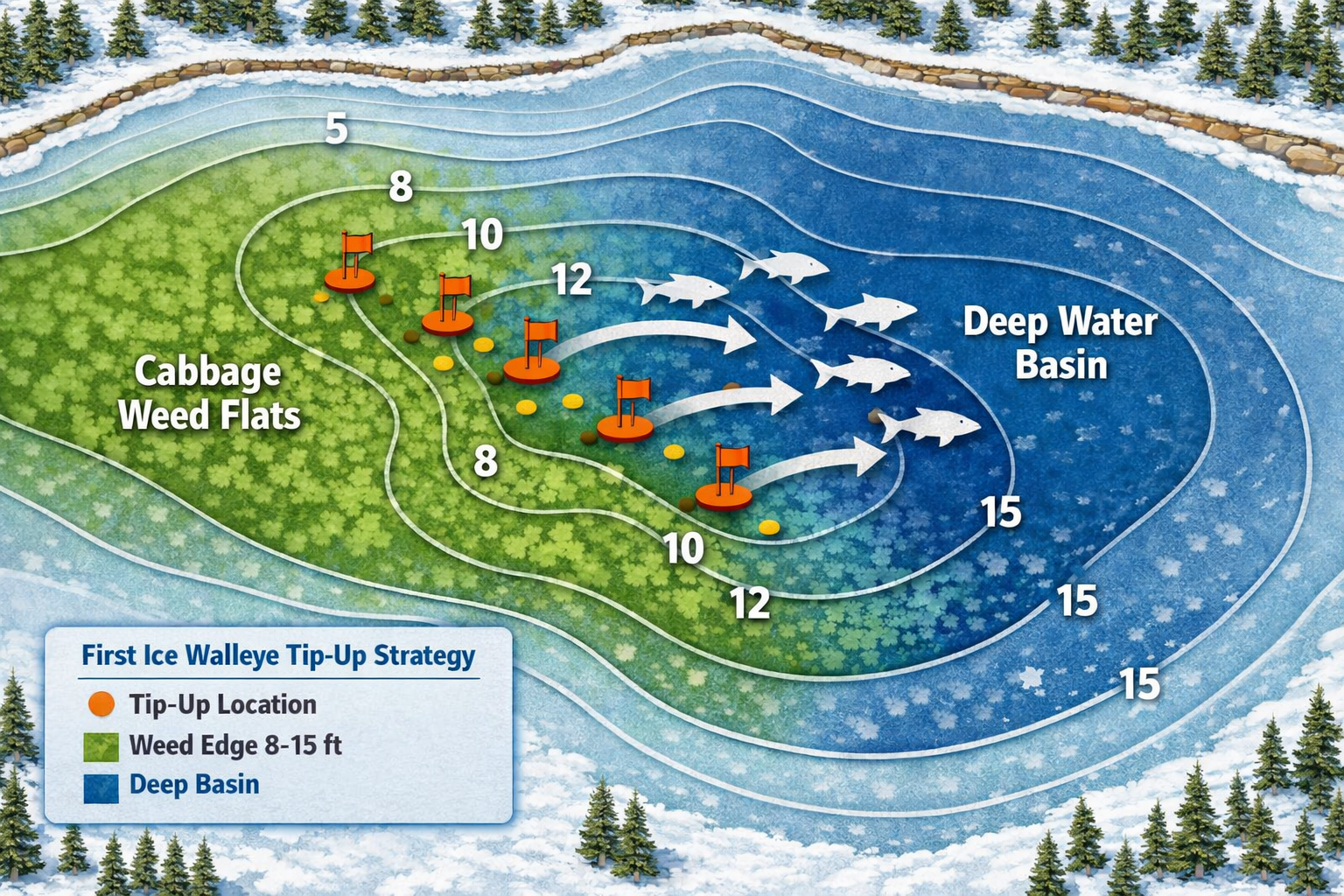
Set your tip-ups along the first major breakline where shallow weed flats drop into deeper water. On most northern lakes, this transition zone sits between 8 and 15 feet. Walleye use this edge as a highway, moving from deep daytime holding areas to shallow feeding zones during low-light periods.
Reading the Structure
Use a portable flasher or forward-facing sonar unit to identify:
- Cabbage weed beds that still hold green growth (walleye and baitfish concentrate here)
- Coontail pockets along the inside edge of the breakline
- Rock-to-sand transitions on the bottom
- Points and inside turns along the weed edge where walleye funnel through
Placement Strategy
Spread your tip-ups in a line along the breakline, spacing them 30 to 50 yards apart. This creates a “fence” that intercepts walleye moving along the edge.
Example setup on a typical northern Minnesota lake:
- Tip-up 1: Inside turn of the weed edge at 10 feet, over cabbage
- Tip-up 2: Point extending from shore at 12 feet, rock-to-sand transition
- Tip-up 3: Outside weed edge at 14 feet, near the drop into the basin
Joel Nelson of Northland Tackle stresses getting your spread set by 4 PM on clear early ice. Walleye begin moving shallow before sunset, and you want your baits in position before the fish arrive, not after.
Choose shallow (8 to 10 feet) if: The lake has stained water, thick weed growth, or you’re fishing the first two weeks of ice.
Choose mid-depth (12 to 15 feet) if: The lake has clear water, sparse weeds, or you’re fishing later in the early ice period when walleye push slightly deeper.
For those who enjoy learning about how to position content and strategy for peak performance, our practice resources offer additional insights.
How Do Tip-Ups Compare to Jigging for First Ice Walleye?
Jigging produces higher catch rates per hour, but tip-ups fill a role that jigging alone does not cover. A 2018-2019 study on Lake Nipissing measured jigging at 0.21 walleye per hour compared to 0.04 walleye per hour for standard tip-ups with J-hooks. When researchers switched tip-ups to circle hooks, the rate improved to 0.13 walleye per hour.
| Method | Catch Rate (walleye/hour) | Deep Hooking Rate | Best Water Clarity | Effort Level |
|---|---|---|---|---|
| Jigging (spoons/rattlers) | 0.21 | 9.3% | Clear | Active |
| Tip-ups (J-hooks) | 0.04 | 50.4% | Stained | Passive |
| Tip-ups (circle hooks) | 0.13 | Significantly reduced | Stained | Passive |
When Tip-Ups Win
On stained northern lakes, live minnows on tip-ups outproduce jigging because walleye locate prey by scent and lateral line detection rather than sight. Tip-ups also shine during the pre-dawn and post-sunset windows when walleye feed but visibility drops to near zero.
When Jigging Wins
On clear-water lakes, jigging spoons and rattling baits trigger reaction strikes from walleye that see the flash and vibration from a distance. Jigging also lets you work through fish quickly, adjusting cadence and depth in real time.
The Combined Approach
The most effective first-ice walleye anglers run both methods simultaneously. Set your tip-ups along the breakline, then sit over a hole between them with a jigging rod. The jigging attracts fish into the area, and the tip-up baits pick off walleye that pass through without committing to the jig.
This is tactical angling at its core. You cover active fish with the jig and neutral fish with the tip-up. Kayak. Drill. Catch. Repeat.
What 2026 Regulations Affect Tip-Up Walleye Fishing on Northern Lakes?
Regulations have tightened across the northern tier states for the 2026 ice season. These changes directly affect how many walleye you keep and what sizes you target.
Minnesota 2026 Changes
- 15 lakes added to 18-to-26-inch walleye slot limits (fish within the slot must be released)
- 8 lakes moved to catch-and-release only for walleye
- These changes protect spawning-class fish from weak 2018-2020 year classes
- A proposed statewide reduction from 6 to 4 walleye daily limit is under review, with potential implementation on March 1, 2027
Wisconsin 2026 Changes
- 3 northern zone lakes reduced from 5 to 3 walleye daily limits
- 6 trophy lakes added 32-inch minimum pike regulations (relevant if your tip-ups pick up incidental pike)
Michigan 2026 Changes
- Lake Huron walleye limit reduced from 5 to 3 fish
- New slot limits on Saginaw Bay to support recovering walleye populations
Action step: Before you drill a single hole, check your state’s DNR website for the specific lake you plan to fish. Regulations vary lake by lake, and the 2026 changes affect many popular northern waters.
Circle hooks on tip-ups reduce deep hooking rates and improve survival of released fish. If you’re fishing a slot lake, switching to circle hooks is a practical decision that keeps fish alive and keeps you within the spirit of the regulation.
Learn more about staying current with changing conditions and strategies on our about page.
What Are the Biggest Mistakes Anglers Make with First Ice Tip-Ups?
Avoiding these common errors will put more walleye on the ice during your early season outings.
Mistake 1: Setting bait too deep. First ice walleye feed shallower than most anglers expect. If weeds top out at 10 feet, set your bait at 8 feet, not 15. Walleye cruise above the weeds, not below them.
Mistake 2: Using dead or dying minnows. A sluggish minnow does not trigger the same response as a lively one. Change your bait every 30 to 45 minutes if the minnow stops swimming actively.
Mistake 3: Setting the flag tension too loose. False flags from swimming minnows waste your time and pull you away from productive jigging. Tighten the trip mechanism until only a deliberate strike triggers the flag.
Mistake 4: Rushing the hookset. When a flag trips, walk to the tip-up calmly. Pick up the line and feel for tension. If the fish is running, let the line feed through your fingers for 3 to 5 seconds, then set the hook with a firm upward sweep of your hand. Premature hooksets pull the bait away from walleye that are still turning the minnow headfirst.
Mistake 5: Ignoring ice safety. First ice is the most dangerous period of the season. A minimum of 4 inches of clear, solid ice is required to support a single angler on foot. Carry ice picks, a throw rope, and check thickness every 50 feet as you move onto the lake.
Mistake 6: Fishing the same depth on every tip-up. Stagger your depths. Set one tip-up at 8 feet, another at 11, and a third at 14. Let the fish tell you where they want the bait, then adjust the others to match.
For a deeper look at building consistent, high-performance habits, explore our case studies.
How Do You Handle a Tripped Flag and Land the Fish?
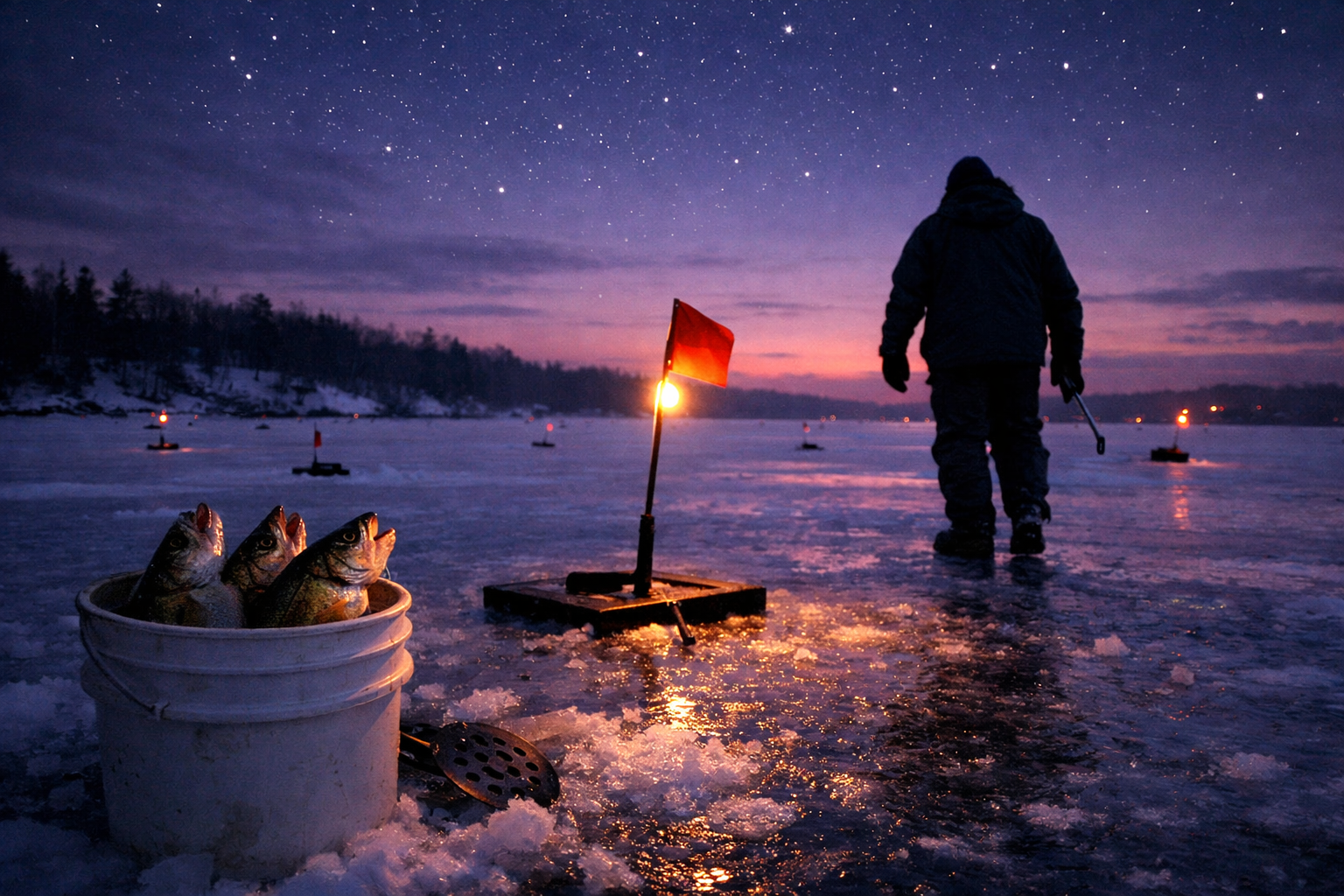
When you see a flag go up, move toward the tip-up at a steady pace. Running on first ice is dangerous and unnecessary.
- Kneel beside the hole. Look at the spool. If line is peeling off, the fish is still running.
- Gently lift the tip-up off the hole and set it aside.
- Pinch the line between your thumb and forefinger. Feel for the fish.
- If the fish is moving, let line slide through your fingers with light tension. Count to three.
- Set the hook by pulling the line firmly upward with a smooth, steady motion. No sharp jerks.
- Retrieve hand over hand, keeping steady tension. Let the fish take line if needed, but maintain contact.
- Guide the fish through the hole headfirst. If the walleye turns sideways, ease off pressure and let the fish reposition.
- Measure immediately if you’re on a slot lake. Release fish within the protected slot quickly by keeping them in the water and backing the hook out with pliers.
Edge case: If you pick up the line and feel no tension, the fish dropped the bait. Re-bait with a fresh minnow and reset. This happens more often with small walleye that mouth the tail of the minnow without committing.
FAQ
How many tip-ups are you allowed per angler in Minnesota? Minnesota allows two lines per angler while ice fishing. You may use two tip-ups, or one tip-up and one jigging rod.
What pound test leader should you use for walleye tip-ups? Use 8 to 12 pound fluorocarbon. This provides enough strength for walleye up to 28 inches while remaining nearly invisible in the water.
Do tip-ups work better at night for walleye? Walleye feed heavily during low-light periods, including after dark. Tip-ups with LED lights and rattling leaders produce well during nighttime hours on lakes that allow after-dark fishing.
What is the best minnow size for first ice walleye tip-ups? Golden shiners in the 3.5 to 4 inch range are the standard recommendation from experienced northern lake anglers. Larger sucker minnows (4 to 5 inches) target bigger fish but produce fewer total flags.
Should you use circle hooks on walleye tip-ups? Yes. Circle hooks reduce deep hooking from over 50% to rates closer to jigging levels. They also improve catch rates on tip-ups from 0.04 to 0.13 walleye per hour based on Lake Nipissing research.
How far apart should you space tip-ups? Space them 30 to 50 yards apart along a structural edge. This covers enough water to intercept traveling walleye without spreading so thin that you struggle to reach tripped flags quickly.
What time should you set tip-ups for first ice walleye? Have your spread in position by 4 PM. The pre-dusk feeding window is the most productive period, and walleye begin moving shallow before sunset.
Do you need a leader on a walleye tip-up? A fluorocarbon leader is strongly recommended. The near-invisibility of fluorocarbon reduces refusals from line-shy walleye, and the abrasion resistance protects against teeth and ice edge contact.
What is the best tip-up brand for walleye? Beaver Dam wooden rail tip-ups remain the most widely used and trusted design for walleye fishing on northern lakes. They are durable, stable in wind, and the below-ice spool design reduces freeze-up.
How thick does ice need to be for tip-up fishing? A minimum of 4 inches of clear, solid ice supports a single angler on foot. Always check thickness as you move, and avoid areas near current, inlets, or pressure cracks.
When is first ice on northern lakes in 2026? First safe ice on northern Minnesota and Wisconsin lakes typically forms between late November and mid-December, depending on the specific year’s weather pattern. Monitor local reports and ice thickness updates from your DNR.
Are tip-ups legal in all northern states? Tip-ups are legal in Minnesota, Wisconsin, Michigan, and most northern tier states, but line limits and specific rules vary. Always verify current regulations for your target lake and state.
The 2026 early ice season on northern lakes brings tighter regulations and renewed focus on responsible walleye harvest. Mastering tip-up setups for first ice walleye gives you a proven method to target fish on shallow weed edges and breaklines during the most productive feeding windows of the year. Rig with fluorocarbon leaders, use lively shiners, spread your setups along the structure, and combine tip-ups with jigging for a complete approach.
Check your state’s 2026 regulations before you head out. Carry safety gear. Set your spread early. And when that flag pops up against the winter sky, take your time, feel the fish, and set the hook with confidence.
See you on the water.
Visit FishOnYak.com for more tactical angling content, rigging guides, and expert coaching to sharpen your skills across every season.