The short version: the Old town Sportsman BigWater ePDL+ 132 is the right kayak for anglers fishing big inshore water, large lakes, and tidal rivers who want motor range without giving up pedal control. It costs $5,999 as of July 2026, ships with the battery and charger in the box, and cruises at about 5 mph. Skip it if you fish tight, weedy flats, launch from soft sand without a cart, or your budget stops under $4,000.
That price stings, so let’s be clear about what you’re paying for. This is the only kayak on the market that gives you three propulsion modes in one drive: pure leg power, five levels of electric pedal assist, and full motor cruise control.
It won Best of Show at ICAST 2023, and unlike most award winners, it earned the hype in real-world testing. It also has real limitations that the marketing skips, and a couple of ownership costs nobody mentions until after you buy. This review covers both.
A note on sourcing: this is a research synthesis, not an ownership diary. Every performance claim below traces to a named reviewer with documented time on the boat or to Old Town’s published specs. Where testers disagree, I say so.
What is the BigWater ePDL+ 132?
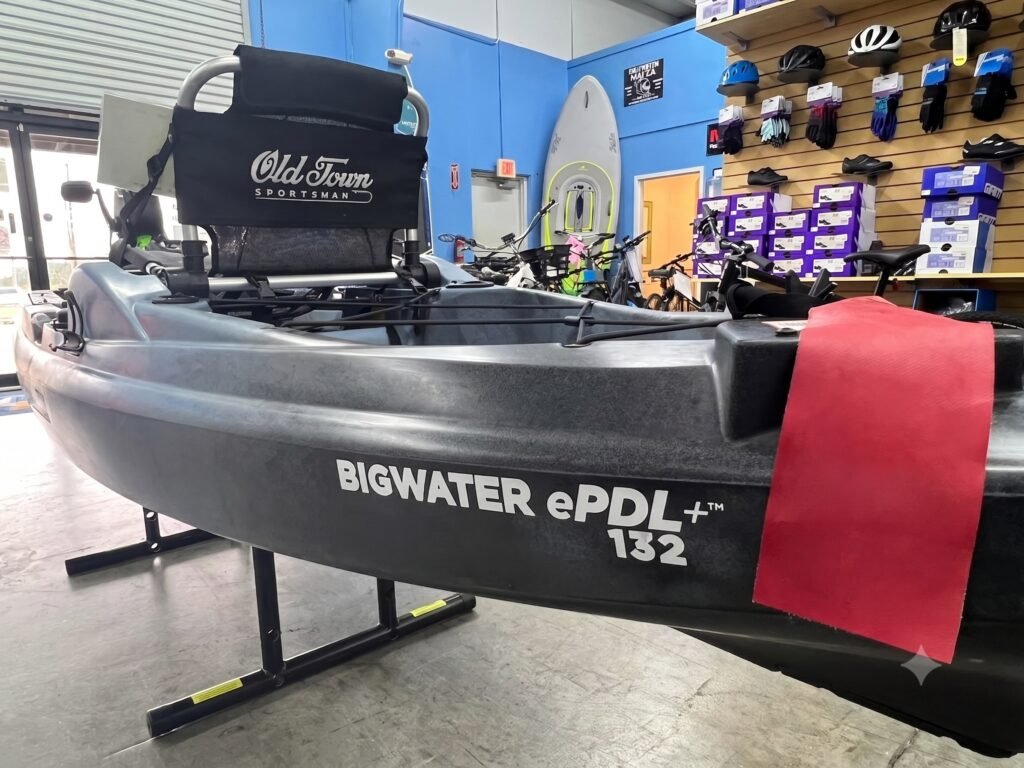
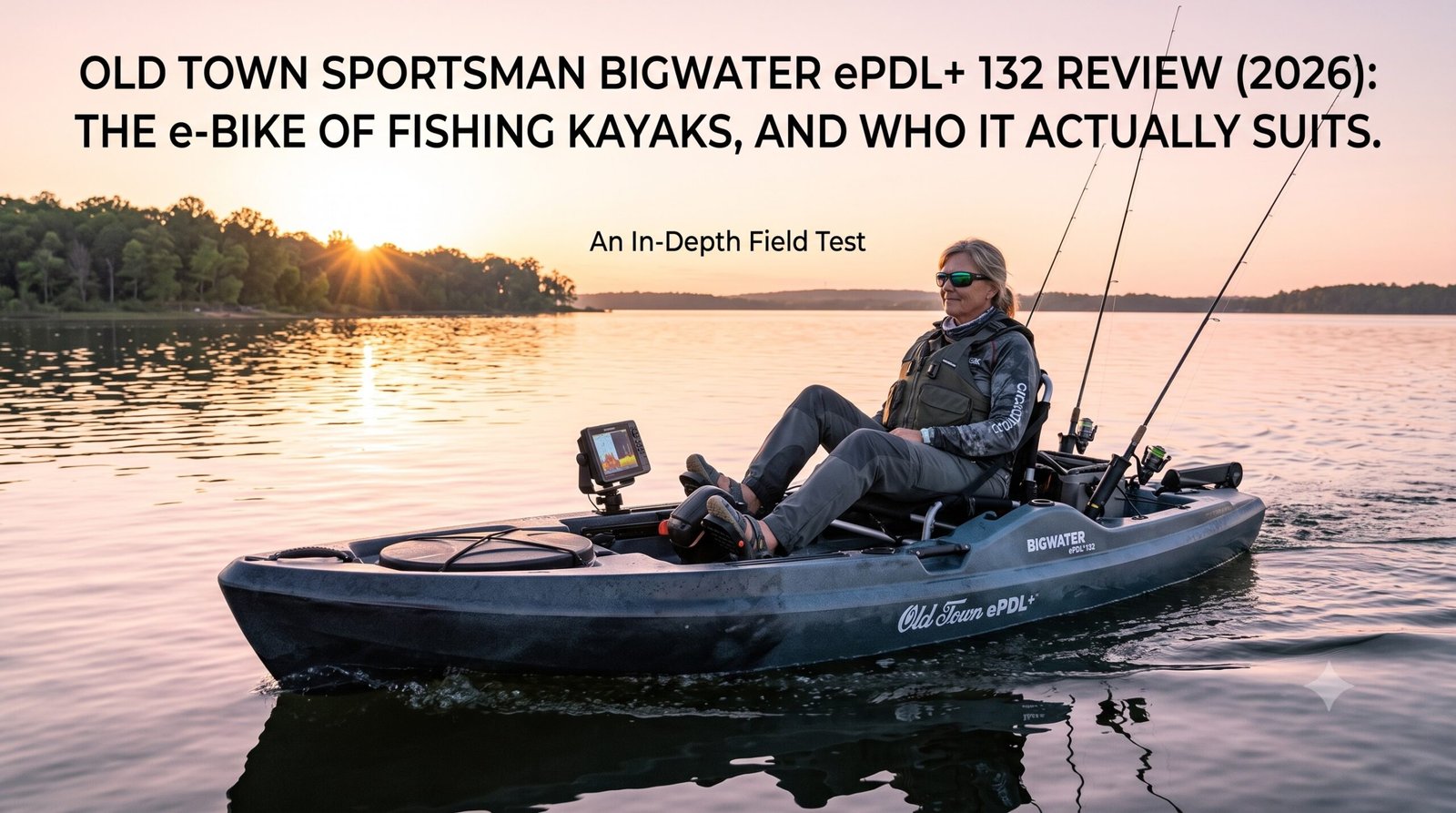
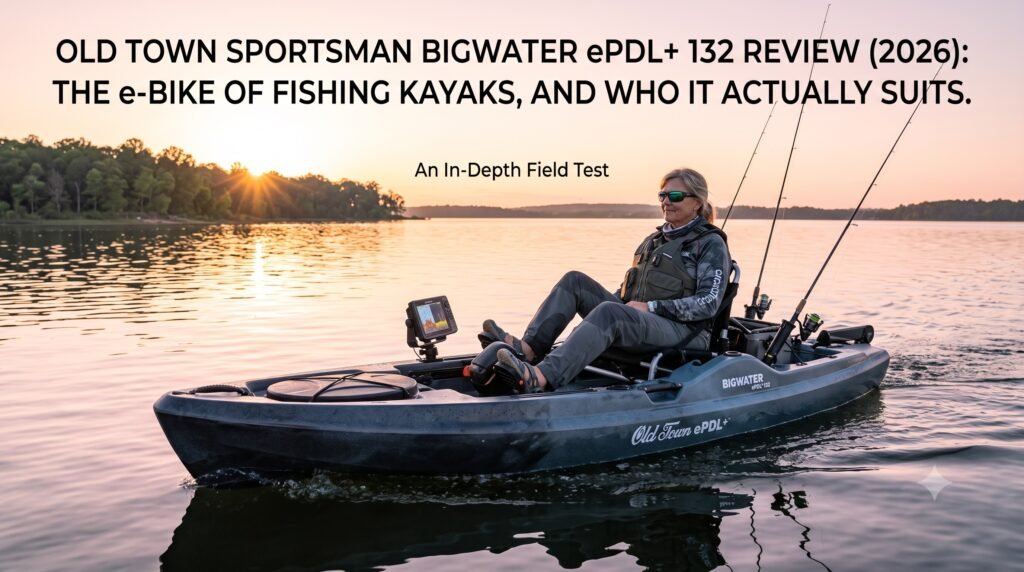
The Old Town Sportsman BigWater ePDL+ 132 is a 13-foot 2-inch sit-on-top fishing kayak with a hybrid drive that combines foot pedals and an integrated electric motor, letting the angler pedal manually, pedal with power assist, or run on motor alone via cruise control.
The easiest way to understand it is the comparison every reviewer reaches for: it’s an e-bike for the water. Pedal and the propeller turns. Add assist and the motor multiplies your effort across five levels. Get tired and cruise control holds your speed with zero pedaling.
The whole system runs off a 36V 20Ah Amped Outdoors lithium battery that sits in a compartment under the seat and comes included, along with the charger.
Old Town made one genuinely smart engineering decision here: they didn’t design a new hull. The ePDL+ drive sits in the proven BigWater 132 platform, which itself descends from the long-running Predator series. That matters for two practical reasons.
First, the hull’s behavior in chop, current, and wind was sorted out years before the motor arrived. Second, the drive well accepts Old Town’s older manual PDL drives, so tournament anglers can swap in a non-motorized drive for events that ban motors. Outdoor Life flagged that backwards compatibility as a quiet standout feature, and I agree. No other electric kayak gives you a legal path into no-motor tournaments without buying a second boat.
How the ePDL+ drive actually works
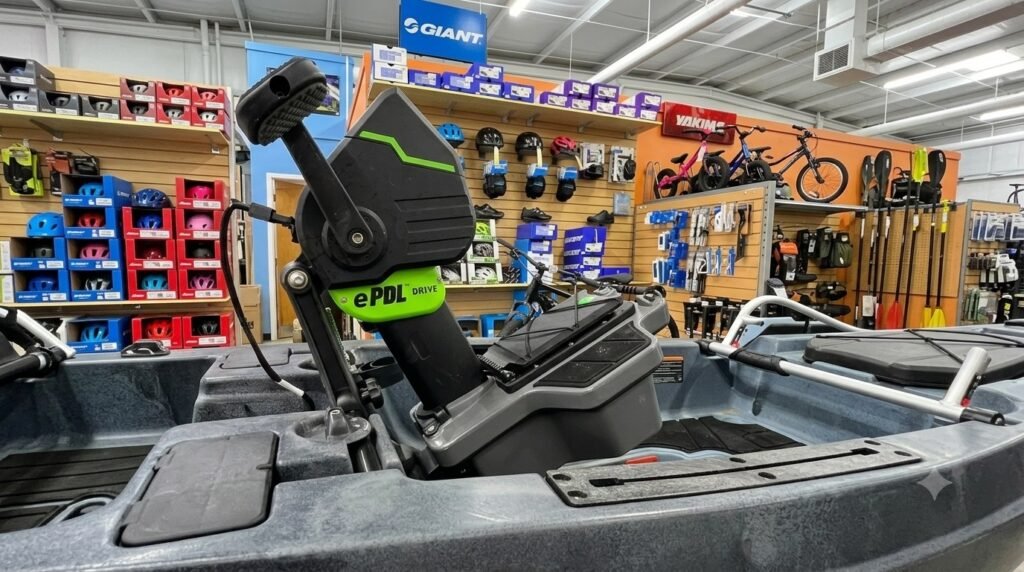
The control interface sits between the pedals: large buttons and a backlit screen that reviewers consistently confirm stays readable through polarized sunglasses in direct sun. You scroll through five assist levels. Level 1 gives a light push. Level 5, in Wired2Fish’s description, nearly moves your feet for you. Press into cruise control and the motor takes over completely at your set speed.
Two safety systems back it up, and they matter more on this boat than on a paddle kayak. A magnetic kill switch fob wears on your body and cuts power if you and the kayak part ways. Backpedaling also kills the motor instantly, which is the mechanism you’ll actually use dozens of times a day when a fish eats mid-cruise.
For a beginner, cruise control is the killer feature, and not for the reason the brochure implies. It’s not about laziness. It’s about attention.
A new kayak angler is already juggling boat position, casting, line management, and a fish finder.
Removing propulsion from that list is the single biggest cognitive unload available on any fishing kayak, and it’s why this boat works so well as a first serious saltwater platform despite the premium price.
One judgment call worth passing along from Sport Fishing Magazine’s Elias Vaisberg, who has logged over 100 full days on this kayak: run full assist between spots, then kill the electric entirely once you arrive. Five mph is great for covering water and counterproductive for working it. That run-and-gun rhythm is how the drive is meant to be fished.
Specs, and what the numbers actually mean
| Spec | Figure |
|---|---|
| Length | 13 ft 2 in |
| Width (beam) | 36 in |
| Assembled weight (hull, drive, battery, seat) | 143 lbs |
| Hull only | 95 lbs |
| ePDL+ drive | 32.5 lbs |
| Battery | 8.5 lbs |
| Total weight capacity | 500 lbs |
| Usable weight capacity | 357 lbs |
| Top assisted speed | ~5 mph on flat water |
| Battery | 36V 20Ah lithium (included, with charger) |
| Price | $5,999 as of July 2026 |
| Colors | Ember, Marsh, Steel Camo |
Two of these numbers get misreported constantly, so they deserve a closer look.
The capacity figure most articles quote is the wrong one. You’ll see “500 lbs” everywhere, including in Old Town’s own materials. That’s total capacity, boat included. The number that matters for loading decisions is usable capacity: 357 lbs for you, your gear, your battery bank, your cooler, and the fish. A 230 lb angler wearing 15 lbs of clothing and PFD has about 110 lbs left for everything else, which is plenty, but it’s not the bottomless margin the 500 figure implies. Kayaks also handle worse well before you hit the ceiling. Keep total load under about 80 percent of usable capacity and this hull stays lively; push past it and it wallows in chop.
The weight is heavy, but it disassembles smarter than the number suggests. The 143 lb assembled figure scares people off, and for good reason if you picture dead-lifting it. But the drive (32.5 lbs), battery (8.5 lbs), and seat (6 lbs) all come out in seconds, leaving a 95 lb hull. That’s still a two-person lift or a cart job, no argument. It is not, however, the immovable object some reviews describe. Vaisberg regularly loads his on a pickup rack solo and wheels it 150 feet across soft sand and mud to launch. His take, after three months of doing exactly that, is that it transports more easily than most other electrified kayaks in its class. Buy a good cart anyway. On this boat it’s not an accessory, it’s part of the purchase.
How long does the battery really last?
The honest answer: Old Town doesn’t publish a range figure because the variables (assist level, load, wind, current, how much you pedal) swing the number too widely. But three independent tests converge on a consistent picture.
Field & Stream’s Travis Smola worked the drive almost constantly for nearly eight hours and finished the day near a full charge. Wired2Fish leaned hard on cruise control across two full days of fishing and burned only a couple of battery bars. A verified owner review reports nine hours of pedal assist with roughly half the battery remaining. Old Town’s own claim of up to 48 hours at the lowest setting is the least useful number of the bunch, since nobody fishes at level 1 all day, but the directional truth holds: at low and moderate assist, the battery outlasts your fishing day with room to spare.
The realistic planning rule: a mixed day of moderate assist plus periodic full-throttle repositioning is a comfortable single-charge outing. A weekend is achievable at low cruise settings if you charge nothing else off the pack. And if you drain it completely, you still have a fully functional pedal kayak. That’s the structural advantage over motor-only boats like Old Town’s own AutoPilot: a dead battery here is an inconvenience, not a rescue call.
Charge it full the night before every trip regardless. A lithium pack left half-charged in a hot garage is the most common self-inflicted wound in electric kayak ownership.
Where it excels and where it struggles inshore
On open bays, tidal rivers, and big lakes, this kayak changes what’s reachable. Wired2Fish tested it on Maine’s Casco Bay chasing stripers through estuaries, tidal raceways, and open beachfront, exactly the mixed inshore conditions it was designed for, and found the assist system shines most against current, tide, and wind: the conditions that end a paddle kayaker’s day early. When fish are pushing bait two miles across a flat, a 5 mph cruise turns a decision (is it worth the effort?) into a non-decision.
The tri-hull design tracks straight and cuts chop better than flat-bottomed competitors, and the 36-inch beam makes standing to sight-fish a genuine option rather than a party trick. Multiple testers, including one on a breezy, choppy Cape Cod cove, describe it as composed in conditions that send lighter kayaks home. Getting rod holders, electronics, and the anchor trolley positioned right for this kind of water is its own project; the inshore saltwater fishing kayak setup guide maps the layout decisions before you drill anything.
The weak spots are just as consistent:
- Skinny water and grass. The prop hangs below the hull. In water under roughly 18 inches, or over dense grass and oyster, you’re risking a strike or a fouled prop. The move is to raise the drive and paddle through, which works but is exactly the scenario where Hobie’s fin drive is simply better.
- Tight creeks. A 13-foot 2-inch hull turns like a 13-foot 2-inch hull. Mangrove tunnels and narrow marsh drains are not its habitat.
- Carry-in launches. No ramp, no cart path, no partner? Look at lighter boats.
Old Town Sportsman BigWater ePDL+ 132 vs Hobie Mirage Pro Angler 14
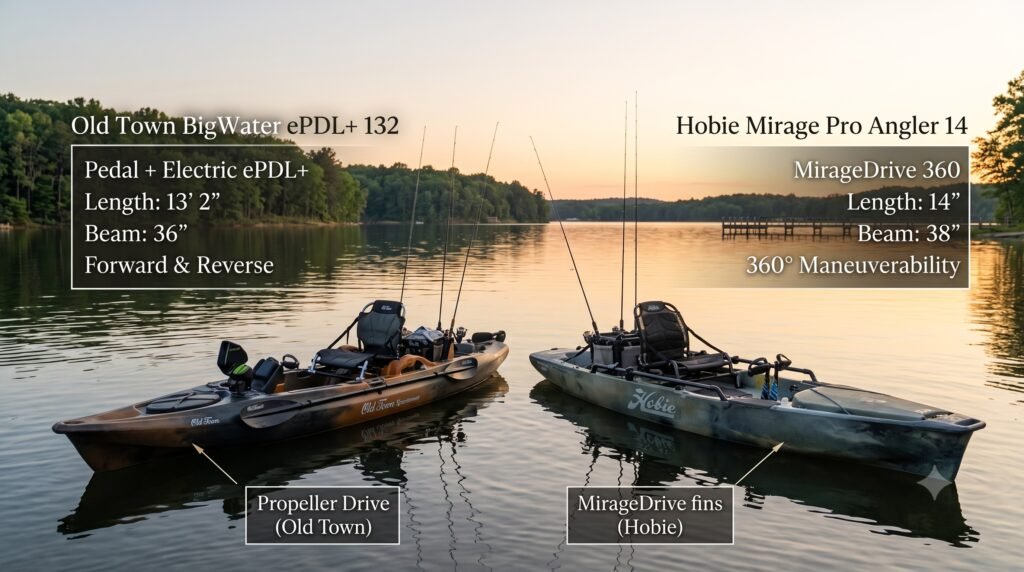
This is the comparison most buyers at this price actually face, and the standard framing gets one big thing wrong.
| Factor | Old Town BigWater ePDL+ 132 | Hobie Mirage Pro Angler 14 |
|---|---|---|
| Length / beam | 13’2″ / 36″ | 13’8″ / 38″ |
| Drive | Prop pedal + electric assist + cruise | MirageDrive 180 fins (no motor standard) |
| Fully rigged weight | 143 lbs | 144.5 lbs |
| Total capacity | 500 lbs | 600 lbs |
| Shallow/weed performance | Weak (exposed prop) | Strong (kick-up fins) |
| Battery and motor | Included | Not included; motor is an add-on |
| Motor-free tournament option | Yes, swap in a manual PDL drive | Already motor-free |
The myth to retire: the Hobie is not the lighter boat. Comparison articles repeat “Hobie wins on portability” reflexively, and it’s false at this size. The PA14 weighs 144.5 lbs fully rigged against the Old Town’s 143. If you want a genuinely lighter Hobie you’re shopping the Pro Angler 12, which is a different class of boat. What Hobie actually wins is shallow water: the MirageDrive’s kick-up fins ride over grass and bounce off bottom contact, while the Old Town’s prop demands vigilance in anything skinny.
What the Old Town wins is complete propulsion out of the box. The PA14’s base price looks friendlier until you spec a motor, battery, and wiring to match the ePDL+’s capability, at which point the total climbs past the Old Town’s sticker while adding rigging complexity the ePDL+ integrates from the factory.
The decision reduces to your water. Mostly open bays, wind, current, and long runs between spots: Old Town. Mostly grass flats, skinny water, and stealth: Hobie. If your fishing splits evenly, the Old Town’s ability to raise the drive and paddle through the skinny stuff makes it the more forgiving compromise, but only barely.
The ownership details nobody mentions before you buy
You probably have to register it. The moment a motor goes on a kayak, most US states treat it as a motorized vessel requiring registration, the same as a jon boat with an outboard. Fees are modest, but showing up at a launch with an unregistered motorized kayak can mean a fine, and enforcement on popular inshore water is real. Check your state’s wildlife or boating agency before your first trip, not after a warden checks you.
Saltwater maintenance is non-negotiable. The drive is rated for salt, but rated is not immune. Rinse the drive, prop, battery contacts, and hull with fresh water after every salt trip. A drive this expensive earns five minutes with a hose.
Budget the full system, not the sticker. Realistic day-one spend on top of the $5,999: a heavy-duty kayak cart, a proper PFD, a fish finder (the hull has a dedicated transducer mount waiting for one), and an anchor trolley. Plan on $700 to $1,200 beyond the boat before your first serious trip. The step-by-step guide on how to rig a kayak for saltwater fishing covers the build order, and if your rod arsenal needs work, these inshore saltwater rod and reel combos match the boat’s mission without doubling your spend. Anglers who prefer casting gear from a seated deck should also look at these lightweight baitcasters built for kayak mobility.
Beginner mistakes worth pre-empting. Don’t run high assist in unfamiliar shallow water; the prop finds the oyster bar before you do. Don’t treat cruise control as autopilot; it holds speed, not course, and it will not dodge crab pot buoys for you. And fish moving tides. On inshore flats, tide timing decides more days than gear does. If you’re new to the salt entirely, start with these saltwater kayak fishing tips for newbies before rigging out.
Who should buy the Old Town Sportman BigWater ePDL+ 132
- Buy it if you fish big inshore bays, tidal rivers, or large lakes, distances between spots regularly exceed a mile, and you have $6,000 plus rigging budget. Nothing else covers water this way while keeping you physically in the loop.
- Buy it if you’re a committed beginner who wants one boat to grow into rather than a starter kayak to outgrow. The stability and cruise control flatten the learning curve more than any other feature set on the market.
- Buy the Hobie PA14 instead if your home water is dominated by grass flats and sub-18-inch depths.
- Buy the standard BigWater PDL 132 instead if you love everything about this hull but the motor pushes you past budget. Same platform, legs only, thousands less. If even that stretches you, the Vibe Makana 100 and Hydra 130 show what entry-level pedal kayaks deliver at a fraction of the price.
- Walk away entirely if you launch solo at carry-in spots with no cart access, or you fish small ponds where 5 mph range solves a problem you don’t have.
FAQ
Is the drive removable for transport? Yes. The drive, battery, and seat all remove quickly without tools, dropping the hull to 95 lbs for loading. Wired2Fish specifically notes the drive removes easily enough to make roof-rack transport practical.
Can I use the Old town Sportsman ePDL+ 132 in tournaments that ban motors? Yes, with a swap. The drive well accepts Old Town’s manual PDL drives, so you can run a non-motorized drive on event days. Confirm the specific event’s rules first, since some ban boats designed for motors regardless of what’s installed that day. The 2026 schedule of motor-friendly saltwater kayak fishing tournaments lists events where the ePDL+ can compete as-is.
What species and water is it best suited for? Redfish, speckled trout, snook, flounder, and striped bass on bays, estuaries, and tidal rivers, plus bass and pike on big lakes. Anywhere the fish are spread out and the wind is a factor, the drive earns its cost. Species-by-species tactics live in the saltwater kayak fishing hub.
How fast is it without the motor? It pedals like the standard BigWater PDL 132 it’s based on. You can touch 5 mph on leg power alone in short bursts, per Sport Fishing Magazine’s testing, but sustaining it burns your legs fast. The assist exists to make that pace routine instead of heroic.
Does cold weather affect the battery? Lithium packs lose usable capacity in cold conditions and shouldn’t be charged below freezing. For winter fishing, store and charge the battery indoors and expect somewhat reduced range on the water.
The bottom line
The Old Town Sportsman BigWater ePDL+ 132 does something no other kayak does: it lets you choose, moment to moment, whether to be a pedal kayak, a power-assisted one, or a small electric boat. For the angler on big inshore water, that flexibility is worth the premium, and the included battery, proven hull, and pedal-drive fallback make it the rare $6,000 gear purchase with a genuinely soft failure mode. It’s the wrong boat for skinny grass and carry-in launches, and the right one for almost everything else a serious inshore beginner will face. Before ordering, sit in one at a dealer to check pedal reach, check your state’s registration rules, and price the cart into the deal. Then go find out what a two-mile flat looks like when it’s twenty minutes away instead of two hours.
Sources & references
All external resources used to research and verify this article.
Manufacturer documentation and specs
- Old Town Sportsman BigWater ePDL+ 132, Old Town Watercraft (official product page): https://oldtownwatercraft.johnsonoutdoors.com/us/shop/kayaks/fishing/sportsman-bigwater-epdl-132
- Mirage Pro Angler 14, Hobie (official product page): https://www.hobie.com/kayaks/mirage-pro-angler-14/
- Oldtown Sportsman BigWater ePDL+ 132, Rocktown Adventures (full weight and capacity spec breakdown): https://rocktownadventures.com/products/oldtown-sportsman-bigwater-epdl-132/
- 2026 Hobie Mirage Pro Angler 14 180, Delaware Paddlesports (PA14 dimensions and rigged weight): https://www.delawarepaddlesports.com/2026-hobie-mirage-pro-angler-14/
Independent reviews and field tests
- ePDL Electric Fishing Kayak Test, Sport Fishing Magazine (Elias Vaisberg, 100+ days on the water): https://www.sportfishingmag.com/gear/old-town-epdl-bigwater-kayak-test/
- Old Town Sportman BigWater ePDL+ 132 Electric Pedal Assist Kayak Review, Field & Stream (Travis Smola): https://www.fieldandstream.com/fishing/old-town-epdl-electric-pedal-assist-kayak-review
- Old Town Sportsman BigWater ePDL+ 132 Review, Outdoor Life: https://www.outdoorlife.com/gear/old-town-watercraft-bigwater-epdl-review/
- Electrified Kayak: The Old Town Sportsman BigWater ePDL+ 132, Wired2Fish (Casco Bay striper test): https://www.wired2fish.com/kayak-fishing/electric-kayak-old-town-sportsman-bigwater
- Old Town Sportsman BigWater 132 ePDL+ Review, Wired2Fish (drive system and safety features): https://www.wired2fish.com/fishing-videos/old-town-sportsman-bigwater-132-epdl-review
- Gear Review: Old Town Sportsman BigWater ePDL+ 132, Bassmaster (ICAST award and feature rundown): https://www.bassmaster.com/gear-reviews/news/gear-review-old-town-sportsman-bigwater-epdl-132/
- A Kayak that Rides like an eBike: Old Town Sportsman BigWater 132 ePDL+ Review, Goose Hummock Shops (Cape Cod chop and speed testing): https://www.goosehummockshops.com/post/a-kayak-that-rides-like-an-ebike-old-town-sportsman-bigwater-132-epdl-review
- Everything You Need to Know About the Old Town Sportsman Big Water 132 ePDL+, Blackhall Outfitters (battery details and deck layout changes): https://blackhalloutfitters.com/blogs/product-reviews-write-ups/everything-you-need-to-know-about-the-old-town-sportsman-big-water-132-epdl
Pricing and owner feedback
- Old Town Sportsman BigWater ePDL+ 132 Fishing Kayak, Eco Fishing Shop (verified owner reviews on battery life and kill switch): https://ecofishingshop.com/products/old-town-sportsman-bigwater-epdl-132-fishing-kayak
- Old Town Sportsman Bigwater ePDL+ 132, Headwaters Adventure Co (current retail and demo pricing): https://www.headwatersadventure.com/products/sportsman-bigwater-epdl-132
- New 2024 Old Town Sportsman BigWater ePDL+ 132, Quest Watersports (pricing confirmation): https://www.questwatersports.com/2024-old-town-sportsman-bigwater-epdl-132-c-1287/