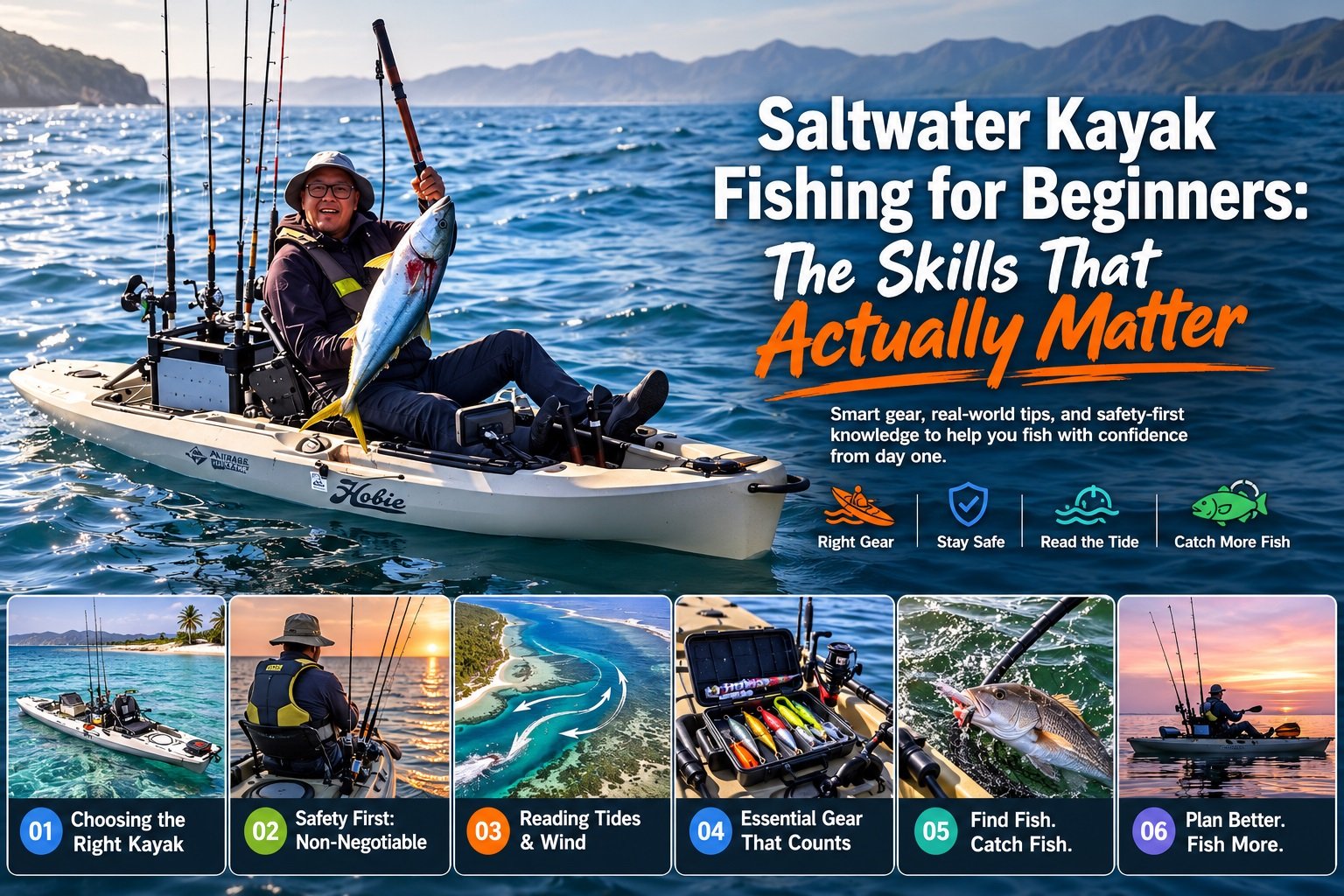
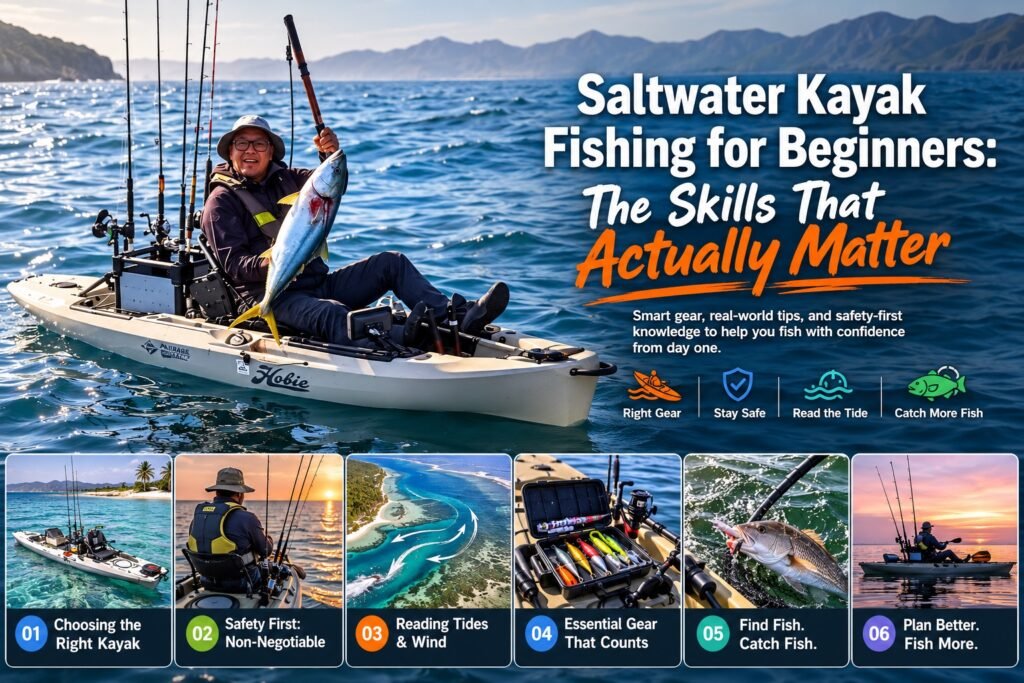
Here’s the short version of saltwater kayak fishing for beginners. You need a stable sit-on-top kayak around 30 to 36 inches wide, a life jacket you actually wear, one or two spinning rods rigged before you launch, and a basic grasp of how tide and wind move fish and move you. That’s the whole entry fee. Everything else, the pedal drives, the sonar, the seventeen trays of lures, can wait until you’ve logged enough trips to know what you’re missing.
The order matters more than the gear. Most beginners spend their first season buying equipment to solve problems that are really skill problems. This guide walks through what to learn first, what to buy first, and where the common advice quietly falls apart on real water.
What kind of kayak do you need for saltwater?
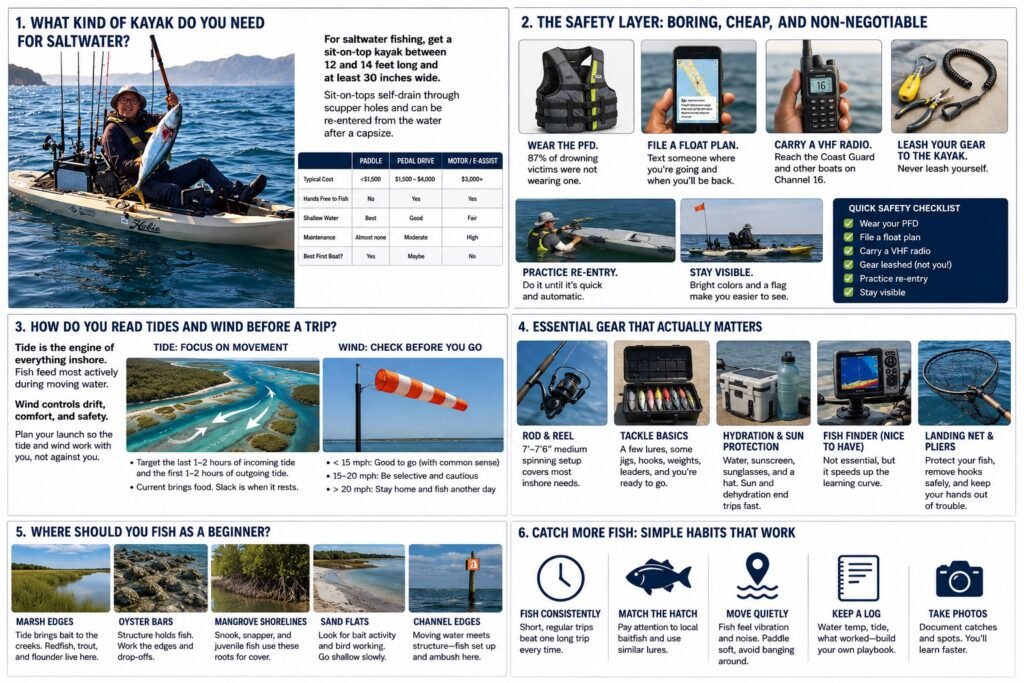
For saltwater fishing, get a sit-on-top kayak between 12 and 14 feet long and at least 30 inches wide. Sit-on-tops self-drain through scupper holes and can be re-entered from the water after a capsize. Sit-inside kayaks can’t do either, which makes them a poor choice anywhere with chop, current, or boat wakes.
Length is a trade-off, not a spec to maximize. A 12-footer turns easily in tidal creeks and loads onto a car roof without a wrestling match. A 14-footer tracks straighter and covers open bays faster, but it’s heavier and clumsier at the launch. If most of your water is protected inshore stuff, shorter wins more often than the marketing suggests.
Then there’s the propulsion question, and it’s mostly a budget question.
| Paddle | Pedal drive | Motor or e-assist | |
|---|---|---|---|
| Typical cost | A few hundred dollars used, under $1,500 new | Roughly $1,500 to $4,000 | $3,000 and up |
| Hands free to fish | No | Yes | Yes |
| Shallow water | Best (inches of draft) | Fins or prop need clearance | Prop needs clearance |
| Maintenance | Almost none | Moving parts in saltwater | Batteries, wiring, salt |
| Best first boat? | Yes, for most people | If budget allows and you fish open water | No, learn to paddle first |
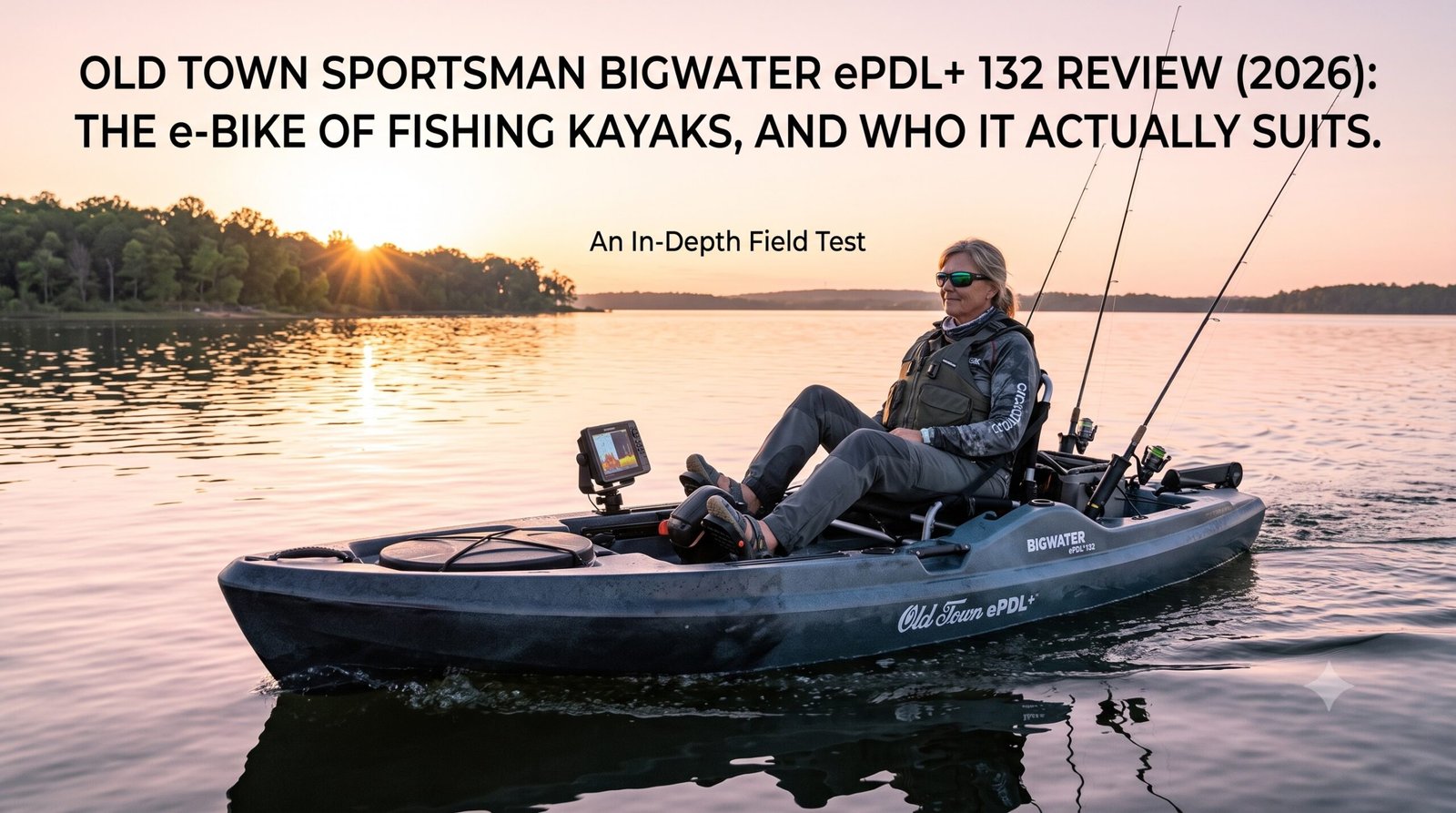
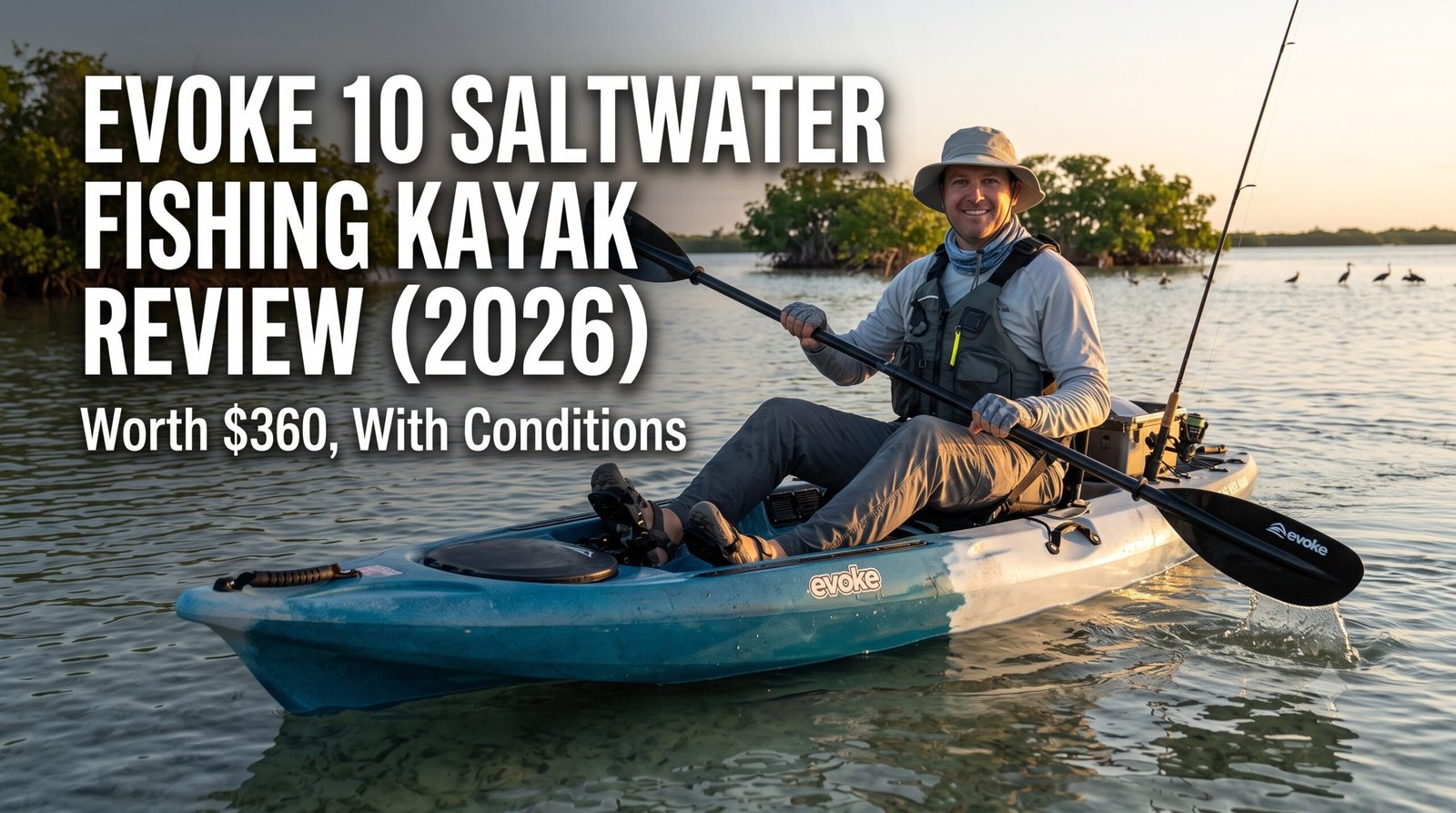
A pedal drive is a genuine advantage in current and wind because your hands stay on the rod. It’s also two to four times the money, and it adds a mechanical system that salt will attack. Plenty of anglers fish their whole lives from paddle kayaks and never feel deprived. If you’re weighing specific boats, the Evoke 10 review covers the honest budget end, the Vibe Makana 100 and Hydra 130 sit in the affordable pedal tier, and the Old Town BigWater ePDL+ 132 shows what the pedal-electric hybrid category looks like when you’re ready to spend real money.
One thing showroom floors won’t teach you: a kayak that feels stable on carpet tilts differently on moving water with a bent rod in your hand. Demo on the water before you buy if there’s any way to arrange it. Local shops and demo days exist for exactly this.
The safety layer: boring, cheap, and non-negotiable
Kayaks accounted for about 16 percent of recreational boating deaths in recent U.S. Coast Guard data, second only to open motorboats. In the Coast Guard’s 2024 statistics, 87 percent of boaters who drowned were not wearing a life jacket. Those two numbers together are the entire argument for the next few paragraphs.
Wear the PFD. Not stowed in the hull, not clipped to the deck. Worn. Modern fishing PFDs are cut high for kayak seats and don’t interfere with casting, and inflatable belt or vest styles exist if bulk bothers you (with the caveat that inflatables need armed, in-date cartridges to work). A PFD in your hatch does nothing when a boat wake dumps you into 62-degree water.
File a float plan. Text someone where you’re launching, where you’re fishing, and when you’ll be back, along with a description of your kayak. Add a hard check-in time: if they don’t hear from you by then, they call for help. Five minutes of typing. It’s the cheapest rescue system ever invented.
Carry a VHF radio, tethered to your PFD. Cell coverage dies fast in marshes and offshore, and a wet phone dies faster. A handheld waterproof VHF reaches the Coast Guard and every boat around you on Channel 16, the international distress and hailing channel. If your radio has DSC, register for an MMSI number so a distress call transmits your position automatically. The tether matters: if you and the kayak separate, the radio needs to be on your body.
Leash your gear to the kayak. Never leash yourself. Paddle, pliers, net, rods when they’re not in your hand. Anything unleashed will eventually swim. But a leash between your body and the boat becomes a trap in surf or strong current, when you may need to swim clear of your own kayak.
Practice re-entry before you need it. In warm, calm, chest-deep water, flip your kayak, right it, and climb back on: approach from the side or stern, kick your legs to the surface behind you, pull your chest across the hull, rotate into the seat. Do it until it’s under a minute and you don’t have to think. Cold water shock steals your coordination in seconds, and the middle of an actual capsize is a terrible classroom.
Stay visible. Bright hull colors, bright clothing, and a flag on a pole in any water with boat traffic. From a center console running 30 knots, a kayak is nearly invisible in light chop. Assume no one sees you and act accordingly, especially near channels and inlets.
How do you read tides and wind before a trip?
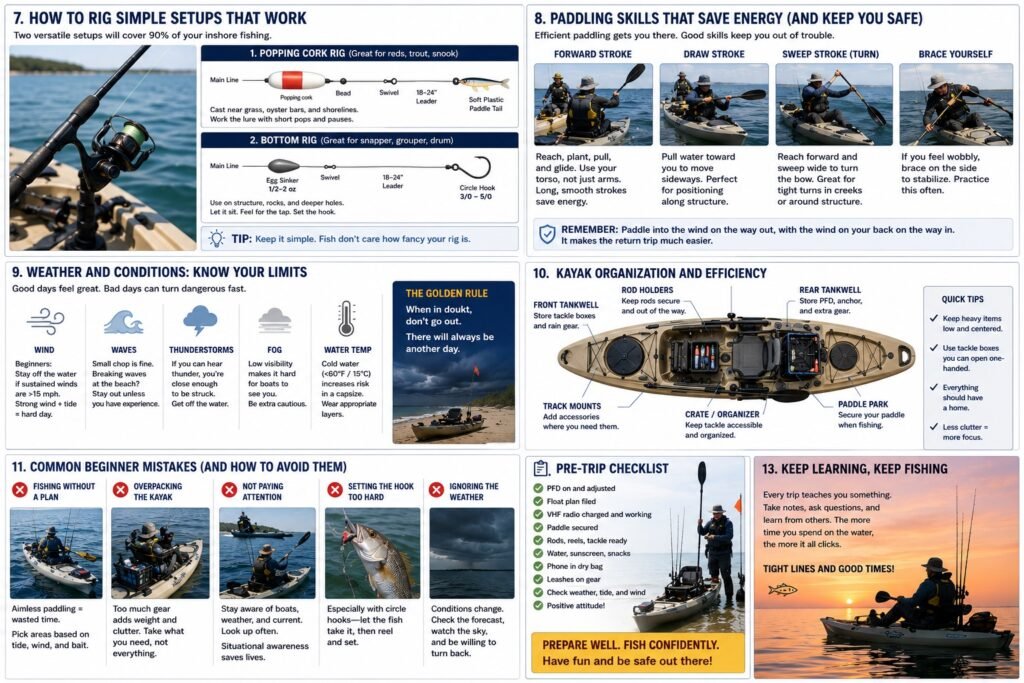
Check two things before every launch: the tide chart and the marine wind forecast. Moving water feeds fish, so plan your trip around the hours when the tide is actually flowing, and treat sustained wind much above 15 mph as a reason for a beginner to stay home.
Tide is the engine of everything inshore. Rising water pushes baitfish onto flats and up into creeks, and predators follow. Falling water drains those same areas and funnels bait through cuts, channel edges, and creek mouths, where fish stack up to ambush it. The common rule says fish the two hours on either side of the tide change and skip the slack. It’s a decent rule, but it’s a starting point, not physics. Some spots fire only on the last of the outgoing; some flats only hold fish with enough water to cover them. Pull free predictions for your nearest station from NOAA Tides and Currents and start keeping notes on what your water actually does.
Wind is your other master, and on a kayak you feel every bit of it. Two habits will save you from most beginner misery. First, paddle into the wind at the start of the trip while you’re fresh, so it pushes you home when you’re tired. Second, respect wind against tide: when a stiff breeze opposes a strong current, the water stacks into short, steep chop that’s far nastier than either force alone. The National Weather Service marine forecast gives hour-by-hour wind for coastal zones. Believe it.
On paddling itself: power comes from torso rotation, not your arms. Plant the blade, rotate your core, and let the big muscles work. Learn a forward stroke, a sweep for turning, and a draw for sliding sideways to structure. An hour of deliberate practice on a calm pond pays off every trip for the rest of your life.
The tackle that covers 90 percent of inshore fishing
Two spinning setups handle nearly everything a beginner will face inshore, and rigging them before you launch is worth more than a third setup.
The light rig: a 7-foot medium rod with a 2500 or 3000 size spinning reel, 10 lb braid, and a couple feet of 15 to 20 lb fluorocarbon leader. This is your flats-and-open-water rod for speckled trout, smaller redfish, and flounder. The heavier rig: a 7-foot medium-heavy rod with a 3000 or 4000 size reel, 20 lb braid, and a 25 to 30 lb leader for pulling fish away from dock pilings, oyster bars, and mangrove roots. The full reasoning, with specific models, is in the inshore rod and reel combo guide.
Spinning gear first, and not because baitcasters are bad. Casting accurately from a seated position, often across your body, is hard enough without managing spool control at the same time. When your mechanics are solid and you want more precision around structure, lightweight baitcasters built for kayak fishing are a legitimate step up. They’re just a second-season purchase, not a first-week one.
For lures, resist the tray-collecting instinct. A soft plastic paddle tail, 3 to 5 inches, on a 1/8 or 1/4 oz jig head is the most versatile inshore bait there is. Slow and steady near bottom on the flats. Faster near structure to trigger reaction strikes. Chartreuse or gold in dirty water, natural white and shad colors in clear water. Add a gold spoon and a topwater plug and you have a complete beginner arsenal that fits in one small box. The gaps in your catch rate are almost never a missing lure. They’re a location or presentation problem.
Rig both rods at home. On the water, switching lures with wet hands while drifting off your spot is how prime tide windows evaporate.
Where are the fish, actually?
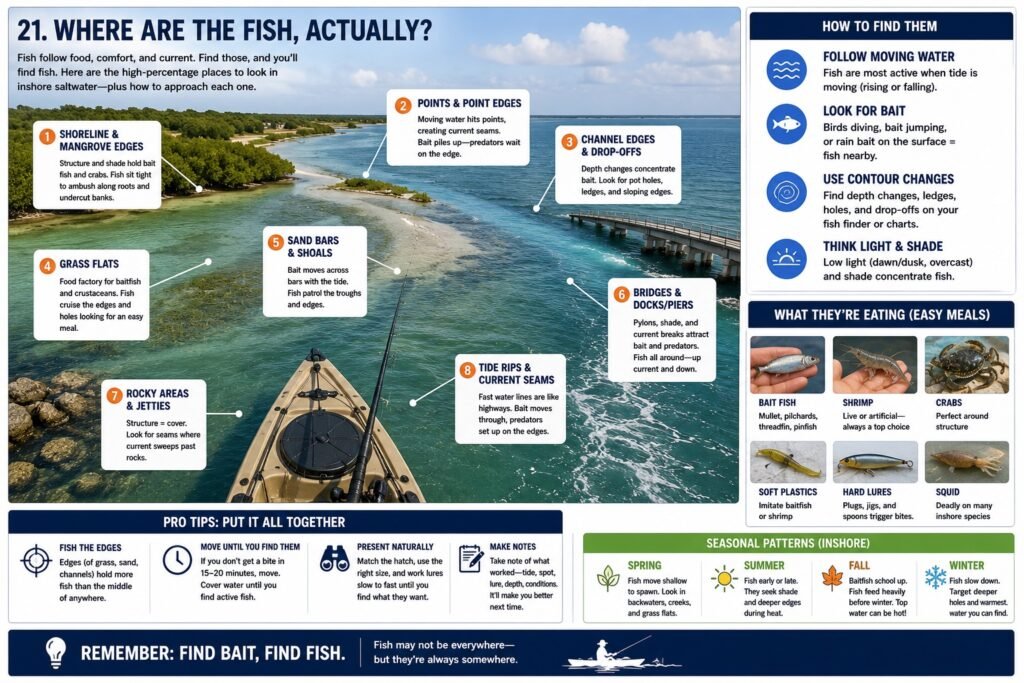
Fish concentrate where current, structure, and bait intersect. Open water in the middle of a bay is mostly empty. Spend your casts on creek mouths, oyster bar edges, dock pilings, grass flat drop-offs, mangrove shorelines, and the seams where fast water meets slow.
The pattern underneath all of those spots is the same: predators sit in the soft water next to moving water and let the tide deliver food. Once you see that, new water stops being intimidating. You’re not searching a whole bay. You’re searching a handful of edges.
Do half your scouting before you ever launch. Satellite view on Google Earth shows creek mouths, bars, channels, and flat edges clearly, especially imagery captured at low tide. Mark five or six candidates, then let the water confirm or veto them. And watch for birds: diving terns and gulls mark bait pushed to the surface by feeding fish below. Paddle toward working birds quietly, and don’t paddle through the school.
Two honest caveats. First, this is inshore advice; Pacific coast kayak fishing for rockfish and lingcod is a different game with surf launches and deeper water, and it deserves its own preparation. Second, no article replaces local knowledge. A conversation at the launch with someone rinsing off a kayak will teach you more about your specific water than an afternoon of reading. If you’re near the Carolina coast, the Carolina Beach kayak fishing spots guide shows what applying these principles to one real fishery looks like.
Fighting, landing, and releasing fish from a seat
Fighting a fish from a kayak means fighting it from water level with no room to move, and sometimes the fish tows you. That’s fine. Let it. A fish pulling your kayak is burning energy against your drag and the hull’s resistance at the same time.
Set your drag before you launch, keep the rod bent, and let the reel do the tiring. Horsing a green fish to the boat is how hooks pull and how you end up with an angry, fully charged redfish thrashing in your lap. When the fish is done, reel down to about an arm’s span of line, move the rod to the hand farther from the fish, and draw it across your body in one smooth arc to your other hand or net. Lip grippers earn their keep on anything with teeth or heavy gill plates.
For the release, follow the actual science rather than habit. The Florida Fish and Wildlife Conservation Commission’s fish handling guidance is blunt: keep the fish in the water whenever possible, handle it with wet hands, hold it horizontally with the belly supported, and keep it out of the water no longer than you can hold your breath. To revive a tired fish, move it forward through the water so it flows over the gills. Not back and forth. Dragging a fish backward doesn’t ventilate its gills, and you’ll still hear that advice at every launch in America. If you’re keeping fish for the table instead, a kayak has no fish box, so read up on keeping fish fresh without ice before your first keeper trip.
The salt tax: what happens after the trip
Salt is patient and it wins every unattended fight. It corrodes reel internals, pits guides, seizes pliers, and eats hardware. The rinse ritual is ten minutes and it’s the difference between gear lasting two seasons and lasting ten.
After every trip: fresh water over the hull, the fittings, and every piece of hardware. Rinse rods and run gentle water over the reels while slowly turning the handles, then let everything dry before storage. Hit reel bearings and pliers pivots with a corrosion inhibitor every few trips. Skip the pressure washer on reels; blasting water past the seals pushes salt in rather than out.
This maintenance habit connects to a bigger project: how your kayak is actually outfitted. Rod holders, gear tracks, anchor trolley, transducer mounting, all of it done with saltwater corrosion in mind from day one. That’s its own topic, covered properly in the saltwater kayak rigging guide and the inshore kayak setup walkthrough.
The mistakes that cost beginners a season
A few patterns come up again and again, so name them now and skip them.
Buying gear to solve skill problems. Sonar won’t help someone who can’t yet read a shoreline, and a $4,000 pedal kayak doesn’t make the fish bite. Log trips first, then let real frustrations pick your upgrades.
Fishing the clock instead of the tide. Dawn on slack water usually loses to mid-morning on a ripping outgoing. The tide chart outranks the alarm clock.
Anchoring badly in current. If you anchor at all, use an anchor trolley so you can shift the anchor point while seated, and be careful about how your hull sits relative to strong flow; an anchor line pulling against fast current from the wrong point on the boat can lean or swamp a kayak. When in doubt, drift instead. Never anchor in a channel.
Trusting the “it’s just inshore” feeling. Protected water breeds complacency. Most paddlecraft fatalities happen close to shore in conditions that looked manageable from the ramp, on days when the PFD stayed in the hatch.
Going alone with no plan. Solo trips are part of the appeal of this sport. They’re only defensible with a filed float plan, a worn PFD, a tethered radio, and conditions well inside your ability.
Frequently asked questions
Do I need a fishing license to kayak fish in saltwater? Almost certainly yes. Every coastal state regulates saltwater fishing, and most require a saltwater license or registration even from a kayak, with rules varying by state and sometimes by species. Check your state’s wildlife agency (in Florida, that’s the FWC) before your first trip. Kayaks themselves typically don’t require registration without a motor, but that also varies by state.
Is saltwater kayak fishing dangerous? It carries real risk, and the risk is heavily concentrated among people who skip the basics. The Coast Guard’s data shows the overwhelming majority of paddlecraft drowning victims weren’t wearing life jackets. With a worn PFD, a float plan, a radio, honest weather judgment, and practiced re-entry, it’s a sport with a long, safe track record.
Can I use my freshwater kayak and gear in saltwater? The kayak, yes, if it’s a stable sit-on-top; salt doesn’t hurt polyethylene. Freshwater rods and reels will work too, but reels without sealed or salt-rated construction corrode quickly even with rinsing. Use what you have for the first trips, rinse fanatically, and upgrade the reel first when budget allows.
What about sharks? They’re present, and they’re overwhelmingly uninterested in kayaks. Practical shark etiquette is about fish handling: don’t tie a stringer of bleeding fish to your boat, don’t dangle fish over the side longer than needed, and give up a hooked fish to a shark rather than fighting it to your lap.
How far from shore should a beginner fish? Stay in protected water within an easy swim of shallow ground or shore for your first season. Distance isn’t the real variable anyway; exposure is. A creek a mile inland is safer than a beachfront 200 yards out. Extend your range only as your paddling, self-rescue, and weather judgment extend with it.
Your first five trips
Forget mastering 21 things at once. Do this instead. Trip one: calm protected water, no rods, just paddling, bracing, and re-entry practice. Trips two and three: bring one rigged rod, fish a single creek mouth or dock line through a moving tide, and take notes. Trips four and five: add the second rod, add a new spot, and start connecting your notes to the tide chart. By trip six you’ll read this guide differently, and you’ll know exactly which upgrade you actually need.
When the inshore game starts feeling comfortable and you want a bigger challenge, the saltwater kayak tournament scene is more welcoming to newcomers than it looks from the outside. For everything else in this niche, the saltwater kayak fishing hub collects the rest of the library.
See you on the water.
Sources & References
Government and regulatory resources
- 2024 Recreational Boating Statistics, U.S. Coast Guard, 2025. https://uscgboating.org/library/accident-statistics/Recreational-Boating-Statistics-2024.pdf. Source for fatality totals and the 87 percent life jacket figure.
- Fish Handling and Gear, Florida Fish and Wildlife Conservation Commission. https://myfwc.com/fishing/saltwater/outreach/fish-handling/. Basis for the catch-and-release handling and revival guidance.
- Techniques to Reduce Catch-and-Release Mortality, Florida Fish and Wildlife Conservation Commission. https://myfwc.com/research/saltwater/fish/snook/reduce-catch-release-mortality/. Supporting detail on fight duration, exhaustion, and in-water release.
- NOAA Tides and Currents, National Oceanic and Atmospheric Administration. https://tidesandcurrents.noaa.gov/. Recommended tool for station-level tide predictions.
- National Weather Service Marine Forecasts, NOAA. https://www.weather.gov/marine/. Recommended tool for coastal wind forecasts.
Boating safety organizations - Recreational Boating Facts, National Safe Boating Council. https://www.safeboatingcouncil.org/resources/recreational-boating-facts/. Source for the kayak share of boating fatalities.